R. Shep Melnick – författare
Visar alla böcker från författaren R. Shep Melnick. Handla med fri frakt och snabb leverans.
6 produkter
6 produkter
983 kr
Skickas inom 5-8 vardagar
Examines the patchwork evolution of school desegregation policy.In 1954, the Supreme Court delivered the landmark decision of Brown v. Board of Education—establishing the right to attend a desegregated school as a national constitutional right—but the decision contained fundamental ambiguities. The Supreme Court has never offered a clear definition of what desegregation means or laid out a framework for evaluating competing interpretations. In The Crucible of Desegregation, R. Shep Melnick examines the evolution of federal school desegregation policy from 1954 through the termination of desegregation orders in the first decades of the twenty-first century, combining legal analysis with a focus on institutional relations, particularly the interactions between federal judges and administrators. Melnick argues that years of ambiguous, inconsistent, and meandering Court decisions left lower court judges adrift, forced to apply contradictory Supreme Court precedents in a wide variety of highly charged political and educational contexts. As a result, desegregation policy has been a patchwork, with lower court judges playing a crucial role and with little opportunity to analyze what worked and what didn’t. The Crucible of Desegregation reveals persistent patterns and disagreements that continue to roil education policy.
280 kr
Skickas inom 5-8 vardagar
Examines the patchwork evolution of school desegregation policy.In 1954, the Supreme Court delivered the landmark decision of Brown v. Board of Education—establishing the right to attend a desegregated school as a national constitutional right—but the decision contained fundamental ambiguities. The Supreme Court has never offered a clear definition of what desegregation means or laid out a framework for evaluating competing interpretations. In The Crucible of Desegregation, R. Shep Melnick examines the evolution of federal school desegregation policy from 1954 through the termination of desegregation orders in the first decades of the twenty-first century, combining legal analysis with a focus on institutional relations, particularly the interactions between federal judges and administrators. Melnick argues that years of ambiguous, inconsistent, and meandering Court decisions left lower court judges adrift, forced to apply contradictory Supreme Court precedents in a wide variety of highly charged political and educational contexts. As a result, desegregation policy has been a patchwork, with lower court judges playing a crucial role and with little opportunity to analyze what worked and what didn’t. The Crucible of Desegregation reveals persistent patterns and disagreements that continue to roil education policy.
911 kr
Tillfälligt slut
What is American government like today? How has it changed - and how has it remained the same - over the course of the century now coming to a close? This study seeks to provide the fullest and most thoughtful answers yet offered to these questions. It brings together eminent historians and political scientists to examine the past experience, current state, and future prospects of five major American public issues: trade and tariff policy, immigration and aliens, conservation and environmentalism, civil rights, and social welfare. The contributors examine the evolving nature of these issues, the reactive policies of the federal government, and the institutional devices by which these policies have been applied. Never before have these major public policy issues been explored so deeply, and with such insight, in a collaborative effort crossing disciplinary borders.
426 kr
Skickas inom 10-15 vardagar
One civil rights-era law has reshaped American society—and contributed to the country's ongoing culture warsFew laws have had such far-reaching impact as Title IX of the Education Amendments of 1972. Intended to give girls and women greater access to sports programs and other courses of study in schools and colleges, the law has since been used by judges and agencies to expand a wide range of antidiscrimination policies—most recently the Obama administration's 2016 mandates on sexual harassment and transgender rights.In this comprehensive review of how Title IX has been implemented, Boston College political science professor R. Shep Melnick analyzes how interpretations of "equal educational opportunity" have changed over the years. In terms accessible to non-lawyers, Melnick examines how Title IX has become a central part of legal and political campaigns to correct gender stereotypes, not only in academic settings but in society at large. Title IX thus has become a major factor in America's culture wars—and almost certainly will remain so for years to come.
267 kr
Skickas inom 10-15 vardagar
In recent years, federal courts have become increasingly aggressive in shaping regulatory policy, abandoning their traditional deference to bureaucratic expertise. This new judicial activism has been particular evident in the regulation of air pollution. R. Shep Melnick analyzes the effects a variety of court decisions have had on federal air pollution control policy and assesses the courts’ institutional capacity for policymaking in such a complex arena. In six cases studies of environmental programs or issues he examines the interplay among the courts, the Environmental Protection Agency, Congress, and the White House. The conventional wisdom is that the courts have improved environmental policymaking, but Melnick concludes that as a whole “the consequences of court action under the Clean Air Act are neither random nor beneficial.” He finds that “court action has encouraged legislators and administrators to establish goals without considering how they can be achieved,” widening the gap between promise and performance. The results, he charges, have been increased cynicism, serious inefficiencies and inequities, and a lack of rational debate. An analysis of the institutional characteristics of the judicial branch reveals how these problems have come about and why they are likely to afflict other programs as well as environmental regulation. The author proposes several reforms to improve the courts’ ability to handle regulatory cases.
290 kr
Skickas inom 10-15 vardagar
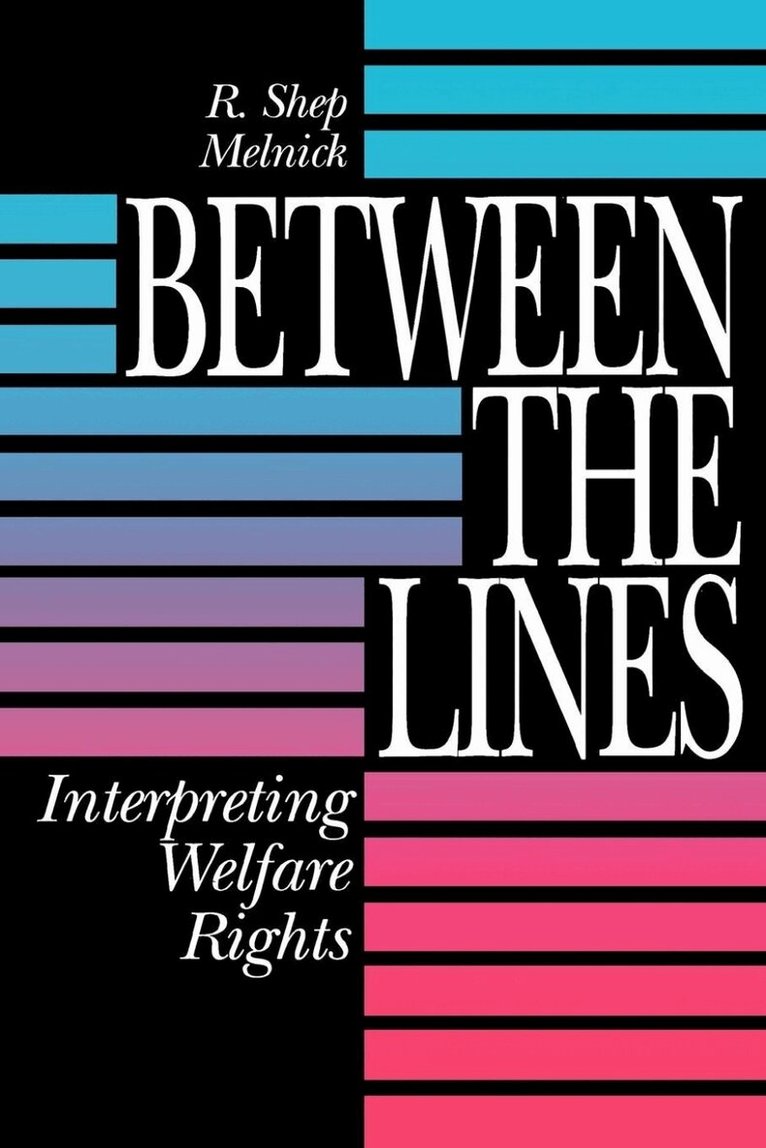
Judicial interpretation of federal statutes has often been at the center of political controversy in recent years. In fact, it would be difficult to find a major domestic policy area in which statutory interpretation by the federal courts has not played a significant role in shaping the activities of government. In most important cases, judges base their interpretation not on the letter of the law, but on their reading of its history, purpose, and spirit. What judges discover between the lines of statutes often has major policy consequences.This book examines how statutory interpretation has affected the development of three programs: Aid to Families with Dependent Children, education for the handicapped, and food stamps. It explores how these decisions have changed state and national policies and how other institutionsespecially Congresshave reacted to them. Although these three programs differ in several important ways, in each instance court action has expanded program benefits and increased federal control over state and local governments.R. Shep Melnick ties trends in statutory interpretation to broader policy developments, including the expansion of the agenda of national government, the persistence of divided government, and the resurgence and decentralization of Congress. He demonstrates that Congress frequently modifies or overturns court rulings, and he explains why statutory interpretation became so controversial in the 1980s.Between the Lines also explores the understanding of welfare rights that has guided the development of welfare policy over the past fifty years. What basic beliefs about the welfare state underlie court decisions interpreting these statutes? To what extent do members of Congress share these views? How have the assumptions of judges and members of Congress changed over time? These are some of the questions addressed in this detailed study of American welfare policy.