Rachel Riedner - Böcker
Visar alla böcker från författaren Rachel Riedner. Handla med fri frakt och snabb leverans.
2 produkter
2 produkter
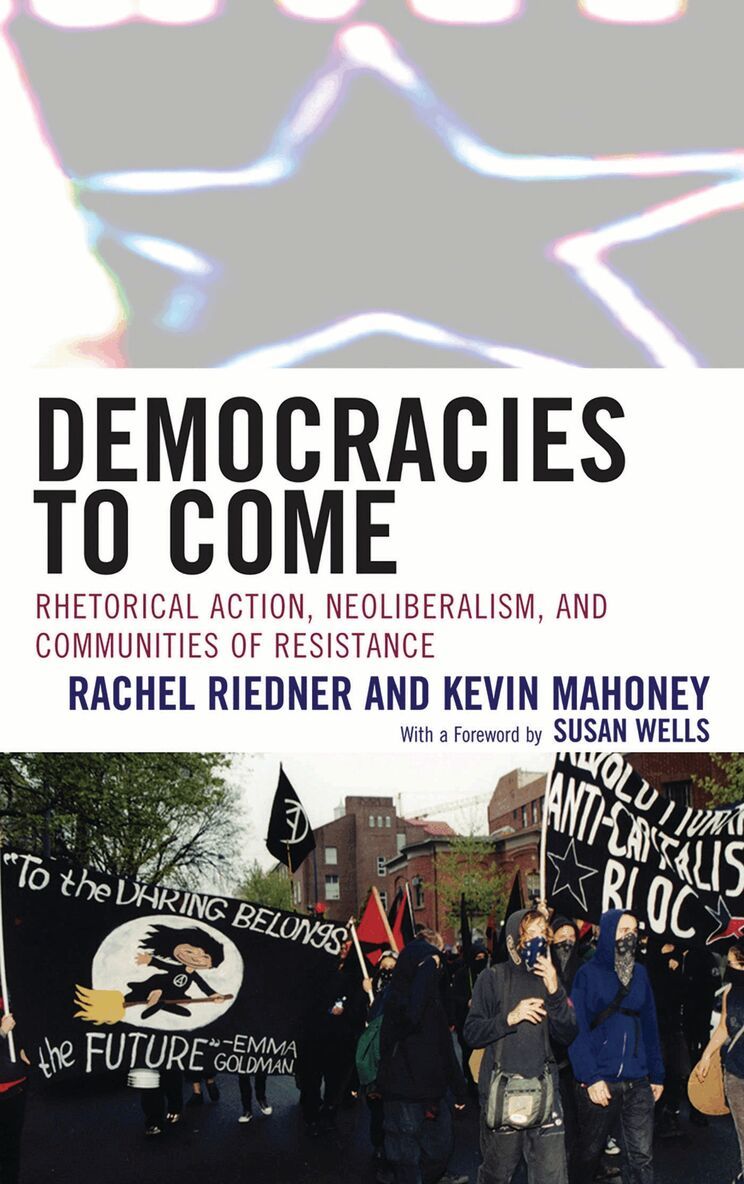
Democracies to Come
Rhetorical Action, Neoliberalism, and Communities of Resistance
Inbunden, Engelska, 2008
1 409 kr
Skickas inom 5-8 vardagar
Democracies to Come draws upon a variety of contemporary sites and moments (e.g. IMF/World Bank protests, writing emerging from social movements in struggle against neoliberalism, classroom praxis, postcolonial literature, student activism) to explore new relationships—pedagogical, emotional, affective, and social—that can be the basis of political and social organizing. Approaching pedagogy as a space of learning, Democracies to Come argues that pedagogy becomes a cultural force for democracy in its own right, a cultural literacy, which intervenes in a multiplicity of systems, institutions, cultural formations, and constituencies. Each chapter of the book answers these questions: How can pedagogy be conceptualized as a site in which to intervene in culture and to act politically? How can pedagogy help cultivate the kairotic act of opening spaces for inquiring into the social relations that education helps shape? How can we re-imagine practices capable of contextualizing education within larger educational and market forces? How do we develop the desire and habit to recognize moments when we move beyond norms and develop new ways of seeing, acting, and relating? How do we see pedagogical activism not as an end in itself but as an integral process of revitalizing democracy? How can we create moments to process new arguments, respond to particular conjunctures, and create languages that articulate the contingencies and affinities of the particular moment?
Beyond Recovery
Reckoning with Race, Nation, Imperialism, and Exceptionalism in Feminist Rhetorical Theory
Inbunden, Engelska, 2026
1 835 kr
Kommande
Beyond Affirmation inspires feminist rhetorical scholarship to shift attention from the speech and action of individual rhetors to analysis of how and with what consequence rhetorics circulate. The book considers the rise of feminist rhetorical theory and historicizes it within the political moment of the Cold War. Beyond Affirmation attends to the rhetorical legacies of the Cold War and its imperialist project, showing how sentimentality subsumed the US academy and dominant feminist rhetorical method of recovery, resulting in the creation of exceptional rhetorical figures. Demonstrating politics of recovery work, chapters offer new methods for the twenty-first century. Through distinct case studies, the authors track the rhetorical processes through which subjects establish certain gendered, raced, imperial, or national political objectives. Rebecca Dingo and Rachel C. Riedner argue that scholars must address the contexts within which social actors speak and act as well as how rhetorical agency and action can be picked up and circulated for political purposes. By forwarding a transnational feminist rhetorical analytic as an alternative to rhetorics of affirmation, Beyond Affirmation emphasizes solidarity.