Radu Stoica – författare
Case Studies in Spatial Point Process Modeling
1 091 kr
Skickas inom 10-15 vardagar
1 367 kr
Läs direkt efter köp
Point process statistics is successfully used in fields such as material science, human epidemiology, social sciences, animal epidemiology, biology, and seismology. Its further application depends greatly on good software and instructive case studies that show the way to successful work. This book satisfies this need by a presentation of the spatstat package and many statistical examples.
Researchers, spatial statisticians and scientists from biology, geosciences, materials sciences and other fields will use this book as a helpful guide to the application of point process statistics. No other book presents so many well-founded point process case studies.
From the reviews:
"For those interested in analyzing their spatial data, the wide variatey of examples and approaches here give a good idea of the possibilities and suggest reasonable paths to explore." Michael Sherman for the Journal of the American Statistical Association, December 2006
1 770 kr
Skickas inom 10-15 vardagar
942 kr
Läs direkt efter köp
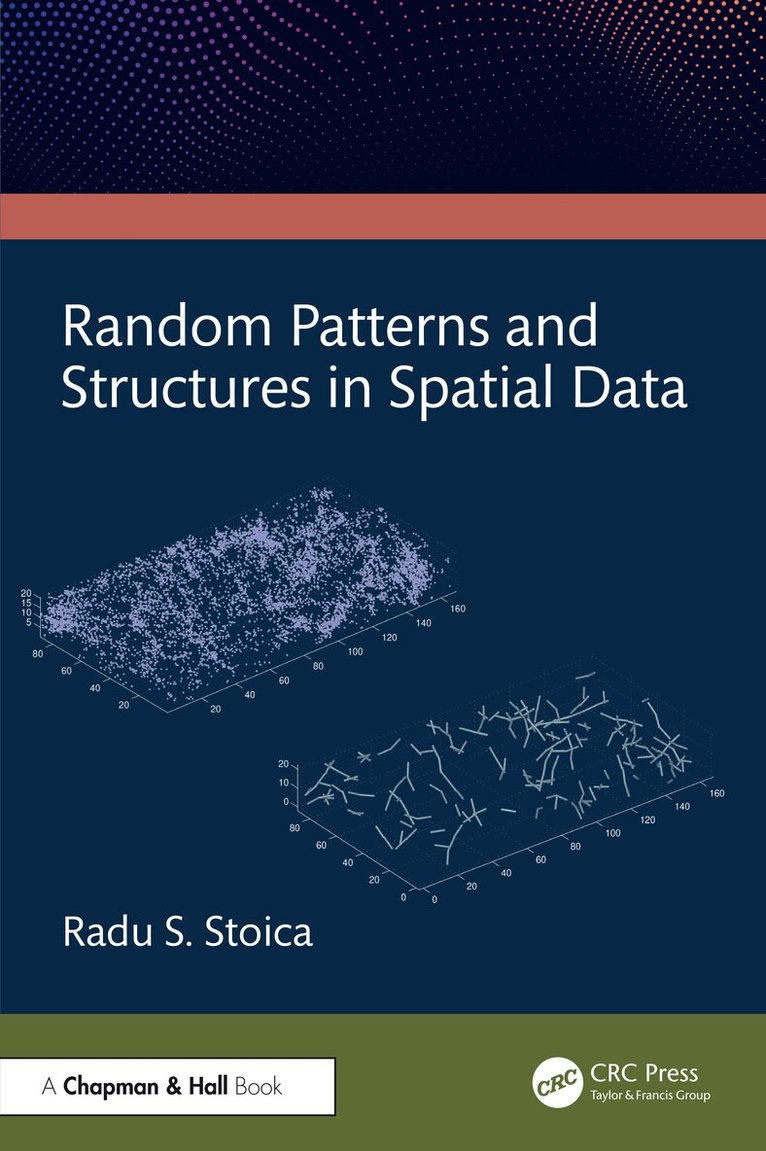
The book presents a general mathematical framework able to detect and to characterise, from a morphological and statistical perspective, patterns hidden in spatial data. The mathematical tools employed are Gibbs Markov processes, mainly marked point procesess with interaction, which permits us to reduce the complexity of the pattern. It presents the framework, step by step, in three major parts: modeling, simulation, and inference. Each of these parts contains a theoretical development followed by applications and examples.
Features
Presents mathematical foundations for tackling pattern detection and characterisation in spatial data using marked Gibbs point processes with interactions Includes application examples from cosmology, environmental sciences, geology, and social networks Presents theoretical and practical details for the presented algorithms in order to be correctly and efficiently used Provides access to C++ and R code to encourage the reader to experiment and to develop new ideas Includes references and pointers to mathematical and applied literature to encourage further studyRandom Patterns and Structures in Spatial Data is primarily aimed at researchers in mathematics, statistics, and the above-mentioned application domains. It is accessible for advanced undergraduate and graduate students and thus could be used to teach a course. It will be of interest to any scientific researcher interested in formulating a mathematical answer to the always challenging question: what is the pattern hidden in the data?
909 kr
Läs direkt efter köp
The book presents a general mathematical framework able to detect and to characterise, from a morphological and statistical perspective, patterns hidden in spatial data. The mathematical tools employed are Gibbs Markov processes, mainly marked point procesess with interaction, which permits us to reduce the complexity of the pattern. It presents the framework, step by step, in three major parts: modeling, simulation, and inference. Each of these parts contains a theoretical development followed by applications and examples.
Features
Presents mathematical foundations for tackling pattern detection and characterisation in spatial data using marked Gibbs point processes with interactions Includes application examples from cosmology, environmental sciences, geology, and social networks Presents theoretical and practical details for the presented algorithms in order to be correctly and efficiently used Provides access to C++ and R code to encourage the reader to experiment and to develop new ideas Includes references and pointers to mathematical and applied literature to encourage further studyRandom Patterns and Structures in Spatial Data is primarily aimed at researchers in mathematics, statistics, and the above-mentioned application domains. It is accessible for advanced undergraduate and graduate students and thus could be used to teach a course. It will be of interest to any scientific researcher interested in formulating a mathematical answer to the always challenging question: what is the pattern hidden in the data?