Adrian Baddeley - Böcker
Visar alla böcker från författaren Adrian Baddeley. Handla med fri frakt och snabb leverans.
3 produkter
3 produkter
Del 185 - Lecture Notes in Statistics
Case Studies in Spatial Point Process Modeling
Häftad, Engelska, 2005
1 073 kr
Skickas inom 10-15 vardagar
Point process statistics is successfully used in fields such as material science, human epidemiology, social sciences, animal epidemiology, biology, and seismology. Its further application depends greatly on good software and instructive case studies that show the way to successful work. This book satisfies this need by a presentation of the spatstat package and many statistical examples.Researchers, spatial statisticians and scientists from biology, geosciences, materials sciences and other fields will use this book as a helpful guide to the application of point process statistics. No other book presents so many well-founded point process case studies.From the reviews:"For those interested in analyzing their spatial data, the wide variatey of examples and approaches here give a good idea of the possibilities and suggest reasonable paths to explore." Michael Sherman for the Journal of the American Statistical Association, December 2006

1 432 kr
Skickas inom 10-15 vardagar
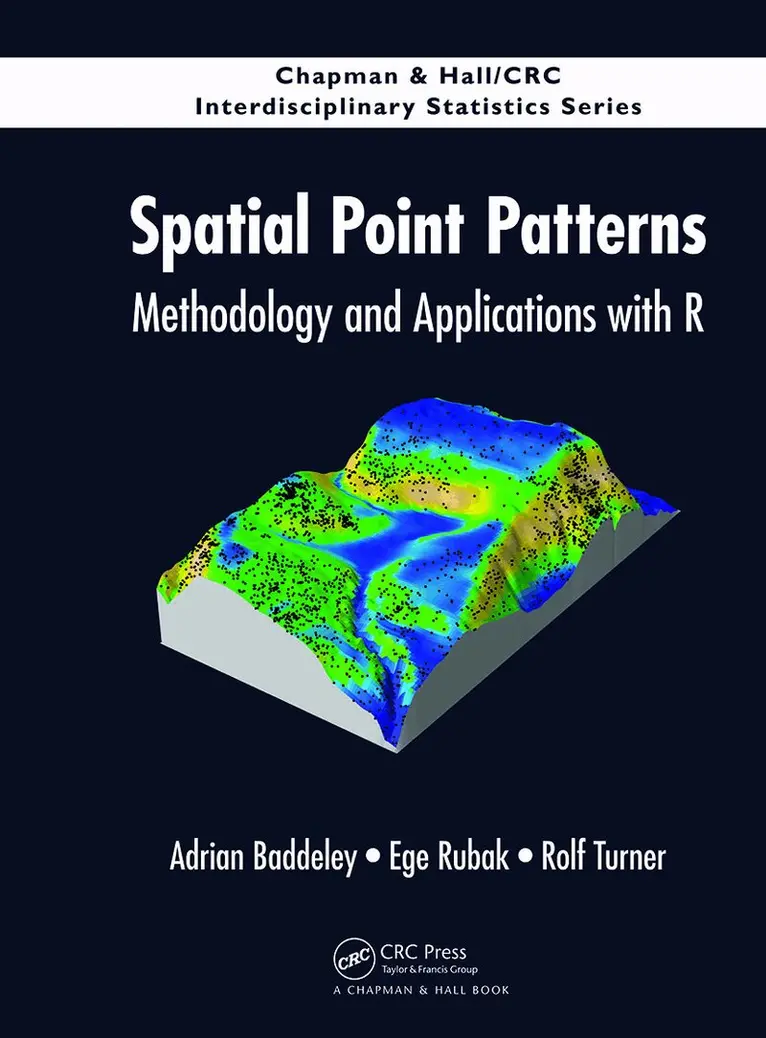
Modern Statistical Methodology and Software for Analyzing Spatial Point PatternsSpatial Point Patterns: Methodology and Applications with R shows scientific researchers and applied statisticians from a wide range of fields how to analyze their spatial point pattern data. Making the techniques accessible to non-mathematicians, the authors draw on their 25 years of software development experiences, methodological research, and broad scientific collaborations to deliver a book that clearly and succinctly explains concepts and addresses real scientific questions.Practical Advice on Data Analysis and Guidance on the Validity and Applicability of MethodsThe first part of the book gives an introduction to R software, advice about collecting data, information about handling and manipulating data, and an accessible introduction to the basic concepts of point processes. The second part presents tools for exploratory data analysis, including non-parametric estimation of intensity, correlation, and spacing properties. The third part discusses model-fitting and statistical inference for point patterns. The final part describes point patterns with additional "structure," such as complicated marks, space-time observations, three- and higher-dimensional spaces, replicated observations, and point patterns constrained to a network of lines.Easily Analyze Your Own DataThroughout the book, the authors use their spatstat package, which is free, open-source code written in the R language. This package provides a wide range of capabilities for spatial point pattern data, from basic data handling to advanced analytic tools. The book focuses on practical needs from the user’s perspective, offering answers to the most frequently asked questions in each chapter.
2 293 kr
Skickas inom 10-15 vardagar
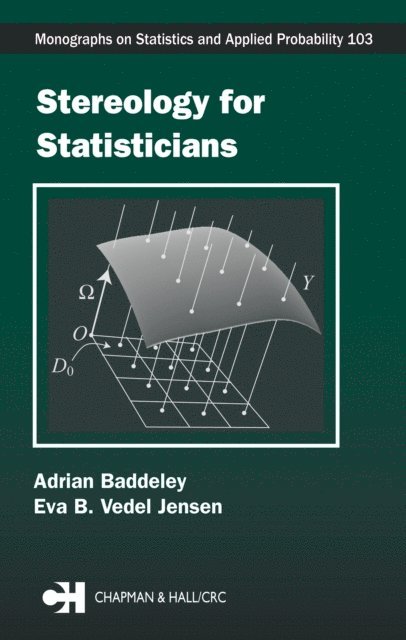
Setting out the principles of stereology from a statistical viewpoint, this book focuses on both basic theory and practical implications. The authors discuss ways to effectively communicate statistical issues to clients, draw attention to common methodological errors, and provide references to essential literature. The first full text on design-based stereology opens with a review of classical and modern stereology, followed by a treatment of mathematical foundations and then on to core techniques. The final chapters discuss implementing techniques in practical sampling designs, summarize understanding of the variance of stereological estimators, and describe open problems for further research. The book also details isotropic, vertical or local sampling designs for estimating stereological parameters such as volume, surface area, particle number and spatial distribution.This extensive text offers support to statistical consultants using examples, applications and unique Advice to Consultants sections. It contains numerous literature references, bibliographic notes and nearly 150 illustrations.