Renée J. Miller – författare
Visar alla böcker från författaren Renée J. Miller. Handla med fri frakt och snabb leverans.
4 produkter
4 produkter
Häftad, Engelska, 2013
372 kr
Skickas inom 10-15 vardagar
Predictive analytics, high volume data, unstructured data, social data, mobile, consumable analytics, and data visualization are all examples of demands and capabilities that have become critical within just the past few years, and are growing at an unprecedented pace.
E-bok
PDF, Engelska, 2022441 kr
Läs direkt efter köp
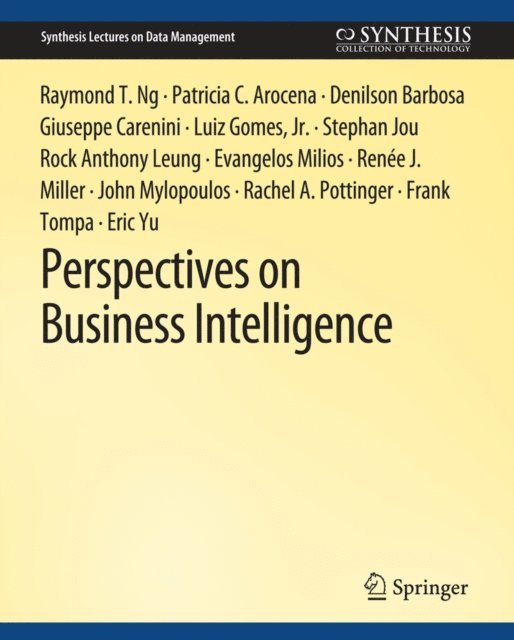
In the 1980s, traditional Business Intelligence (BI) systems focused on the delivery of reports that describe the state of business activities in the past, such as for questions like "How did our sales perform during the last quarter?" A decade later, there was a shift to more interactive content that presented how the business was performing at the present time, answering questions like "How are we doing right now?" Today the focus of BI users are looking into the future. "Given what I did before and how I am currently doing this quarter, how will I do next quarter?" Furthermore, fuelled by the demands of Big Data, BI systems are going through a time of incredible change. Predictive analytics, high volume data, unstructured data, social data, mobile, consumable analytics, and data visualization are all examples of demands and capabilities that have become critical within just the past few years, and are growing at an unprecedented pace. This book introduces research problems and solutions on various aspects central to next-generation BI systems. It begins with a chapter on an industry perspective on how BI has evolved, and discusses how game-changing trends have drastically reshaped the landscape of BI. One of the game changers is the shift toward the consumerization of BI tools. As a result, for BI tools to be successfully used by business users (rather than IT departments), the tools need a business model, rather than a data model. One chapter of the book surveys four different types of business modeling. However, even with the existence of a business model for users to express queries, the data that can meet the needs are still captured within a data model. The next chapter on vivification addresses the problem of closing the gap, which is often significant, between the business and the data models. Moreover, Big Data forces BI systems to integrate and consolidate multiple, and often wildly different, data sources. One chapter gives an overview of several integration architectures for dealing with the challenges that need to be overcome. While the book so far focuses on the usual structured relational data, the remaining chapters turn to unstructured data, an ever-increasing and important component of Big Data. One chapter on information extraction describes methods for dealing with the extraction of relations from free text and the web. Finally, BI users need tools to visualize and interpret new and complex types of information in a way that is compelling, intuitive, but accurate. The last chapter gives an overview of information visualization for decision support and text.
561 kr
Skickas inom 10-15 vardagar
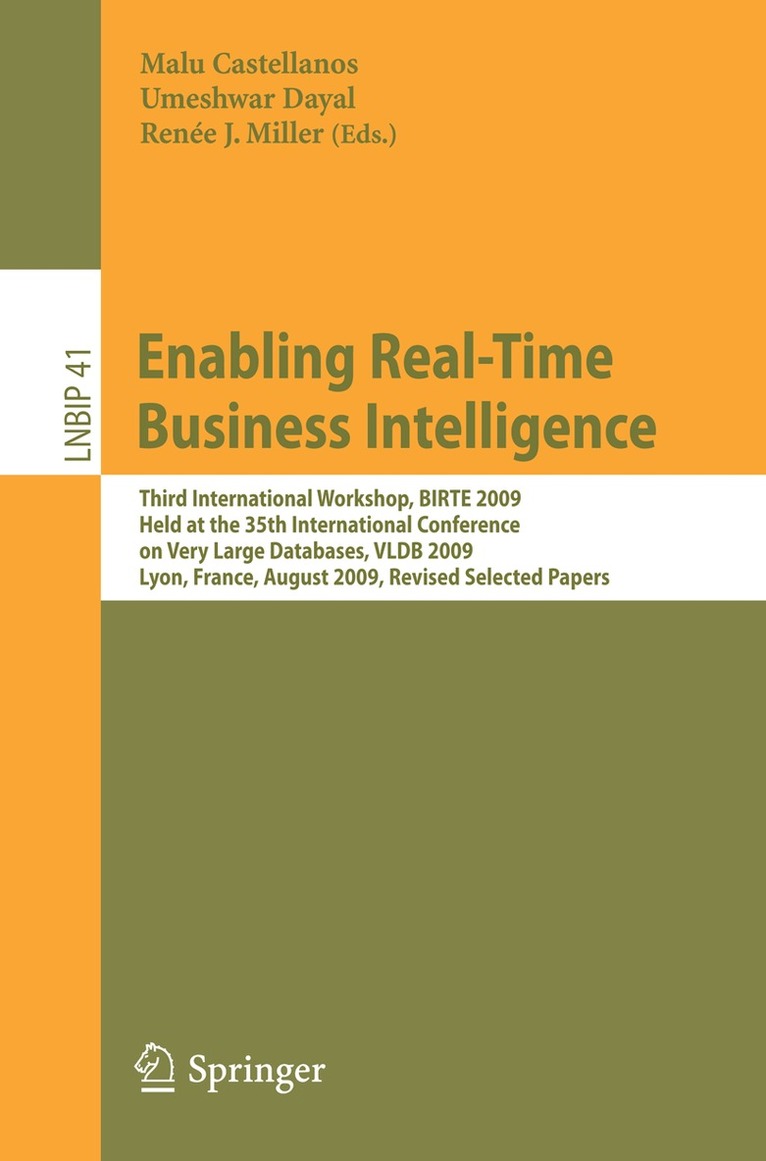
In today’s competitive and highly dynamic environment, organizations need new so- tions to enable them to solve modern business problems and to make decisions using integrated, trustworthy, and up-to-date data. Modern real-time enterprises need to act on events as they happen. They need new, easy-to-use intelligent solutions capable of analyzing heterogeneous real-time enterprise data to provide insight and actionable information at the right time. To enable real-time enterprises, we need fundamental advancements in the science and engineering that underlie intelligent information management including: the management of streaming data; the modeling, analysis and management of unstructured data; along with the integrated use of unstructured, se- structured, and structure data. We need new models and paradigms that raise the level of abstraction used in such critical technologies as ETL, data warehousing, and event and business process modeling. The series of BIRTE workshops aims to provide a forum to discuss and advance the foundational science and engineering required to enable real-time business intel- gence and the novel applications and solutions that build on these foundational te- niques. Following the success of our first workshop, BIRTE 2006, held in Seoul, Korea, in conjunction with VLDB 2006, and our second workshop, BIRTE 2008, held in Auckland, New Zealand, with VLDB 2008, our third workshop was held in Lyon, France on August 24, 2009 with VLDB 2009.
E-bok
PDF, Engelska, 2010708 kr
Läs direkt efter köp
In today’s competitive and highly dynamic environment, organizations need new so- tions to enable them to solve modern business problems and to make decisions using integrated, trustworthy, and up-to-date data. Modern real-time enterprises need to act on events as they happen. They need new, easy-to-use intelligent solutions capable of analyzing heterogeneous real-time enterprise data to provide insight and actionable information at the right time. To enable real-time enterprises, we need fundamental advancements in the science and engineering that underlie intelligent information management including: the management of streaming data; the modeling, analysis and management of unstructured data; along with the integrated use of unstructured, se- structured, and structure data. We need new models and paradigms that raise the level of abstraction used in such critical technologies as ETL, data warehousing, and event and business process modeling. The series of BIRTE workshops aims to provide a forum to discuss and advance the foundational science and engineering required to enable real-time business intel- gence and the novel applications and solutions that build on these foundational te- niques. Following the success of our first workshop, BIRTE 2006, held in Seoul, Korea, in conjunction with VLDB 2006, and our second workshop, BIRTE 2008, held in Auckland, New Zealand, with VLDB 2008, our third workshop was held in Lyon, France on August 24, 2009 with VLDB 2009.