Richard Bessel - Böcker
Visar alla böcker från författaren Richard Bessel. Handla med fri frakt och snabb leverans.
15 produkter
15 produkter
129 kr
Skickas inom 5-8 vardagar
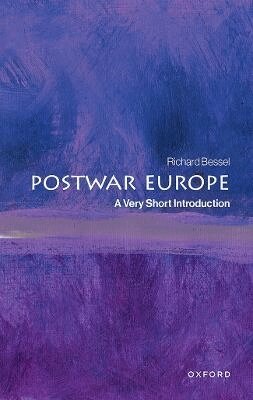
Very Short Introductions: Brilliant, Sharp, InspiringThe Second World War was the most destructive conflict in history. It left Europe in ruins, its economies severely damaged and millions of its people facing malnutrition, its political systems shaken if not destroyed. Yet three decades later its economies had recovered; it largely appeared politically stable; its inhabitants generally were well housed and well fed. Then at the end of the 1980s, the postwar settlement disintegrated, and a new chapter in Europe's postwar history had begun.In this Very Short introduction, Richard Bessel presents a clear, concise, informative account of Europe's history between the end of the Second World War and roughly the end of the twentieth century. He explores the conditions in Europe at the end of the war, how political life took shape and societies were rebuilt, the impressive economic recovery, the Cold War division, the end of empire, and European cultural life. Bessel discusses how we might understand the beginnings and endings of the postwar era, and emphasises the importance of the experiences and actions of specific generations of Europeans. ABOUT THE SERIES: The Very Short Introductions series from Oxford University Press contains hundreds of titles in almost every subject area. These pocket-sized books are the perfect way to get ahead in a new subject quickly. Our expert authors combine facts, analysis, perspective, new ideas, and enthusiasm to make interesting and challenging topics highly readable.
266 kr
Skickas inom 3-6 vardagar
302 kr
Skickas inom 5-8 vardagar
The Third Reich, a regime which instigated the most destructive war in modern history, still evokes fascination and horror today. Yet how were the lives of ordinary German people of the 1930s and 1940s affected by the politics of Hitler and his folllowers? Looking beyond the catalogue of events, this book reveals that daily life involved a complex mixture of bribery and terror, of fear and concessions, of barbarism and appeals to conventional moral values, employed to maintain a grip upon society. The essays presented here by eight leading historians shed fresh light on familiar topics, the role of political violence in Nazi seizure of power, the German view of Hitler himself, and also focus upon less well-known aspects of life in the Third Reich, such as village life, the treatment of 'social outcasts', and the Germans own retrospective view of this period of their history.
2 280 kr
Skickas inom 7-10 vardagar
This is a social history of Germany in the years following the First World War. Germany's defeat and the subsequent demobilization of her armies had enormous economic, social, and psychological consequences for the nation, and it is these which Richard Bessel sets out to explore these.Dr Bessel examines the changes brought by the War to Germany, by the return of the soldiers to civilian life and by the demobilization of the economy. He demonstrates how the postwar transition was viewed as a moral crusade by Germans desperately concerned about challenges to traditional authority; and he assesses the ways in which the experiences and memories of the War affected the politics of the Weimar Republic.This original and scholarly book offers important insights into the sense of dislocation, both personal and national, experienced by Germany and Germans after the First World War, and the damaging legacy of the War for German democracy.
1 666 kr
Skickas inom 10-15 vardagar
Originally published in 1981 and comprising research and interpretation from American, German and British scholars deals with many of the most salient facets of the Weimar period, including the revolutionary events following the First World War; the development of the Reichswehr; the role of heavy industry in shaping foreign policy, and the dissolution of the bourgeois party system during the last years before 1933. Each contribution examines the inter-relationships between social and economic change on the one hand, and political developments on the other.
496 kr
Skickas inom 10-15 vardagar
Originally published in 1981 and comprising research and interpretation from American, German and British scholars deals with many of the most salient facets of the Weimar period, including the revolutionary events following the First World War; the development of the Reichswehr; the role of heavy industry in shaping foreign policy, and the dissolution of the bourgeois party system during the last years before 1933. Each contribution examines the inter-relationships between social and economic change on the one hand, and political developments on the other.
Life after Death
Approaches to a Cultural and Social History of Europe During the 1940s and 1950s
Häftad, Engelska, 2003
536 kr
Skickas inom 7-10 vardagar
This collection of essays offers a novel approach to the cultural and social history of Europe after the Second World War. In a shift of perspective, it does not conceive of the impressive economic and political stability of the postwar era as a quasi-natural return to previous patterns of societal development but approaches it as an attempt to establish 'normality' upon the lingering memories of experiencing violence on a hitherto unprecedented scale. It views the relationship of the violence of the 1940s to the apparent 'normality' and stability of the 1950s as a key to understanding the history of post-war Europe. While the history of post-war Germany naturally looms large in this collection, the essays deal with countries across Western and Central Europe, offer comparative perspectives on their subjects, and draw upon a wide range of primary and secondary source material.
712 kr
Skickas inom 7-10 vardagar
Can Fascist Italy and Nazi Germany be compared? Not long ago, the answer seemed obvious: they could be and they were. Nationalist rhetoric, hostility to the left and to parliamentary government, and the glorification of violence seemed to invite comparison. More recently, doubts have arisen. As more attention is paid to the consequences of Nazi racism, it has been questioned whether Nazi Germany can be compared with anything. This collaborative volume meets the challenge of comparing the two movements. It contains ten essays, two each on five central themes: the rise of the Fascist and Nazi movements; the relation of the regimes to workers, women, and war; and how the regimes may be viewed in a long-term perspective. The essays take stock of recent research, advance fresh theories about the histories of Nazism and Fascism, and provide a basis for informed comparison of two regimes central to twentieth-century history.
500 kr
Skickas inom 7-10 vardagar
Can Fascist Italy and Nazi Germany be compared? Not long ago, the answer seemed obvious: they could be and they were. Nationalist rhetoric, hostility to the left and to parliamentary government, and the glorification of violence seemed to invite comparison. More recently, doubts have arisen. As more attention is paid to the consequences of Nazi racism, it has been questioned whether Nazi Germany can be compared with anything. This collaborative volume meets the challenge of comparing the two movements. It contains ten essays, two each on five central themes: the rise of the Fascist and Nazi movements; the relation of the regimes to workers, women, and war; and how the regimes may be viewed in a long-term perspective. The essays take stock of recent research, advance fresh theories about the histories of Nazism and Fascism, and provide a basis for informed comparison of two regimes central to twentieth-century history.
Life after Death
Approaches to a Cultural and Social History of Europe During the 1940s and 1950s
Inbunden, Engelska, 2003
1 065 kr
Skickas inom 7-10 vardagar
This collection of essays offers a novel approach to the cultural and social history of Europe after the Second World War. In a shift of perspective, it does not conceive of the impressive economic and political stability of the postwar era as a quasi-natural return to previous patterns of societal development but approaches it as an attempt to establish 'normality' upon the lingering memories of experiencing violence on a hitherto unprecedented scale. It views the relationship of the violence of the 1940s to the apparent 'normality' and stability of the 1950s as a key to understanding the history of post-war Europe. While the history of post-war Germany naturally looms large in this collection, the essays deal with countries across Western and Central Europe, offer comparative perspectives on their subjects, and draw upon a wide range of primary and secondary source material.
324 kr
Skickas inom 3-6 vardagar
121 kr
Skickas inom 11-20 vardagar
In 1945, Germany experienced the greatest outburst of deadly violence that the world has ever seen. Germany 1945 examines the country's emergence from the most terrible catastrophe in modern history. When the Second World War ended, millions had been murdered; survivors had lost their families; cities and towns had been reduced to rubble and were littered with corpses. Yet people lived on, and began rebuilding their lives in the most inauspicious of circumstances. Bombing, military casualties, territorial loss, economic collapse and the processes of denazification gave Germans a deep sense of their own victimhood, which would become central to how they emerged from the trauma of total defeat, turned their backs on the Third Reich and its crimes, and focused on a transition to relative peace. Germany's return to humanity and prosperity is the hinge on which Europe's twentieth century turned. For years we have concentrated on how Europe slid into tyranny, violence, war and genocide; this book describes how humanity began to get back out.
111 kr
Skickas inom 11-20 vardagar
After a century that has been described as the most violent in the history of humanity, Professor Richard Bessel has written an intelligent and fascinating book on the history of our violent world and how we have become obsessed about violence. He critiques the great themes of modern history from revolutionary upheavals around the globe, to the two world wars and the murder of the European Jews, to the great purges and, more recently, terrorism. Violence, it seems, is on everyone's mind. It constantly is in the news; it has given rise to an enormous historical, sociological, and philosophical literature; it occupies a prominent place in popular entertainment; and it is regarded as one of the fundamental problems affecting social, political and interpersonal relations. Bessel sheds light on this phenomenon and how our sensitivity towards violence has grown and has affected the ways in which we understand the world around us - in terms of religious faith, politics, military confrontation, the role of the state, as well as of interpersonal and intimate relations. He critiques our modern day relationship with violence and how despite its continuing and inevitable nature, we have become more committed to limiting and suppressing it. Both historically questioning and intensely evocative of the most vicious and brutal violence enacted by mankind, this book shows how the place of violence in the modern world presents a number of paradoxes and how it is an inescapable theme in human history.
1 956 kr
Skickas inom 3-6 vardagar
Over the past thirty years social scientists and particularly social historians have stressed the need to take popular protest seriously. The corollary of this, the need to take the policing of protest seriously, seems to have been less well acknowledged. The aim of this volume is to redress this situation by probing, in depth, a limited number of incidents of public disorder and focusing particularly on the role of the police. In doing so, this collection will draw out general patterns of police provocation and public responses and suggest general hypotheses. The incidents explored range across Europe and the United States, involve different kinds of political regime, and are drawn from both the interwar and the postwar years. They pose important questions about the effects of riot training and specialist equipment for the police, about the reality and roles of "agitators" and of "rotten apples" amongst the police, and about the role of the media and the courts in fostering certain kinds of undesirable and counterproductive police behavior.
566 kr
Skickas inom 3-6 vardagar
Over the past thirty years social scientists and particularly social historians have stressed the need to take popular protest seriously. The corollary of this, the need to take the policing of protest seriously, seems to have been less well acknowledged. The aim of this volume is to redress this situation by probing, in depth, a limited number of incidents of public disorder and focusing particularly on the role of the police. In doing so, this collection will draw out general patterns of police provocation and public responses and suggest general hypotheses. The incidents explored range across Europe and the United States, involve different kinds of political regime, and are drawn from both the interwar and the postwar years. They pose important questions about the effects of riot training and specialist equipment for the police, about the reality and roles of "agitators" and of "rotten apples" amongst the police, and about the role of the media and the courts in fostering certain kinds of undesirable and counterproductive police behavior.