Richard Krever – författare
2 355 kr
Skickas inom 5-8 vardagar
1 892 kr
Skickas inom 3-6 vardagar
1 690 kr
Läs direkt efter köp
2 494 kr
Läs direkt efter köp
Why are tax systems so complex? What are the causes of tax law complexity? What are the consequences? Why is tax simplification so difficult to achieve? These, and related questions, lie at the core of this volume on tax simplification featuring chapters by leading tax experts around the world. The quest for simplicity 舒 or at least some move towards simplification 舒 has been a fixation of governments and others for many years, but little appears to have been achieved. Tax simplification is the most widely quoted but the least widely observed of the usually stated goals of policy (equity and efficiency being the others). It has been used (and abused) as a primary justification for tax reform over the last century, and typically it is seen as 舖a good thing舗 舒 to say that one is in favour of tax simplification is tantamount to stating that one is in favour of good as opposed to evil.
Tax Conversations: A Guide to the Key Issues in the Tax Reform Debate
Essay in Honour of John G. Head
4 483 kr
Läs direkt efter köp
The 20th century will probably be regarded as a watershed in the history of taxation. The first half of the century was characterised by numerous changes to tax theory and practice that alone probably outstripped those of the previous millennium. But these developments are modest when viewed against the barrage of competing theoretical views and technical analyses of tax policy in the century''s last five decades, let alone the avalanche of legislation, regulations, rulings, tax commissions, etc., that marked, first, the post-war growth of the welfare state and, second, the growing internationalisation of world commerce and the ensuing competition for economic advantages. The expert papers in Tax Conversations review the principal themes dominating tax debate and tax reform at the end of the century. Together, they seek to explain how these issues have evolved, their current implications, and their possible or probable directions into the next century. The conversations analyse these elements of the tax debate in order to give meaning to their past and to assess the prospects for their futures.
The papers in this volume are presented in honour of John G. Head, a scholar whose work has done much to educate tax theorists and those implementing policy, and considered by many to be his generation''s leading figure in Australian public finance.
2 245 kr
Skickas inom 3-6 vardagar
2 088 kr
Läs direkt efter köp
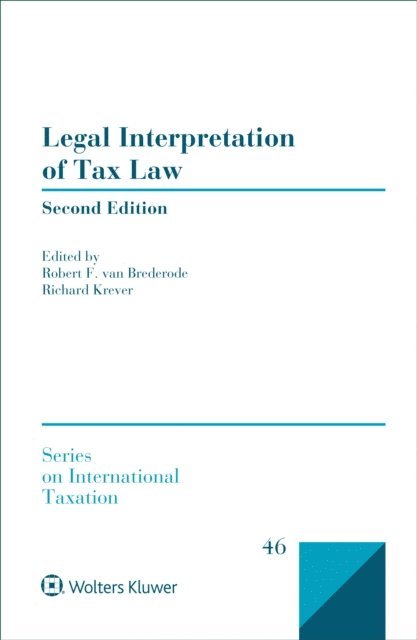
Series on International Taxation Volume 46
Legal Interpretation of Tax Law is a comprehensive multi-jurisdiction survey of the interpretation of the corporate income tax and VAT and GST or other general sales tax laws. As a result of the globalization of trade and business, tax departments and their external advisors are increasingly required to deal with the tax law of foreign jurisdictions. Effective consulting, whether internal or external, requires not only knowledge of tax law per se but also of how tax law is explained and interpreted by the courts of foreign jurisdictions. This book is the first to deal comparatively with tax law interpretation in economies engaged in cross-border investment at a global level.
What’s in this book:
Leading experts from fourteen jurisdictions – ranging from long-standing common law and civil law countries to emerging economies and transitional economies shifting from socialist to market systems – provide detailed analysis and commentary on such tax law topics and issues as:
methods of tax law interpretation used in each jurisdiction; how the judiciary is organized in each jurisdiction as regards tax law; the role, if any, of the central government’s high court in providing precedent and guidelines for interpretation; external sources a court can consider when interpreting legislation; constitutional restrictions on the interpretation of legislation; prevalence of the General Anti-Avoidance Rule (GAAR); ‘transplanted’ categories (undefined terms that are clarified through the meaning of those same terms in another law); the concept of ‘ordinary income’; the concept of ‘capital’ expenses; interpretation of tax treaties; interpretation of key concepts in VAT and GST law, and interrelation of judicial interpretation and administrative interpretation.The introduction outlines the theoretical approaches to legal interpretation in general and gives an overview of issues and topics relevant to taxation – designed to help readers understand the jurisdictional chapters that follow. Each author pays detailed attention to such documentary elements as explanatory memoranda, administrative rulings, judicial precedents, judgments of foreign courts, legislative debates, and OECD guidelines.
How this will help you:
This book helps practitioners and academics gain insight into how tax law and its provisions, in general and in particular, are likely to be applied to different types of cross-border transactions and investments. This unmatched resource thus serves as a handbook of information to tax departments and their advisors, tax lawyers working for international law firms and accounting firms, and in-house tax professionals working for multinational companies.
1 989 kr
Skickas inom 5-8 vardagar
1 752 kr
Läs direkt efter köp
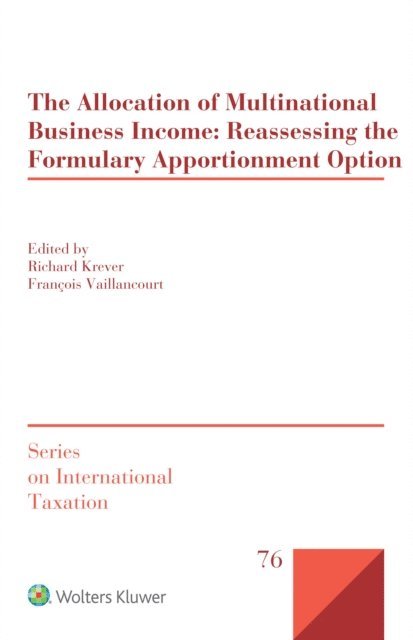
The Allocation of Multinational Business Income: Reassessing the Formulary Apportionment Option
Edited by Richard Krever & François Vaillancourt
Although arm’s length methodology continues to prevail in international taxation policy, it has long been replaced by the formulary apportionment method at the subnational level in a few federal countries. Its use is planned for international profit allocation as an element of the European Union’s CCCTB proposals. In this timely book – a global guide to formulary apportionment, both as it exists in practice and how it might function internationally – a knowledgeable group of contributors from Australia, Canada, the United Kingdom and the United States, address this actively debated topic, both in respect of its technical aspects and its promise as a global response to the avoidance, distortions, and unfairness of current allocation systems.
Drawing on a wealth of literature considering formulary apportionment in the international sphere and considering decades of experience with the system in the states and provinces of the United States and Canada, the contributors explicate and examine such pertinent issues as the following:
the debate about what factors should be used to allocate profits under a formulary apportionment system and experience in jurisdictions using formulary apportionment; application of formulary apportionment in specific sectors such as digital enterprises and the banking industry; the political economy of establishing and maintaining a successful formulary apportionment regime; formulary apportionment proposals for Europe; the role of traditional tax criteria such as economic efficiency, fairness, ease of administration, and robustness to avoidance and incentive compatibility; determining which parts of a multinational group are included in a formulary apportionment unit; and whether innovative profit-split methodologies such as those developed by China are shifting traditional arm’s length methods to a quasi-formulary apportionment system.Providing a comprehensive understanding of all aspects of the formulary apportionment option, this state of the art summary of history, current practice, proposals and prospects in the ongoing debate over arm’s length versus formulary apportionment methodologies will be welcomed by practitioners, policy-makers, and academics concerned with international taxation, all of whom will gain an understanding of the case put forward by proponents for adoption of formulary apportionment in Europe and globally and the counter-arguments they face. Readers will acquire a better understanding of the implications of formulary apportionment and its central role in the current debate about the future of international taxation rules.
1 690 kr
Läs direkt efter köp
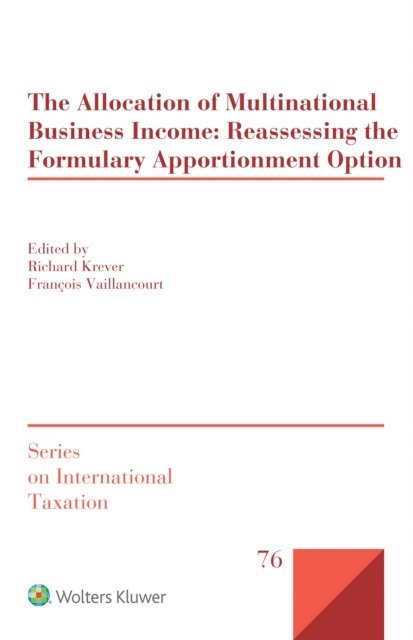
The Allocation of Multinational Business Income: Reassessing the Formulary Apportionment Option
Edited by Richard Krever & François Vaillancourt
Although arm’s length methodology continues to prevail in international taxation policy, it has long been replaced by the formulary apportionment method at the subnational level in a few federal countries. Its use is planned for international profit allocation as an element of the European Union’s CCCTB proposals. In this timely book – a global guide to formulary apportionment, both as it exists in practice and how it might function internationally – a knowledgeable group of contributors from Australia, Canada, the United Kingdom and the United States, address this actively debated topic, both in respect of its technical aspects and its promise as a global response to the avoidance, distortions, and unfairness of current allocation systems.
Drawing on a wealth of literature considering formulary apportionment in the international sphere and considering decades of experience with the system in the states and provinces of the United States and Canada, the contributors explicate and examine such pertinent issues as the following:
the debate about what factors should be used to allocate profits under a formulary apportionment system and experience in jurisdictions using formulary apportionment; application of formulary apportionment in specific sectors such as digital enterprises and the banking industry; the political economy of establishing and maintaining a successful formulary apportionment regime; formulary apportionment proposals for Europe; the role of traditional tax criteria such as economic efficiency, fairness, ease of administration, and robustness to avoidance and incentive compatibility; determining which parts of a multinational group are included in a formulary apportionment unit; and whether innovative profit-split methodologies such as those developed by China are shifting traditional arm’s length methods to a quasi-formulary apportionment system.Providing a comprehensive understanding of all aspects of the formulary apportionment option, this state of the art summary of history, current practice, proposals and prospects in the ongoing debate over arm’s length versus formulary apportionment methodologies will be welcomed by practitioners, policy-makers, and academics concerned with international taxation, all of whom will gain an understanding of the case put forward by proponents for adoption of formulary apportionment in Europe and globally and the counter-arguments they face. Readers will acquire a better understanding of the implications of formulary apportionment and its central role in the current debate about the future of international taxation rules.
2 219 kr
Skickas
2 827 kr
Läs direkt efter köp
2 276 kr
Skickas inom 10-15 vardagar
2 388 kr
Tillfälligt slut
3 156 kr
Tillfälligt slut