Richard N. Cooper – författare
Visar alla böcker från författaren Richard N. Cooper. Handla med fri frakt och snabb leverans.
4 produkter
4 produkter
Häftad, Engelska, 1994
277 kr
Skickas inom 10-15 vardagar
To whom do the Earth's riches belongall of mankind, the nations in which those riches are found, or individuals? Why should a relatively small number of Arabs own most of the world's oil reserves? Why should South Africans own most of the world's gold and diamond resources? Or why should the Americans and Canadians own the agriculturally rich Great Plains? Shouldn't these resources and the environment be treated as endowments available to all mankind?Long ago, the international community agreed to a system of national ownership of natural resources, giving states sovereignty over their respective territories. In recent years, however, environmentalists have raised questions about this distribution of property rights with respect to global environmental issues, such as atmospheric disposal of waste gases, preservation of the Earth's genetic material, and the destruction of tropical rain forests. When environmental impacts are global, international action may be warranted to ensure that individual nations are complying with transnational standards.In this book, part of the Brookings Integrating National Economies series, Richard N. Cooper evaluates the need for international policy action in natural resource and environmental management. Using numerous examples, he illustrates the issues that cause conflict in environment and resources policies. Cooper divides the use of natural resources into three categories and examines the rationale for international action in each. He discusses the use of resources not yet subject to national jurisdiction, such as Antarctica, open oceans, and outer space, and analyzes the effects of national action on other nations via both market and environmental externalities.Taking into account the diversity of individual states' circumstances and priorities, Copper concludes that stiff environmental regulations generally are not the best answer to environmental management. He explains that developing countries a
E-bok
PDF, Engelska, 2001476 kr
Läs direkt efter köp
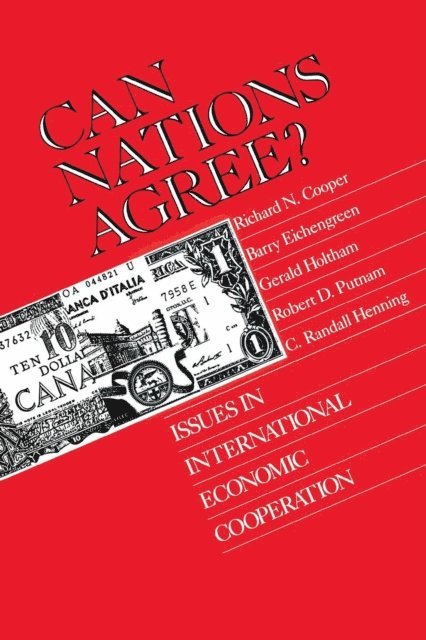
In the age of Three Mile Island and Chernobyl, a new international trade in industrial and human waste, the depletion of the ozone layer, and the greenhouse effect, the importance of international cooperation is supremely evident. In the economic arena, such problems include speculative instability in financial and primary commodities markets, competition in tax regimes, and the greatly enhanced scope for tax evasion. Can Nations Agree? examines the crucial issues surrounding international cooperation-- conditions that foster cooperation toward common goals; ways to handle the friction arising from conflicting goals; and the structures that best promote cooperation. Although nations recognize the value of cooperation in an independent world, a variety of conditions inhibit the process. In recent decades the number of independent nations has risen rapidly, and so has the variety of decisionmakers and national interests to be reconciled. At the same time, the economic power of the United States has declined in relation to other successful capitalist countries. In the chapters on the 1978 Bonn economic summit, German macroeconomic policy, international cooperation on public health issues, and hegemony and stability, the scholars contributing to this volume analyze the history and process of international cooperation to offer fresh insight for future efforts.
E-bok
PDF, Engelska, 1994286 kr
Läs direkt efter köp
To whom do the Earth's riches belongall of mankind, the nations in which those riches are found, or individuals? Why should a relatively small number of Arabs own most of the world's oil reserves? Why should South Africans own most of the world's gold and diamond resources? Or why should the Americans and Canadians own the agriculturally rich Great Plains? Shouldn't these resources and the environment be treated as endowments available to all mankind?Long ago, the international community agreed to a system of national ownership of natural resources, giving states sovereignty over their respective territories. In recent years, however, environmentalists have raised questions about this distribution of property rights with respect to global environmental issues, such as atmospheric disposal of waste gases, preservation of the Earth's genetic material, and the destruction of tropical rain forests. When environmental impacts are global, international action may be warranted to ensure that individual nations are complying with transnational standards.In this book, part of the Brookings Integrating National Economies series, Richard N. Cooper evaluates the need for international policy action in natural resource and environmental management. Using numerous examples, he illustrates the issues that cause conflict in environment and resources policies. Cooper divides the use of natural resources into three categories and examines the rationale for international action in each. He discusses the use of resources not yet subject to national jurisdiction, such as Antarctica, open oceans, and outer space, and analyzes the effects of national action on other nations via both market and environmental externalities.Taking into account the diversity of individual states' circumstances and priorities, Copper concludes that stiff environmental regulations generally are not the best answer to environmental management. He explains that developing countries a
Häftad, Engelska, 2003
51 kr
Tillfälligt slut