Richard O. Michaud - Böcker
Visar alla böcker från författaren Richard O. Michaud. Handla med fri frakt och snabb leverans.
3 produkter
3 produkter
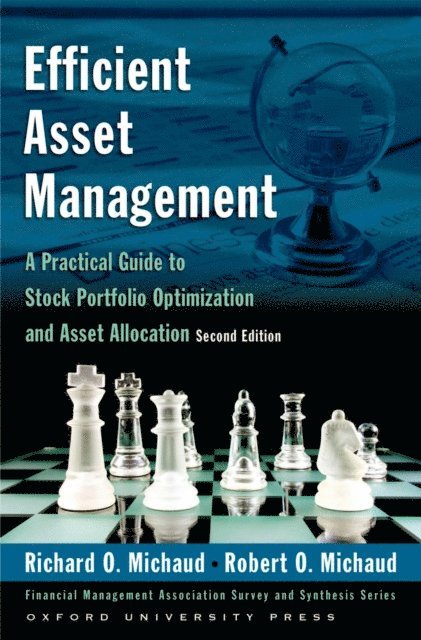
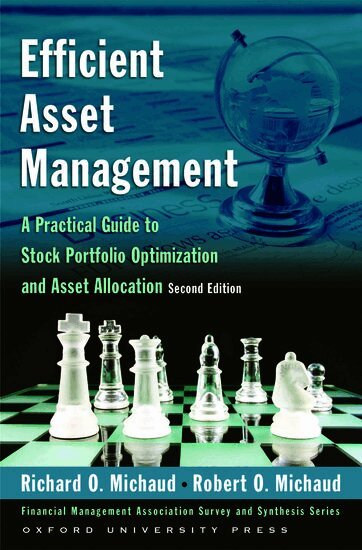
Efficient Asset Management
A Practical Guide to Stock Portfolio Optimization and Asset Allocation
Inbunden, Engelska, 2008
921 kr
Skickas inom 5-8 vardagar
In spite of theoretical benefits, Markowitz mean-variance (MV) optimized portfolios often fail to meet practical investment goals of marketability, usability, and performance, prompting many investors to seek simpler alternatives. Financial experts Richard and Robert Michaud demonstrate that the limitations of MV optimization are not the result of conceptual flaws in Markowitz theory but unrealistic representation of investment information. What is missing is a realistic treatment of estimation error in the optimization and rebalancing process. The text provides a non-technical review of classical Markowitz optimization and traditional objections. The authors demonstrate that in practice the single most important limitation of MV optimization is oversensitivity to estimation error. Portfolio optimization requires a modern statistical perspective. Efficient Asset Management, Second Edition uses Monte Carlo resampling to address information uncertainty and define Resampled Efficiency(TM) (RE) technology. RE optimized portfolios represent a new definition of portfolio optimality that is more investment intuitive, robust, and provably investment effective. RE rebalancing provides the first rigorous portfolio trading, monitoring, and asset importance rules, avoiding widespread ad hoc methods in current practice. The Second Edition resolves several open issues and misunderstandings that have emerged since the original edition. The new edition includes new proofs of effectiveness, substantial revisions of statistical estimation, extensive discussion of long-short optimization, and new tools for dealing with estimation error in applications and enhancing computational efficiency. RE optimization is shown to be a Bayesian-based generalization and enhancement of Markowitz's solution. RE technology corrects many current practices that may adversely impact the investment value of trillions of dollars under current asset management. RE optimization technology may also be useful in other financial optimizations and more generally in multivariate estimation contexts of information uncertainty with Bayesian linear constraints. Michaud and Michaud's new book includes numerous additional proposals to enhance investment value including Stein and Bayesian methods for improved input estimation, the use of portfolio priors, and an economic perspective for asset-liability optimization. Applications include investment policy, asset allocation, and equity portfolio optimization. A final chapter includes practical advice for avoiding simple portfolio design errors. A simple global asset allocation problem illustrates portfolio optimization techniques. The presentation is intuitive, rigorous and informed with institutional management experience to appeal to investment management executives, consultants, fund trustees, brokers, academics, and anyone seeking to stay abreast of the future of investment technology. With its important implications for investment practice, Efficient Asset Management's highly intuitive yet rigorous approach to defining optimal portfolios will appeal to investment management executives, consultants, brokers, and anyone seeking to stay abreast of current investment technology. Through practical examples and illustrations, Michaud and Michaud update the practice of optimization for modern investment management.
Finance's Wrong Turns
A New Foundation for Financial Markets, Asset Management, and Social Science
Inbunden, Engelska, 2022
497 kr
Skickas inom 10-15 vardagar
There is a foundational crisis in financial theory and professional investment practice: There is little, if any, credible evidence that active investment strategies and traditional institutional quantitative technologies are able to provide superior risk-adjusted, cost-adjusted return over investment relevant horizons.Economic and financial theory has been in error for more than fifty years and is the fundamental cause of the persistent ineffectiveness of professional asset management. Contemporary sociological and economic theory, agent-based modeling, and an appreciation of the social context for preference theory provides a rational and intuitive framework for understanding financial markets and economic behavior. The author narrates his long-term experience in the use and limitations of traditional tools of quantitative asset management as an institutional asset manager in practice and as a quantitative analyst and strategist on Wall Street. Monte Carlo simulation methods, modern statistical tools, and U.S. patented innovations are introduced to redefine portfolio optimality and procedures for enhanced professional asset management. A new social context for expected utility theory leads to a novel understanding of modern equity markets as a financial intermediary for purchasing power constant time-shift investing uniquely appropriate for meeting investor long-term investment objectives. This book addresses the limitations and indicated resolutions for more useful financial theory and more reliable asset management technology. In the process, it traces the major historical developments of theory and institutional asset management practice and their limitations over the course of the 20th century to the present, including Markowitz and the birth of modern finance, CAPM theory and emergence of institutional quantitative asset management, CAPM and VM theory limitations and ineffective iconic tools and strategies, andinnovations in statistical methodologies and financial market theory.
Finance's Wrong Turns
A New Foundation for Financial Markets, Asset Management, and Social Science
Häftad, Engelska, 2023
497 kr
Skickas inom 10-15 vardagar
There is a foundational crisis in financial theory and professional investment practice: There is little, if any, credible evidence that active investment strategies and traditional institutional quantitative technologies are able to provide superior risk-adjusted, cost-adjusted return over investment relevant horizons.Economic and financial theory has been in error for more than fifty years and is the fundamental cause of the persistent ineffectiveness of professional asset management. Contemporary sociological and economic theory, agent-based modeling, and an appreciation of the social context for preference theory provides a rational and intuitive framework for understanding financial markets and economic behavior. The author narrates his long-term experience in the use and limitations of traditional tools of quantitative asset management as an institutional asset manager in practice and as a quantitative analyst and strategist on Wall Street. Monte Carlo simulation methods, modern statistical tools, and U.S. patented innovations are introduced to redefine portfolio optimality and procedures for enhanced professional asset management. A new social context for expected utility theory leads to a novel understanding of modern equity markets as a financial intermediary for purchasing power constant time-shift investing uniquely appropriate for meeting investor long-term investment objectives. This book addresses the limitations and indicated resolutions for more useful financial theory and more reliable asset management technology. In the process, it traces the major historical developments of theory and institutional asset management practice and their limitations over the course of the 20th century to the present, including Markowitz and the birth of modern finance, CAPM theory and emergence of institutional quantitative asset management, CAPM and VM theory limitations and ineffective iconic tools and strategies, andinnovations in statistical methodologies and financial market theory.