Rob A. Rutenbar – författare
Visar alla böcker från författaren Rob A. Rutenbar. Handla med fri frakt och snabb leverans.
15 produkter
15 produkter
Inbunden, Engelska, 2002
2 281 kr
Skickas inom 5-8 vardagar
The tools and techniques you need to break the analog design bottleneck!Ten years ago, analog seemed to be a dead-end technology. Today, System-on-Chip (SoC) designs are increasingly mixed-signal designs. With the advent of application-specific integrated circuits (ASIC) technologies that can integrate both analog and digital functions on a single chip, analog has become more crucial than ever to the design process. Today, designers are moving beyond hand-crafted, one-transistor-at-a-time methods. They are using new circuit and physical synthesis tools to design practical analog circuits; new modeling and analysis tools to allow rapid exploration of system level alternatives; and new simulation tools to provide accurate answers for analog circuit behaviors and interactions that were considered impossible to handle only a few years ago.To give circuit designers and CAD professionals a better understanding of the history and the current state of the art in the field, this volume collects in one place the essential set of analog CAD papers that form the foundation of today's new analog design automation tools. Areas covered are:* Analog synthesis* Symbolic analysis* Analog layout* Analog modeling and analysis* Specialized analog simulation* Circuit centering and yield optimization* Circuit testingComputer-Aided Design of Analog Integrated Circuits and Systems is the cutting-edge reference that will be an invaluable resource for every semiconductor circuit designer and CAD professional who hopes to break the analog design bottleneck.
Inbunden, Engelska, 1998
1 616 kr
Skickas inom 10-15 vardagar
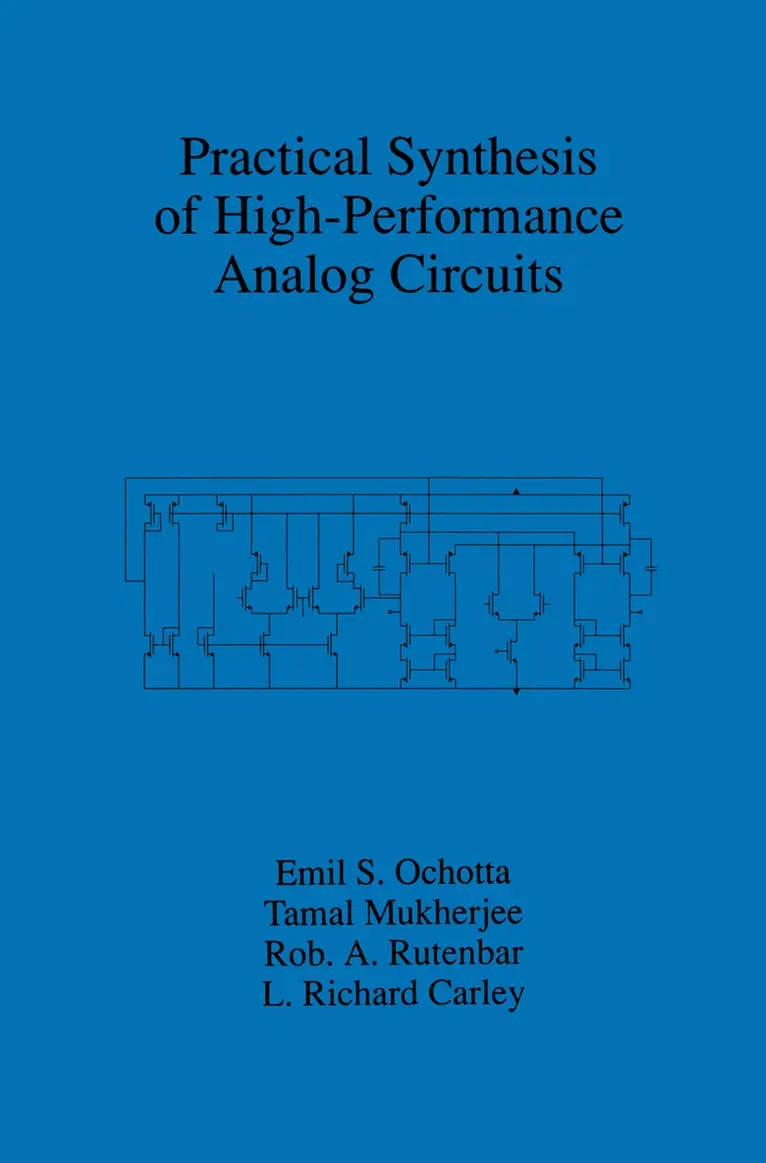
This text presents a technique for automating the design of analogue circuits. Market competition and the pace of technological innovation exert pressure on circuit design engineers to turn ideas into products quickly and get them to market. In digital Application Specific Integrated Circuit (ASIC) design, computer aided design (CAD) tools have substantially eased this pressure by automating many of the laborious steps in the design process, thereby allowing the designer to maximise his design expertise. But the world is not solely digital. Cellular telephones, magnetic disk drives, neural networks and speech recognition systems are a few of the technological innovations that rely on a core of analog circuitry and exploit the density and performance of mixed analog/digital ASICs. To maximize profit, these mixed-signal ASICs must also make it to market as quickly as possible. However, although the engineer working on the digital portion of the ASIC can rely on sophisticated CAD tools to automate much of the design process, there is little help for the engineer working on the analogue portion of the chip.With the exception of simulators to verify the circuit design when it is complete, there are almost no general purpose CAD tools that an analog design engineer can take advantage of to automate the analog design flow and reduce his time to market. This volume presents a variation-tolerant analogue synthesis strategy that is a significant step towards ending the wait for a practical analogue synthesis tool.
Inbunden, Engelska, 1990
1 665 kr
Skickas inom 10-15 vardagar
Unfortunately, this resemblance is often of little help in actually writing the software for problem X' given the software for problem X. And of course, VLSI design software, and engineering design software in general, is often exquisitely sensitive to some aspects of the domain (technology) in which it operates.
Del 263 - Springer International Series in Engineering and Computer Science
Analog Device-Level Layout Automation
Inbunden, Engelska, 1994
1 616 kr
Skickas inom 10-15 vardagar
This monograph addresses the problem of device layout for high-performance custom analog cells. In particular, an alternative placement and routing formulation is proposed that is designed to minimize the cost in layout quality that is traditionally associated with analog layout automation. The goal of analog layout is to minimize the effects of layout induced performance degradation while, at the same time, maximizing the area utilization of the circuit. Human layout experts observe a variety of analog-specific layout constraints and exploit a range of geometric optimizations to achieve these performance and density goals. This work is directed at discovering how these constraints and optimizations can best be incorporated into automatic layout optimization. Two of the products of this research are a analog device-level placer, KOAN, and a analogue device-level router, ANAGRAM II [40], which incorporate a more comprehensive set of layout constraints and geometric optimizations than in any previous systems. The work focuses on the formulation, algorithms, and certain relevant implementation details of KOAN and ANAGRAM II.
Inbunden, Engelska, 1996
1 080 kr
Skickas inom 10-15 vardagar
The move to higher levels of integration has increased the fraction of application-specific integrated circuit (ASIC) designs containing both analog and digital circuits. While the die area for the analog portion of these chips is modest, the design time is often significant. This has motivated the development of automated analog physical design tools for cell-level place-and-route and system-level signal-integrity-routing. To date, there is no tool that has specifically addressed the critical design task of synthesizing the power distribution for the analog portion of an analog or mixed-signal ASIC. This text describes algorithms for analog power distribution synthesis and demonstrates their effectivenes. Existing digital power bus synthesis algorithms have failed to address critical concerns for analog circuitry, thus yielding unacceptable results. These tools synthesize only the bus component of power distribution networks and only consider simplified DC aspects of macros and buses. This work addresses power distribution synthesis for mixed-signal integrated circuits.Several key challenges in power distribution design are identified and automated methods to overcome them are described. The text presents a formulation for the analog power distribution synthesis problem which synthesizes both the power busses power I/O cell assignment by evaluating DC, AC, and transient interaction between the macros, busses, chip substrate, and package. Furthermore, algorithms are introduced which simultaneously optimize power I/O cell assignment, macro cell substrate coupling, power bus topology selection and power bus sizing. The book should be of interest to CAD designers and researchers specializing in physical design, modelling and circuit synthesis.
Inbunden, Engelska, 2004
1 080 kr
Skickas inom 10-15 vardagar
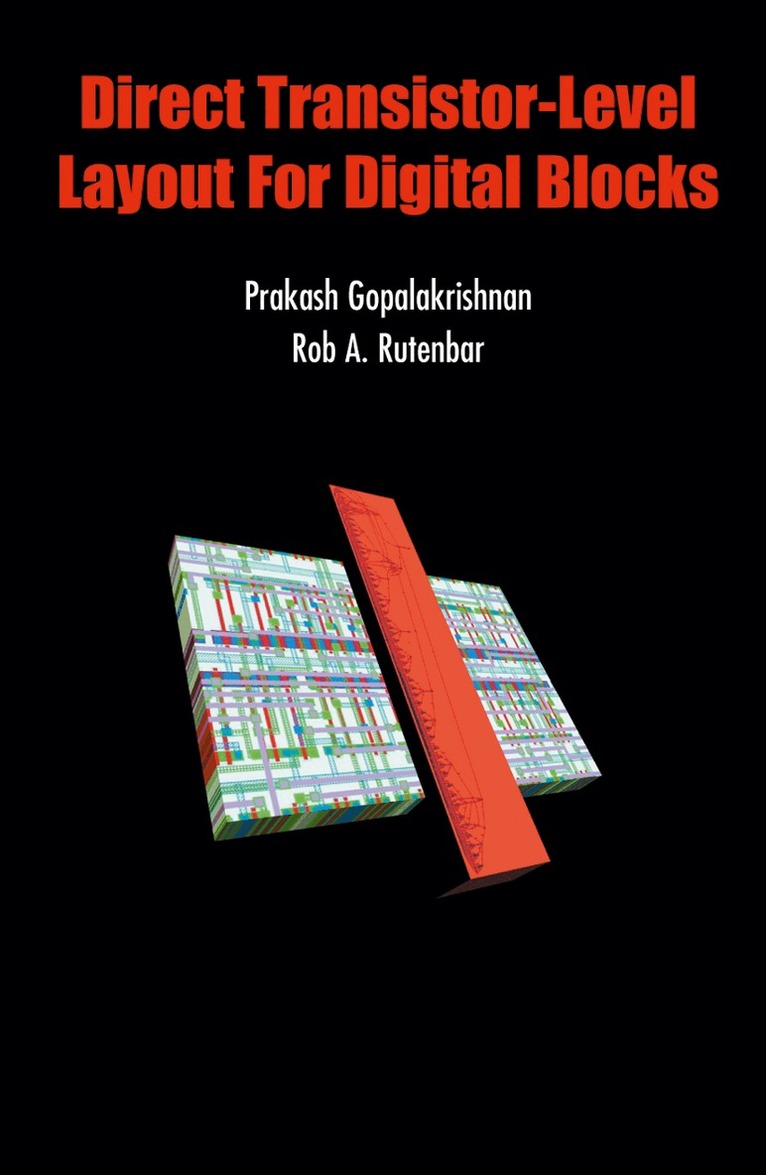
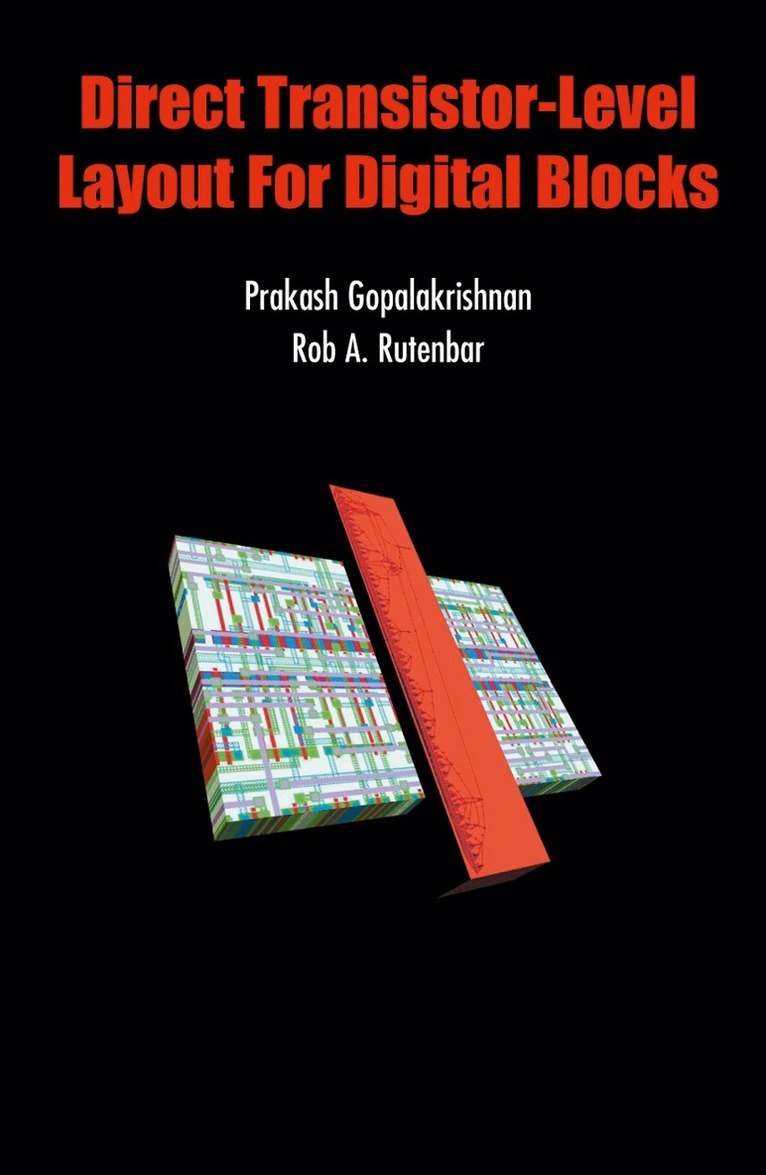
Cell-based design methodologies have dominated layout generation of digital circuits. Unfortunately, the growing demands for transparent process portability, increased performance, and low-level device sizing for timing/power are poorly handled in a fixed cell library. Direct Transistor-Level Layout For Digital Blocks proposes a direct transistor-level layout approach for small blocks of custom digital logic as an alternative that better accommodates demands for device-level flexibility. This approach captures essential shape-level optimizations, yet scales easily to netlists with thousands of devices, and incorporates timing optimization during layout. The key idea is early identification of essential diffusion-merged MOS device groups, and their preservation in an uncommitted geometric form until the very end of detailed placement. Roughly speaking, essential groups are extracted early from the transistor-level netlist, placed globally, optimized locally, and then finally committed each to a specific shape-level form while concurrently optimizing for both density and routability. The essential flaw in prior efforts is an over-reliance on geometric assumptions from large-scale cell-based layout algorithms. Individual transistors may seem simple, but they do not pack as gates do. Algorithms that ignore these shape-level issues suffer the consequences when thousands of devices are poorly packed. The approach described in this book can pack devices much more densely than a typical cell-based layout.Direct Transistor-Level Layout For Digital Blocks is a comprehensive reference work on device-level layout optimization, which will be valuable to CAD tool and circuit designers.
Inbunden, Engelska, 2010
1 616 kr
Skickas inom 10-15 vardagar
Knowledge exists: you only have to ?nd it VLSI design has come to an important in?ection point with the appearance of large manufacturing variations as semiconductor technology has moved to 45 nm feature sizes and below. If we ignore the random variations in the manufacturing process, simulation-based design essentially becomes useless, since its predictions will be far from the reality of manufactured ICs. On the other hand, using design margins based on some traditional notion of worst-case scenarios can force us to sacri?ce too much in terms of power consumption or manufacturing cost, to the extent of making the design goals even infeasible. We absolutely need to explicitly account for the statistics of this random variability, to have design margins that are accurate so that we can ?nd the optimum balance between yield loss and design cost. This discontinuity in design processes has led many researchers to develop effective methods of statistical design, where the designer can simulate not just the behavior of the nominal design, but the expected statistics of the behavior in manufactured ICs. Memory circuits tend to be the hardest hit by the problem of these random variations because of their high replication count on any single chip, which demands a very high statistical quality from the product. Requirements of 5–6s (0.
Häftad, Engelska, 2011
1 080 kr
Skickas inom 10-15 vardagar
In the early days of VLSI, the design of the power distribution for an integrated cir cuit was rather simple. Power distribution --the design of the geometric topology for the network of wires that connect the various power supplies, the widths of the indi vidual segments for each of these wires, the number and location of the power I/O pins around the periphery of the chip --was simple because the chips were simpler. Few available wiring layers forced floorplans that allowed simple, planar (non-over lapping) power networks. Lower speeds and circuit density made the choice of the wire widths easier: we made them just fat enough to avoid resistive voltage drops due to switching currents in the supply network. And we just didn't need enormous num bers of power and ground pins on the package for the chips to work. It's not so simple any more. Increased integration has forced us to focus on reliability concerns such as metal elec tromigration, which affects wire sizing decisions in the power network. Extra metal layers have allowed more flexibility in the topological layout of the power networks.
Häftad, Engelska, 2011
1 616 kr
Skickas inom 10-15 vardagar
This book, and the research it describes, resulted from a simple observation we made sometime in 1986. Put simply, we noticed that many VLSI design tools looked "alike". That is, at least at the overall software architecture level, the algorithms and data structures required to solve problem X looked much like those required to solve problem X'. Unfortunately, this resemblance is often of little help in actually writing the software for problem X' given the software for problem X. In the VLSI CAD world, technology changes rapidly enough that design software must continually strive to keep up. And of course, VLSI design software, and engineering design software in general, is often exquisitely sensitive to some aspects of the domain (technology) in which it operates. Modest changes in functionality have an unfortunate tendency to require substantial (and time-consuming) internal software modifications. Now, observing that large engineering software systems are technology dependent is not particularly clever. However, we believe that our approach to xiv Preface dealing with this problem took an interesting new direction. We chose to investigate the extent to which automatic programming ideas cold be used to synthesize such software systems from high-level specifications. This book is one of the results of that effort.
Del 263 - Springer International Series in Engineering and Computer Science
Analog Device-Level Layout Automation
Häftad, Engelska, 2012
1 616 kr
Skickas inom 10-15 vardagar
This book presents a detailed summary of research on automatic layout of device-level analog circuits that was undertaken in the late 1980s and early 1990s at Carnegie Mellon University. We focus on the work behind the creation of the tools called KOAN and ANAGRAM II, which form part of the core of the CMU ACACIA analog CAD system. KOAN is a device placer for custom analog cells; ANANGRAM II a detailed area router for these analog cells. We strive to present the motivations behind the architecture of these tools, including detailed discussion of the subtle technology and circuit concerns that must be addressed in any successful analog or mixed-signal layout tool. Our approach in organizing the chapters of the book has been to present our algo rithms as a series of responses to these very real and very difficult analog layout problems. Finally, we present numerous examples of results generated by our algorithms. This research was supported in part by the Semiconductor Research Corpora tion, by the National Science Foundation, by Harris Semiconductor, and by the International Business Machines Corporation Resident Study Program. Finally, just for the record: John Cohn was the designer of the KOAN placer; David Garrod was the designer of the ANAGRAM II router (and its predeces sor, ANAGRAM I). This book was architected by all four authors, edited by John Cohn and Rob Rutenbar, and produced in finished form by John Cohn.
Häftad, Engelska, 2012
1 616 kr
Skickas inom 10-15 vardagar
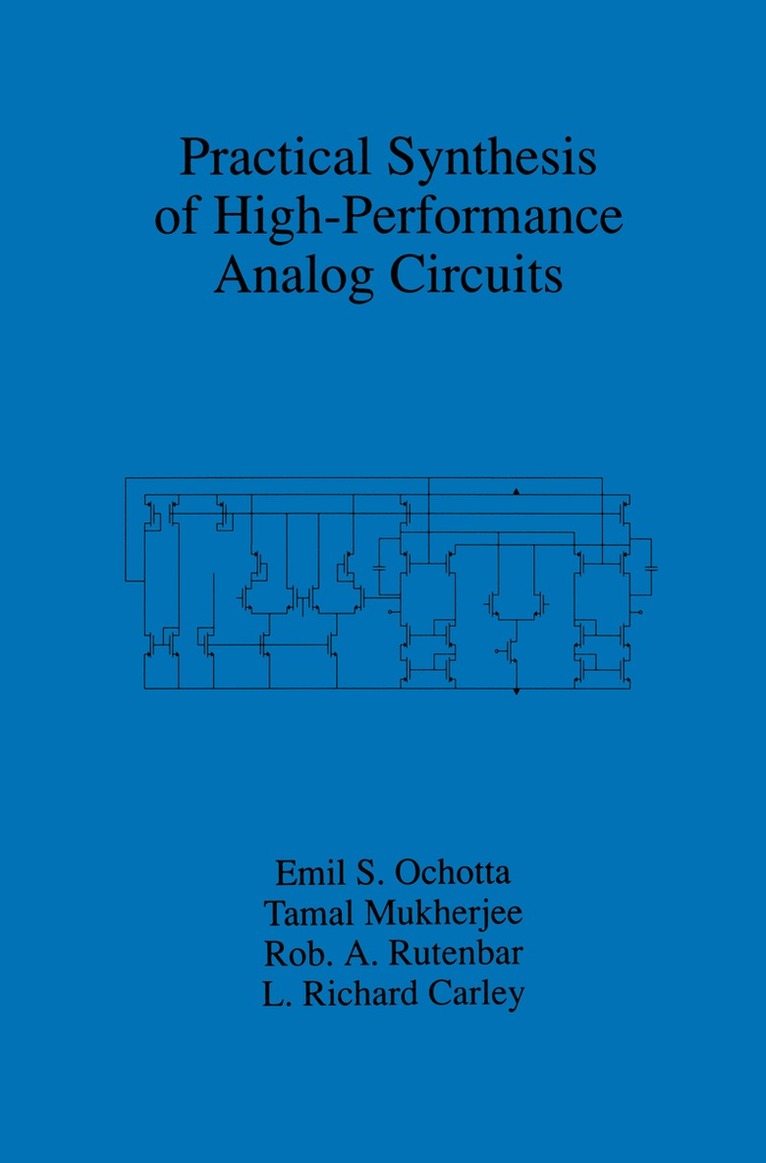
Practical Synthesis of High-Performance Analog Circuits presents a technique for automating the design of analog circuits. Market competition and the astounding pace of technological innovation exert tremendous pressure on circuit design engineers to turn ideas into products quickly and get them to market. In digital Application Specific Integrated Circuit (ASIC) design, computer aided design (CAD) tools have substantially eased this pressure by automating many of the laborious steps in the design process, thereby allowing the designer to maximise his design expertise. But the world is not solely digital. Cellular telephones, magnetic disk drives, neural networks and speech recognition systems are a few of the recent technological innovations that rely on a core of analog circuitry and exploit the density and performance of mixed analog/digital ASICs. To maximize profit, these mixed-signal ASICs must also make it to market as quickly as possible. However, although the engineer working on the digital portion of the ASIC can rely on sophisticated CAD tools to automate much of the design process, there is little help for the engineer working on the analog portion of the chip. With the exception of simulators to verify the circuit design when it is complete, there are almost no general purpose CAD tools that an analog design engineer can take advantage of to automate the analog design flow and reduce his time to market. Practical Synthesis of High-Performance Analog Circuits presents a new variation-tolerant analog synthesis strategy that is a significant step towards ending the wait for a practical analog synthesis tool. A new synthesis strategy is presented that can fully automate the path from a circuit topology and performance specifications to a sized variation-tolerant circuit schematic. This strategy relies on asymptotic waveform evaluation to predict circuit performance and simulated annealing to solve a novel non-linear infinite programming optimization formulation of the circuit synthesis problem via a sequence of smaller optimization problems. Practical Synthesis of High-Performance Analog Circuits will be of interest to analog circuit designers, CAD/EDA industry professionals, academics and students.
Häftad, Engelska, 2012
1 616 kr
Skickas inom 10-15 vardagar
Knowledge exists: you only have to ?nd it VLSI design has come to an important in?ection point with the appearance of large manufacturing variations as semiconductor technology has moved to 45 nm feature sizes and below. If we ignore the random variations in the manufacturing process, simulation-based design essentially becomes useless, since its predictions will be far from the reality of manufactured ICs. On the other hand, using design margins based on some traditional notion of worst-case scenarios can force us to sacri?ce too much in terms of power consumption or manufacturing cost, to the extent of making the design goals even infeasible. We absolutely need to explicitly account for the statistics of this random variability, to have design margins that are accurate so that we can ?nd the optimum balance between yield loss and design cost. This discontinuity in design processes has led many researchers to develop effective methods of statistical design, where the designer can simulate not just the behavior of the nominal design, but the expected statistics of the behavior in manufactured ICs. Memory circuits tend to be the hardest hit by the problem of these random variations because of their high replication count on any single chip, which demands a very high statistical quality from the product. Requirements of 5–6s (0.
Häftad, Engelska, 2013
1 080 kr
Skickas inom 10-15 vardagar
Cell-based design methodologies have dominated layout generation of digital circuits. Unfortunately, the growing demands for transparent process portability, increased performance, and low-level device sizing for timing/power are poorly handled in a fixed cell library. Direct Transistor-Level Layout For Digital Blocks proposes a direct transistor-level layout approach for small blocks of custom digital logic as an alternative that better accommodates demands for device-level flexibility. This approach captures essential shape-level optimizations, yet scales easily to netlists with thousands of devices, and incorporates timing optimization during layout. The key idea is early identification of essential diffusion-merged MOS device groups, and their preservation in an uncommitted geometric form until the very end of detailed placement. Roughly speaking, essential groups are extracted early from the transistor-level netlist, placed globally, optimized locally, and then finally committed each to a specific shape-level form while concurrently optimizing for both density and routability. The essential flaw in prior efforts is an over-reliance on geometric assumptions from large-scale cell-based layout algorithms. Individual transistors may seem simple, but they do not pack as gates do. Algorithms that ignore these shape-level issues suffer the consequences when thousands of devices are poorly packed. The approach described in this book can pack devices much more densely than a typical cell-based layout.Direct Transistor-Level Layout For Digital Blocks is a comprehensive reference work on device-level layout optimization, which will be valuable to CAD tool and circuit designers.
Inbunden, Engelska, 2009
1 071 kr
Skickas inom 10-15 vardagar
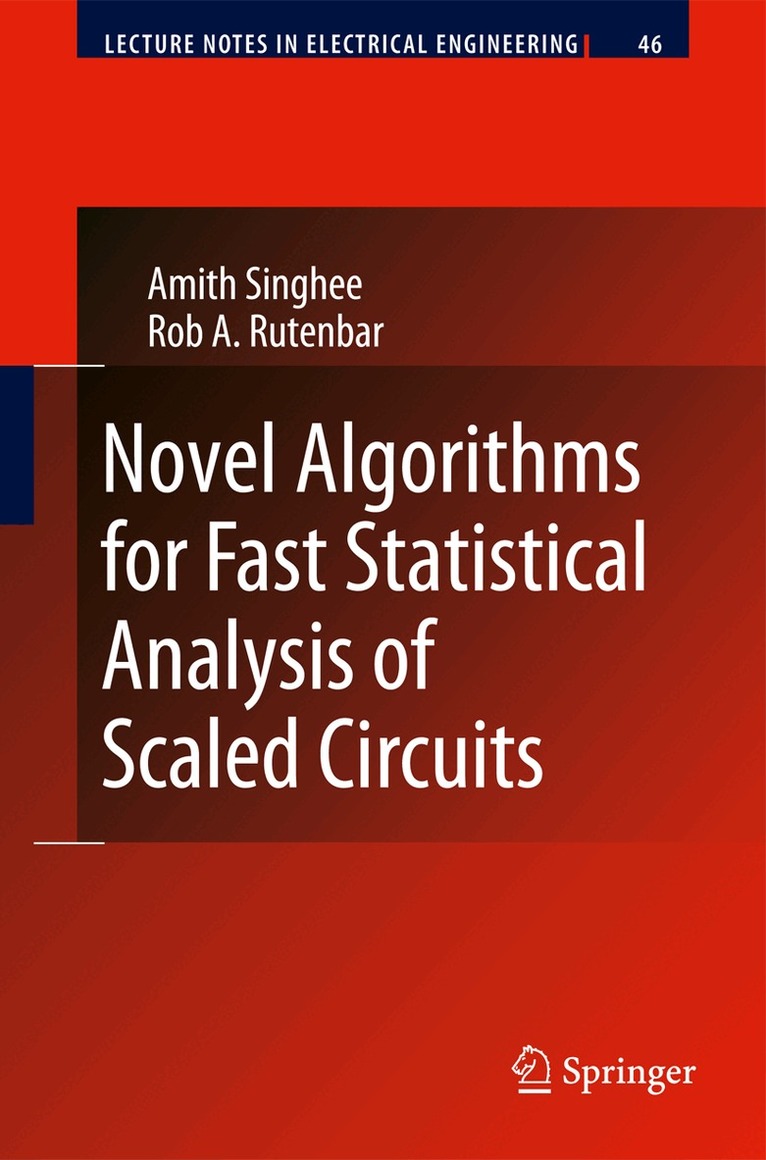
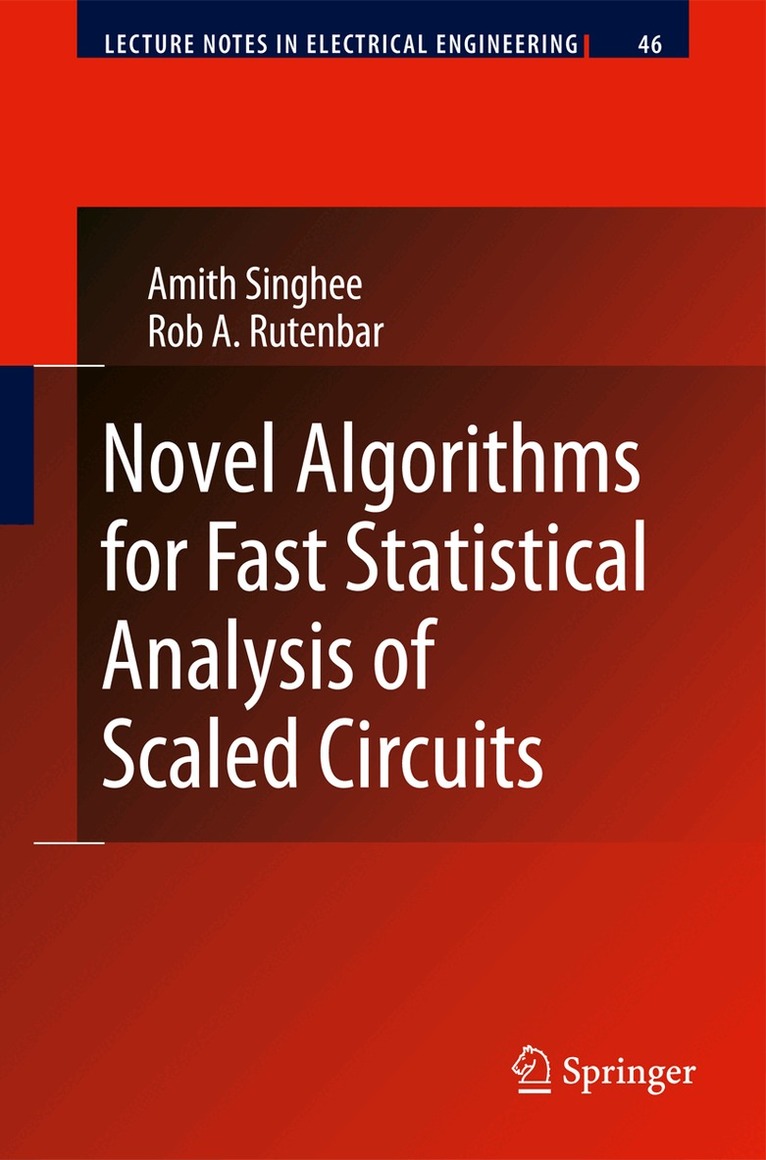
Novel Algorithms for Fast Statistical Analysis of Scaled Circuits draws upon ideas for attacking parallel problems in other technical fields, such as computational finance, machine learning and actuarial risk, and synthesizes them with innovative attacks for the problem domain of integrated circuits.
Del 46 - Lecture Notes in Electrical Engineering
Novel Algorithms for Fast Statistical Analysis of Scaled Circuits
Häftad, Engelska, 2012
1 071 kr
Skickas inom 10-15 vardagar
As VLSI technology moves to the nanometer scale for transistor feature sizes, the impact of manufacturing imperfections result in large variations in the circuit performance. Traditional CAD tools are not well-equipped to handle this scenario, since they do not model this statistical nature of the circuit parameters and performances, or if they do, the existing techniques tend to be over-simplified or intractably slow. Novel Algorithms for Fast Statistical Analysis of Scaled Circuits draws upon ideas for attacking parallel problems in other technical fields, such as computational finance, machine learning and actuarial risk, and synthesizes them with innovative attacks for the problem domain of integrated circuits. The result is a set of novel solutions to problems of efficient statistical analysis of circuits in the nanometer regime.