Robert E. Rhoads – författare
Visar alla böcker från författaren Robert E. Rhoads. Handla med fri frakt och snabb leverans.
16 produkter
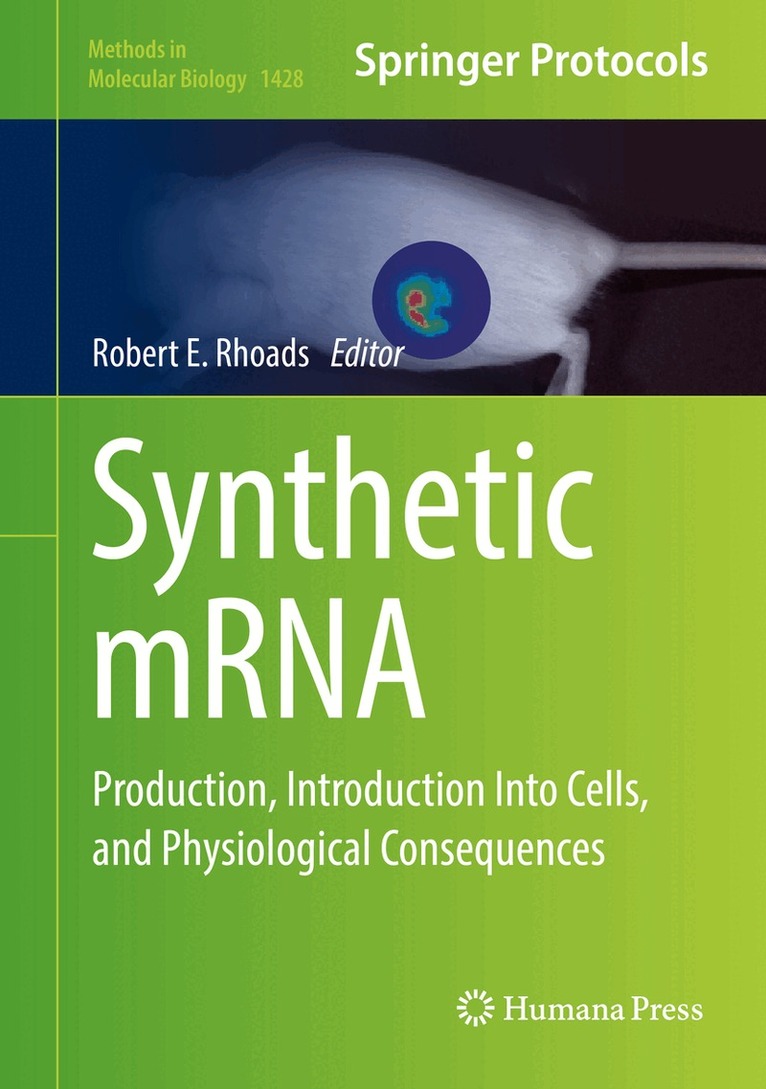
Synthetic mRNA
Production, Introduction Into Cells, and Physiological Consequences
Inbunden, 2016
1909 kr
Lägg i varukorg
This volumepresents detailed laboratory protocols for invitro synthesis of mRNA with favorable properties, its introduction intocells by a variety of techniques, and the measurement of physiological andclinical consequences such as protein replacement and cancer immunotherapy. Synthetictechniques …
Synthetic mRNA
Production, Introduction Into Cells, and Physiological Consequences
E-bok, 2016
1670 kr
Lägg i varukorg
This volumepresents detailed laboratory protocols for invitro synthesis of mRNA with favorable properties, its introduction intocells by a variety of techniques, and the measurement of physiological andclinical consequences such as protein replacement and cancer immunotherapy. Synthetictechniques …
Synthetic mRNA
Production, Introduction Into Cells, and Physiological Consequences
Häftad, 2018
1237 kr
Lägg i varukorg
This volumepresents detailed laboratory protocols for invitro synthesis of mRNA with favorable properties, its introduction intocells by a variety of techniques, and the measurement of physiological andclinical consequences such as protein replacement and cancer immunotherapy. Synthetictechniques …
Signaling Pathways for Translation
Insulin and Nutrients
Inbunden, 2001
1636 kr
Lägg i varukorg
This book deals with anabolic mechanisms which regulate eukaryotic protein synthesis, with particular emphasis on insulin and amino acids. Six chapters written by leading experts in the field provide both new data and comprehensive literature reviews. The regulation of both the eIF2 and eIF4 groups …
Signaling Pathways for Translation
Stress, Calcium, and Rapamycin
Inbunden, 2001
1636 kr
Lägg i varukorg
This volume presents the response of the eukaryotic translational apparatus to cellular stress and apoptosis, including kinases activated through both the ERK and stress-activated pathways. It further explores two agents that inhibit protein synthesis, calcium and the immunosuppressant rapamycin. …
miRNA Regulation of the Translational Machinery
Inbunden, 2009
1126 kr
Lägg i varukorg
An odd and unexpected finding was reported by the laboratory of Richard Jorgensen in 1990: expression of extra copies of the gene encoding chalone synthase in petunias turned off the endogenous chalone synthase gene. An observation that appeared totally unrelated was made by the laboratory of …
Signaling Pathways for Translation
Stress, Calcium, and Rapamycin
Häftad, 2010
1636 kr
Lägg i varukorg
This volume presents the response of the eukaryotic translational apparatus to cellular stress and apoptosis, including kinases activated through both the ERK and stress-activated pathways. It further explores two agents that inhibit protein synthesis, calcium and the immunosuppressant rapamycin. …
miRNA Regulation of the Translational Machinery
Häftad, 2012
1126 kr
Lägg i varukorg
An odd and unexpected finding was reported by the laboratory of Richard Jorgensen in 1990: expression of extra copies of the gene encoding chalone synthase in petunias turned off the endogenous chalone synthase gene. An observation that appeared totally unrelated was made by the laboratory of …
Signaling Pathways for Translation
Insulin and Nutrients
E-bok, 2012
2065 kr
Lägg i varukorg
The articles in the present volume are by major contributors to our under standing of signaling pathways affecting protein synthesis. They focus pri marily on two extracellular anabolic signals, although others are included as well. Insulin is one of the best-studied extracellular regulators of …
Signaling Pathways for Translation
Insulin and Nutrients
Häftad, 2012
1636 kr
Lägg i varukorg
The articles in the present volume are by major contributors to our under standing of signaling pathways affecting protein synthesis. They focus pri marily on two extracellular anabolic signals, although others are included as well. Insulin is one of the best-studied extracellular regulators of …
Proceedings of the Research Symposium on Complexes of Biologically Active Substances with Nucleic Acids and Their Modes of Action
Held at the Walter Reed Army Institute of Research Washington, 16–19 March 1970
E-bok, 2012
1502 kr
Lägg i varukorg
Proceedings of the Research Symposium on Complexes of Biologically Active Substances with Nucleic Acids and Their Modes of Action
Held at the Walter Reed Army Institute of Research Washington, 16–19 March 1970
Häftad, 2012
1126 kr
Lägg i varukorg
Signaling Pathways for Translation
Stress, Calcium, and Rapamycin
E-bok, 2013
2111 kr
Lägg i varukorg
This volume presents the response of the eukaryotic translational apparatus to cellular stress and apoptosis, including kinases activated through both the ERK and stress-activated pathways. It further explores two agents that inhibit protein synthesis, calcium and the immunosuppressant rapamycin. …