Robert Ford Campany - Böcker
Visar alla böcker från författaren Robert Ford Campany. Handla med fri frakt och snabb leverans.
10 produkter
10 produkter
1 612 kr
Skickas inom 7-10 vardagar
This innovative sourcebook builds a dynamic understanding of China's early medieval period (220-589) through an original selection and arrangement of literary, historical, religious, and critical texts. A tumultuous and formative era, these centuries saw the longest stretch of political fragmentation in China's imperial history, resulting in new ethnic configurations, the rise of powerful clans, and a pervasive divide between north and south. Deploying thematic categories, the editors sketch the period in a novel way for students and, by featuring many texts translated into English for the first time, recast the era for specialists. Thematic topics include regional definitions and tensions, governing mechanisms and social reality, ideas of self and other, relations with the unseen world, everyday life, and cultural concepts. Within each section, the editors and translators introduce the selected texts and provide critical commentary on their historical significance, along with suggestions for further reading and research.
412 kr
Skickas inom 7-10 vardagar
This innovative sourcebook builds a dynamic understanding of China's early medieval period (220-589) through an original selection and arrangement of literary, historical, religious, and critical texts. A tumultuous and formative era, these centuries saw the longest stretch of political fragmentation in China's imperial history, resulting in new ethnic configurations, the rise of powerful clans, and a pervasive divide between north and south. Deploying thematic categories, the editors sketch the period in a novel way for students and, by featuring many texts translated into English for the first time, recast the era for specialists. Thematic topics include regional definitions and tensions, governing mechanisms and social reality, ideas of self and other, relations with the unseen world, everyday life, and cultural concepts. Within each section, the editors and translators introduce the selected texts and provide critical commentary on their historical significance, along with suggestions for further reading and research.
506 kr
Skickas inom 7-10 vardagar
Dreaming is a near-universal human experience, but there is no consensus on why we dream or what dreams should be taken to mean. In this book, Robert Ford Campany investigates what people in late classical and early medieval China thought of dreams. He maps a common dreamscape—an array of ideas about what dreams are and what responses they should provoke—that underlies texts of diverse persuasions and genres over several centuries. These writings include manuals of dream interpretation, scriptural instructions, essays, treatises, poems, recovered manuscripts, histories, and anecdotes of successful dream-based predictions. In these many sources, we find culturally distinctive answers to questions peoples the world over have asked for millennia: What happens when we dream? Do dreams foretell future events? If so, how might their imagistic code be unlocked to yield predictions? Could dreams enable direct communication between the living and the dead, or between humans and nonhuman animals? The Chinese Dreamscape, 300 BCE – 800 CE sheds light on how people in a distant age negotiated these mysteries and brings Chinese notions of dreaming into conversation with studies of dreams in other cultures, ancient and contemporary. Taking stock of how Chinese people wrestled with—and celebrated—the strangeness of dreams, Campany asks us to reflect on how we might reconsider our own notions of dreaming.
Del 122 - Harvard-Yenching Institute Monograph Series
Chinese Dreamscape, 300 BCE–800 CE
Häftad, Engelska, 2020
279 kr
Skickas inom 7-10 vardagar
Winner of the Stanislas Julien PrizeWinner of the Joseph Levenson Prize for Scholarship on Pre-1900 ChinaDreaming is a near-universal human experience, but there is no consensus on why we dream or what dreams should be taken to mean. In this book, Robert Ford Campany investigates what people in late classical and early medieval China thought of dreams. He maps a common dreamscape—an array of ideas about what dreams are and what responses they should provoke—that underlies texts of diverse persuasions and genres over several centuries. These writings include manuals of dream interpretation, scriptural instructions, essays, treatises, poems, recovered manuscripts, histories, and anecdotes of successful dream-based predictions.In these many sources, we find culturally distinctive answers to questions peoples the world over have asked for millennia: What happens when we dream? Do dreams foretell future events? If so, how might their imagistic code be unlocked to yield predictions? Could dreams enable direct communication between the living and the dead, or between humans and nonhuman animals? The Chinese Dreamscape, 300 BCE–800 CE sheds light on how people in a distant age negotiated these mysteries and brings Chinese notions of dreaming into conversation with studies of dreams in other cultures, ancient and contemporary. Taking stock of how Chinese people wrestled with—and celebrated—the strangeness of dreams, Campany asks us to reflect on how we might reconsider our own notions of dreaming.
Del 138 - Harvard-Yenching Institute Monograph Series
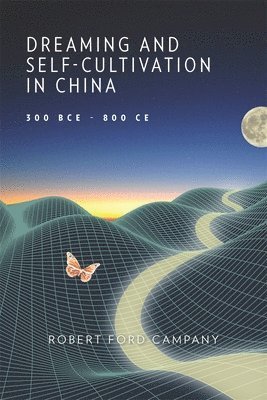
Dreaming and Self-Cultivation in China, 300 BCE–800 CE
Inbunden, Engelska, 2023
479 kr
Skickas inom 7-10 vardagar
Practitioners of any of the paths of self-cultivation available in ancient and medieval China engaged daily in practices meant to bring their bodies and minds under firm control. They took on regimens to discipline their comportment, speech, breathing, diet, senses, desires, sexuality, even their dreams. Yet, compared with waking life, dreams are incongruous, unpredictable—in a word, strange. How, then, did these regimes of self-fashioning grapple with dreaming, a lawless yet ubiquitous domain of individual experience?In Dreaming and Self-Cultivation in China, 300 BCE–800 CE, Robert Ford Campany examines how dreaming was addressed in texts produced and circulated by practitioners of Daoist, Buddhist, Confucian, and other self-cultivational disciplines. Working through a wide range of scriptures, essays, treatises, biographies, commentaries, fictive dialogues, diary records, interpretive keys, and ritual instructions, Campany uncovers a set of discrete paradigms by which dreams were viewed and responded to by practitioners. He shows how these paradigms underlay texts of diverse religious and ideological persuasions that are usually treated in mutual isolation. The result is a provocative meditation on the relationship between individuals’ nocturnal experiences and one culture’s persistent attempts to discipline, interpret, and incorporate them into waking practice.
Del 138 - Harvard-Yenching Institute Monograph Series
Dreaming and Self-Cultivation in China, 300 BCE–800 CE
Häftad, Engelska, 2023
266 kr
Skickas inom 7-10 vardagar
Practitioners of any of the paths of self-cultivation available in ancient and medieval China engaged daily in practices meant to bring their bodies and minds under firm control. They took on regimens to discipline their comportment, speech, breathing, diet, senses, desires, sexuality, even their dreams. Yet, compared with waking life, dreams are incongruous, unpredictable—in a word, strange. How, then, did these regimes of self-fashioning grapple with dreaming, a lawless yet ubiquitous domain of individual experience?In Dreaming and Self-Cultivation in China, 300 BCE–800 CE, Robert Ford Campany examines how dreaming was addressed in texts produced and circulated by practitioners of Daoist, Buddhist, Confucian, and other self-cultivational disciplines. Working through a wide range of scriptures, essays, treatises, biographies, commentaries, fictive dialogues, diary records, interpretive keys, and ritual instructions, Campany uncovers a set of discrete paradigms by which dreams were viewed and responded to by practitioners. He shows how these paradigms underlay texts of diverse religious and ideological persuasions that are usually treated in mutual isolation. The result is a provocative meditation on the relationship between individuals’ nocturnal experiences and one culture’s persistent attempts to discipline, interpret, and incorporate them into waking practice.
1 215 kr
Tillfälligt slut
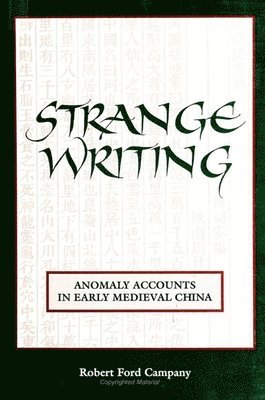
The first comprehensive, Western-language study of the important Chinese genre of writing known as "accounts of the anomalies" (zhiguai) in its formative period. The book sets forth a new view of the nature and origins of the genreBetween the Han dynasty, founded in 206 B.C.E., and the Sui, which ended in 618 C.E., Chinese authors wrote many thousands of short textual items, each of which narrated or described some phenomenon deemed "strange." Most items told of encounters between humans and various denizens of the spirit-world, or of the miraculous feats of masters of esoteric arts; some described the wonders of exotic lands, or transmitted fragments of ancient mythology. This genre of writing came to be known as zhiguai ("accounts of anomalies").Who were the authors of these books, and why did they write of these "strange" matters? Why was such writing seen as a compelling thing to do? In this book, the first comprehensive study in a Western language of the zhiguai genre in its formative period, Campany sets forth a new view of the nature of the genre and the reasons for its emergence. He shows that contemporaries portrayed it as an extension of old royal and imperial traditions in which strange reports from the periphery were collected in the capital as a way of ordering the world. He illuminates how authors writing from most of the religious and cultural perspectives of the times-including Daoists, Buddhists, Confucians, and others-used the genre differently for their own persuasive purposes, in the process fundamentally altering the old traditions of anomaly-collecting. Analyzing the "accounts of anomalies" both in the context of Chinese religious and cultural history and as examples of a cross-culturally attested type of discourse, Campany combines in-depth Sinological research with broad-ranging comparative thinking in his approach to these puzzling, rich texts.
501 kr
Tillfälligt slut
The first comprehensive, Western-language study of the important Chinese genre of writing known as "accounts of the anomalies" (zhiguai) in its formative period. The book sets forth a new view of the nature and origins of the genreBetween the Han dynasty, founded in 206 B.C.E., and the Sui, which ended in 618 C.E., Chinese authors wrote many thousands of short textual items, each of which narrated or described some phenomenon deemed "strange." Most items told of encounters between humans and various denizens of the spirit-world, or of the miraculous feats of masters of esoteric arts; some described the wonders of exotic lands, or transmitted fragments of ancient mythology. This genre of writing came to be known as zhiguai ("accounts of anomalies").Who were the authors of these books, and why did they write of these "strange" matters? Why was such writing seen as a compelling thing to do? In this book, the first comprehensive study in a Western language of the zhiguai genre in its formative period, Campany sets forth a new view of the nature of the genre and the reasons for its emergence. He shows that contemporaries portrayed it as an extension of old royal and imperial traditions in which strange reports from the periphery were collected in the capital as a way of ordering the world. He illuminates how authors writing from most of the religious and cultural perspectives of the times-including Daoists, Buddhists, Confucians, and others-used the genre differently for their own persuasive purposes, in the process fundamentally altering the old traditions of anomaly-collecting. Analyzing the "accounts of anomalies" both in the context of Chinese religious and cultural history and as examples of a cross-culturally attested type of discourse, Campany combines in-depth Sinological research with broad-ranging comparative thinking in his approach to these puzzling, rich texts.
204 kr
Skickas inom 7-10 vardagar
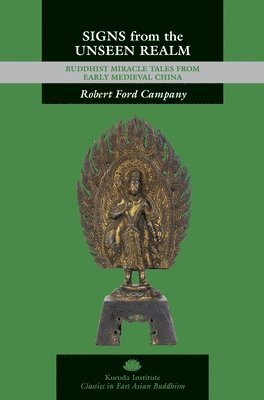
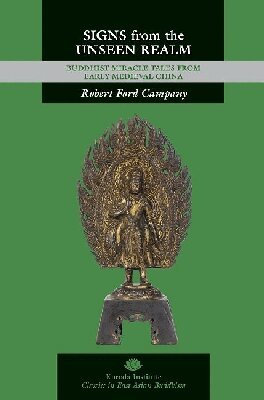
In early medieval China hundreds of Buddhist miracle texts were circulated, inaugurating a trend that would continue for centuries. Each tale recounted extraordinary events involving Chinese persons and places—events seen as verifying claims made in Buddhist scriptures, demonstrating the reality of karmic retribution, or confirming the efficacy of Buddhist devotional practices. Robert Ford Campany, one of North America’s preeminent scholars of Chinese religion, presents in this volume the first complete, annotated translation, with in-depth commentary, of the largest extant collection of miracle tales from the early medieval period, Wang Yan’s Records of Signs from the Unseen Realm, compiled around 490 C.E.In addition to the translation, Campany provides a substantial study of the text and its author in their historical and religious settings. He shows how these lively tales helped integrate Buddhism into Chinese society at the same time that they served as platforms for religious contestation and persuasion. Campany offers a nuanced, clear methodological discussion of how such narratives, being products of social memory, may be read as valuable evidence for the history of religion and culture.Readers interested in Buddhism; historians of Chinese religions, culture, society, and literature; scholars of comparative religion: All will find Signs from the Unseen Realm a stimulating and rich contribution to scholarship.
681 kr
Kommande
By the middle of the third century BCE, some people in China had begun to imagine it possible to employ esoteric methods to refashion themselves into posthuman beings with spirit-like capabilities, enhanced bodies, and greatly extended lifespans. Such beings were termed transcendents (xian 仙). Traditions of Exemplary Transcendents (Liexian zhuan 列仙傳), attributed to the imperial bibliographer Liu Xiang 劉向 (79-8 BCE), is the earliest extant collection of colorful stories about such figures. This volume makes available a critical edition and the first complete, annotated English translation of a text preserving some of the earliest mentions of alchemical, dietary, and medicinal methods of self-cultivation that later became standard in transcendence-seekers’ repertoire of practices. Through this work we can already glimpse the sorts of engagements with local communities that made the quest for transcendence a matter of keen interest not just to practitioners themselves but to many in Chinese society for centuries thereafter.