Robert Gascoigne - Böcker
Visar alla böcker från författaren Robert Gascoigne. Handla med fri frakt och snabb leverans.
5 produkter
5 produkter
455 kr
Skickas inom 7-10 vardagar
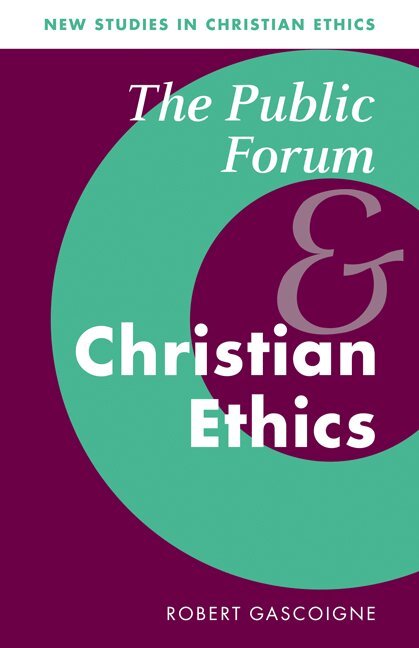
This book addresses the question of the communication of Christian ethics in the public forum of liberal, pluralist societies. Drawing on debates in philosophy, theology and sociological theory, it relates the problem of communication to fundamental questions about the nature of liberal societies and the identity of Christian faith and the Christian community. With particular emphasis on Kantian and neo-Kantian ethics, it explores the link between autonomy and community in liberal societies. The theology of communio, expressed in revealed Christian traditions, can reconcile autonomy and community. Any Christian attempt to communicate this vision must also reflect on Christianity's own identity, especially the ways in which its own self-consciousness grows in critical interaction with secularity. In this light, Christian ethical communication is both a witness to a distinctive identity, founded in the revelation of the triune God, and a vision of universal human solidarity which can reconcile autonomy and community.
Del 19 - New Studies in Christian Ethics
The Public Forum and Christian Ethics
Inbunden, Engelska, 2000
1 192 kr
Skickas inom 7-10 vardagar
This book addresses the question of the communication of Christian ethics in the public forum of liberal, pluralist societies. Drawing on debates in philosophy, theology and sociological theory, it relates the problem of communication to fundamental questions about the nature of liberal societies and the identity of Christian faith and the Christian community. With particular emphasis on Kantian and neo-Kantian ethics, it explores the link between autonomy and community in liberal societies. The theology of communio, expressed in revealed Christian traditions, can reconcile autonomy and community. Any Christian attempt to communicate this vision must also reflect on Christianity's own identity, especially the ways in which its own self-consciousness grows in critical interaction with secularity. In this light, Christian ethical communication is both a witness to a distinctive identity, founded in the revelation of the triune God, and a vision of universal human solidarity which can reconcile autonomy and community.
957 kr
Skickas inom 3-6 vardagar
Western liberal societies are characterized by two stories: a positive story of freedom of conscience and the recognition of community and human rights, and a negative story of unrestrained freedom that leads to self-centeredness, vacuity, and the destructive compromise of human values. Can the Catholic Church play a more meaningful role in assisting liberal societies in telling their better story? Australian ethicist Robert Gascoigne thinks it can. In "The Church and Secularity" he considers the meaning of secularity as a shared space for all citizens and asks how the Church can contribute to a sensitivity to - and respect for - human dignity and human rights. Drawing on Augustine's "City of God" and "Vatican II's Gaudium et spes", Gascoigne interprets the meaning of freedom in liberal societies through the lens of Augustine's "two loves," the love of God and neighbor and the love of self, and reveals how the two are connected to our contemporary experience."The Church and Secularity" argues that the Church can serve liberal societies in a positive way and that its own social identity, rooted in Eucharistic communities, must be bound up with the struggle for human rights and resistance to the commodification of the human in all its forms.
Religion, Rationality and Community
Sacred and secular in the thought of Hegel and his critics
Inbunden, Engelska, 1985
1 059 kr
Skickas inom 10-15 vardagar
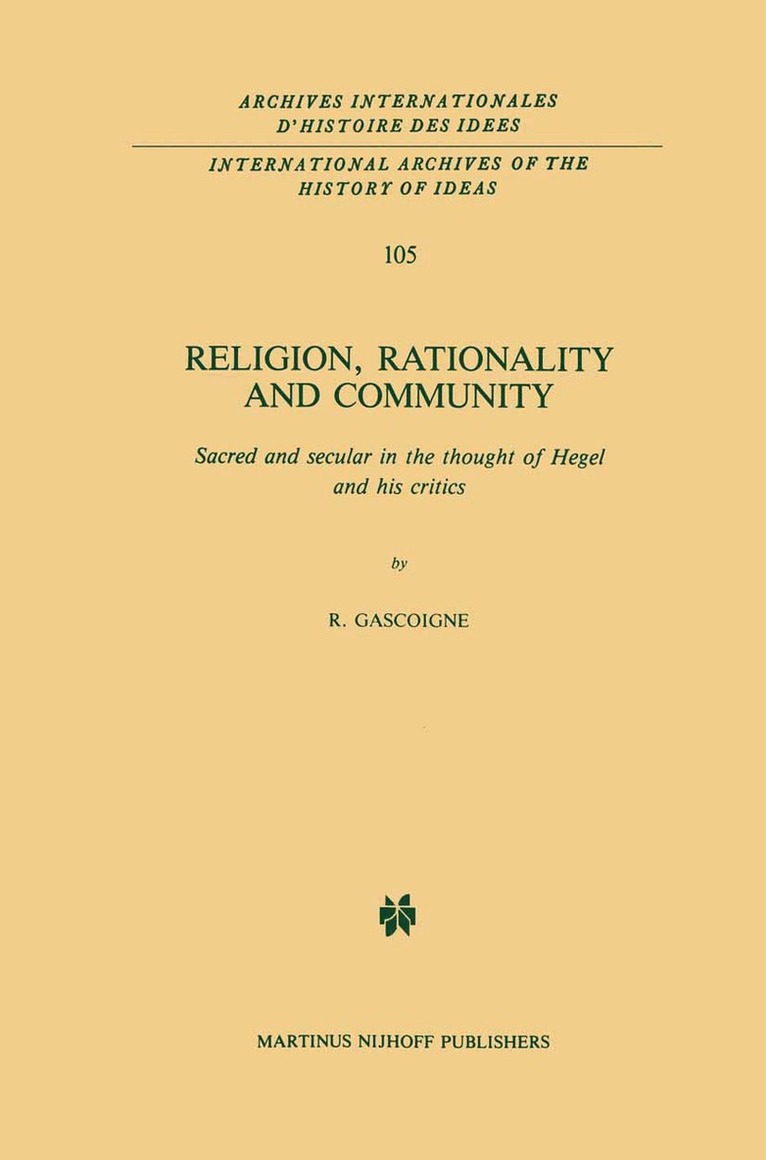
This study is an attempt to examine the relationships between religious belief and the humanism of the Enlightenment in the philosophy of Hegel and of a group of thinkers who related to his thought in various ways during the 1840's. It begins with a study of the ways in which Hegel attempted to evolve a genuinely Christian humanism by his demonstration that the modern understanding of man as a free and rational subject derived its strength and validity from the union of God and human existence in the incarnation. The rest of this study is con cerned with two different forms of opposition to Hegel: first, the criti cal discipleship of the Young Hegelians and Moses Hess, who insisted that Hegel's notion of Christian humanism was false because religious belief was necessarily inimical to a clear consciousness of social evil and the determination to abolish it; second, the religious opposition to the Enlightenment in the thought of Schelling and Kierkegaard, which emphasized God's transcendence to human reason and the insig nificance of secular history. In the years leading up to the revolution of 1848, Hegel's synthesis was rejected in favour of the assertion of atheistic humanism or religious otherworldliness. Chapter One, after discussing the young Hegel's critique of the social and political effects of Christianity, examines the union of religi ous belief, speculative philosophy and the rational state in Hegel's mature system.
Religion, Rationality and Community
Sacred and secular in the thought of Hegel and his critics
Häftad, Engelska, 2011
1 059 kr
Skickas inom 10-15 vardagar
This study is an attempt to examine the relationships between religious belief and the humanism of the Enlightenment in the philosophy of Hegel and of a group of thinkers who related to his thought in various ways during the 1840's. It begins with a study of the ways in which Hegel attempted to evolve a genuinely Christian humanism by his demonstration that the modern understanding of man as a free and rational subject derived its strength and validity from the union of God and human existence in the incarnation. The rest of this study is con cerned with two different forms of opposition to Hegel: first, the criti cal discipleship of the Young Hegelians and Moses Hess, who insisted that Hegel's notion of Christian humanism was false because religious belief was necessarily inimical to a clear consciousness of social evil and the determination to abolish it; second, the religious opposition to the Enlightenment in the thought of Schelling and Kierkegaard, which emphasized God's transcendence to human reason and the insig nificance of secular history. In the years leading up to the revolution of 1848, Hegel's synthesis was rejected in favour of the assertion of atheistic humanism or religious otherworldliness. Chapter One, after discussing the young Hegel's critique of the social and political effects of Christianity, examines the union of religi ous belief, speculative philosophy and the rational state in Hegel's mature system.