Robert H. Webb - Böcker
Visar alla böcker från författaren Robert H. Webb. Handla med fri frakt och snabb leverans.
9 produkter
9 produkter
250 kr
Tillfälligt slut
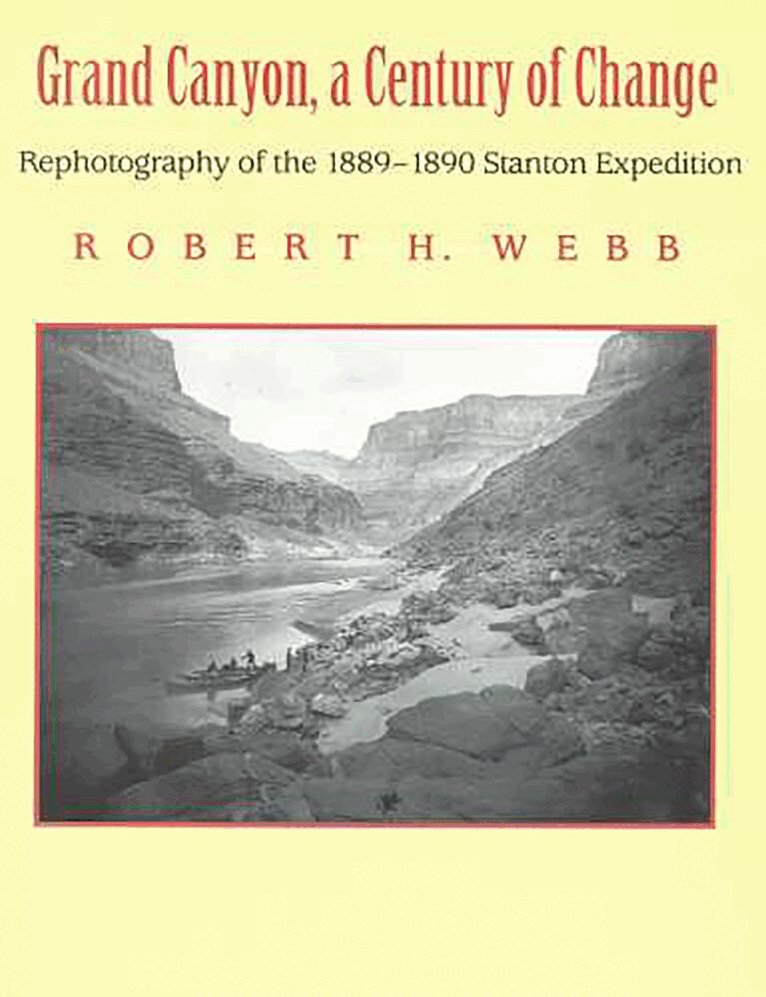
Grand Canyon, a Century of Change
Rephotography of the 1889-1890 Stanton Expedition
Häftad, Engelska, 1996
433 kr
Skickas inom 3-6 vardagar
Photographs made in Grand Canyon a century ago may provide us today with a sense of history; photographs made a century later from the same vantage points give us a more precise picture of change in this seemingly timeless place. Between 1889 and 1890, Robert Brewster Stanton made photographs every 1-2 miles through the river corridor for the purpose of planning a water-level railroad route and produced the largest collection of photographs of the Colorado River at one point in time. Robert Webb, a USGS hydrologist conducting research on debris flows in the Canyon, obtained the photographs and from 1989 to 1995 replicated all 445 of the views captured by Stanton, matching as closely as possible the original camera positions and lighting conditions. Grand Canyon, a Century of Change assembles the most dramatic of these paired photographs to demonstrate both the persistence of nature and the presence of humanity. Unexpected longevity of some plant species, effects of animal grazing, and expansion of cacti are all captured by the replicate photographs. More telling is evidence of the impact of Glen Canyon Dam: increased riparian vegetation, new marshes, aggraded debris fans, and eroded sand bars. In the accompanying text, Webb provides a thorough analysis of what each pair of photographs shows and places the project in its historical context. Complementing his narrative are six sidebar articles by authorities on Canyon natural history that further attest to a century of change. The level of detail obtained from the photographs represents one of the most extensive long-term monitoring efforts ever conducted in a national park; it is the most detailed documentation effort ever performed using repeat photography. Much more than simply a picture book, Grand Canyon, a Century of Change is an environmental history of the river corridor, a fascinating book that clearly shows the impact of human influence on Grand Canyon and warns us that its future is very much in our hands.
875 kr
Skickas inom 11-20 vardagar
In prehistoric times, the Santa Cruz River in what is now southern Arizona saw many ebbs, flows, and floods. It flowed on the surface, meandered across the floodplain, and occasionally carved deep channels or arroyos into valley fill. Groundwater was never far from the surface, in places outcropping to feed marshlands or cienegas. In these wet places, arroyos would heal quickly as the river channel revegetated, the thriving vegetation trapped sediment, and the channel refilled. As readers of Requiem for the Santa Cruz learn, these aridland geomorphic processes also took place in the valley as Tucson grew from mud-walled village to modern metropolis, with one exception: historical water development and channel changes proceeded hand in glove, each taking turns reacting to the other, eventually lowering the water table and killing a unique habitat that can no longer recover or be restored.Authored by an esteemed group of scientists, Requiem for the Santa Cruz thoroughly documents this river—the premier example of historic arroyo cutting during the late nineteenth and early twentieth centuries, when large floodflows cut down through unconsolidated valley fill to form deep channels in the major valleys of the American Southwest. Each chapter provides a unique opportunity to chronicle the arroyo legacy, evaluate its causes, and consider its aftermath. Using more than a century of observations and collections, the authors reconstruct the circumstances of the river's entrenchment and the groundwater mining that ultimately killed the marshlands, a veritable mesquite forest, and a birdwatcher's paradise.Today, communities everywhere face this conundrum: do we manage ephemeral rivers through urban areas for flood control, or do we attempt to restore them to some previous state of naturalness? Requiem for the Santa Cruz carefully explores the legacies of channel change, groundwater depletion, flood control, and nascent attempts at river restoration to give a long-term perspective on management of rivers in arid lands. Tied together by authors who have committed their life's work to the study of aridland rivers, this book offers a touching and scientifically grounded requiem for the Santa Cruz and every southwestern river.
455 kr
Tillfälligt slut
482 kr
Tillfälligt slut
1 224 kr
Skickas inom 10-15 vardagar
The modern southwestern cities of Phoenix, Tucson, Las Vegas, Albuquerque, and El Paso occupy lands that once supported rich desert ecosystems. Typical development activities often resulted in scraping these desert lands of an ancient living landscape, to be replaced with one that is human-made and dependent on a large consumption of energy and natural resources. Design with the Desert: Conservation and Sustainable Development explores the natural and built environment of the American Southwest and introduces development tools for shaping the future of the region in a more sustainable way.Explore the Desert Landscape and EcologyThis transdisciplinary collaboration draws on insights from leading authorities in their fields, spanning science, ecology, planning, landscape development, architecture, and urban design. Organized into five parts, the book begins by introducing the physical aspects of the desert realm: the land, geology, water, and climate. The second part deals with the "living" and ecological aspects, from plants and animals to ecosystems. The third part, on planning in the desert, covers the ecological and social issues surrounding water, natural resource planning, and community development.Bring the Desert into the CityThe fourth part looks at how to bring nature into the built environment through the use of native plants, the creation of habitats for nature in urban settings, and the design of buildings, communities, and projects that create life. The final part of the book focuses on urban sustainability and how to design urban systems that provide a secure future for community development. Topics include water security, sustainable building practices, and bold architecture and community designs.Design Solutions That Work with the Local EnvironmentThis book will inspire discussion and contemplation for anyone interested in desert development, from developers and environmentalists to planners, community leaders, and those who live in desert regions. Throughout this volume, the contributors present solutions to help promote ecological balance between nature and the built environment in the American Southwest—and offer valuable insights for other ecologically fragile regions around the world.
Debris flows from tributaries of the Colorado River, Grand Canyon National Park, Arizona
USGS Professional Paper 1492
Häftad, Engelska, 2013
276 kr
Skickas inom 3-6 vardagar
2 968 kr
Skickas inom 7-10 vardagar
The modern southwestern cities of Phoenix, Tucson, Las Vegas, Albuquerque, and El Paso occupy lands that once supported rich desert ecosystems. Typical development activities often resulted in scraping these desert lands of an ancient living landscape, to be replaced with one that is human-made and dependent on a large consumption of energy and natural resources. Design with the Desert: Conservation and Sustainable Development explores the natural and built environment of the American Southwest and introduces development tools for shaping the future of the region in a more sustainable way.Explore the Desert Landscape and EcologyThis transdisciplinary collaboration draws on insights from leading authorities in their fields, spanning science, ecology, planning, landscape development, architecture, and urban design. Organized into five parts, the book begins by introducing the physical aspects of the desert realm: the land, geology, water, and climate. The second part deals with the "living" and ecological aspects, from plants and animals to ecosystems. The third part, on planning in the desert, covers the ecological and social issues surrounding water, natural resource planning, and community development.Bring the Desert into the CityThe fourth part looks at how to bring nature into the built environment through the use of native plants, the creation of habitats for nature in urban settings, and the design of buildings, communities, and projects that create life. The final part of the book focuses on urban sustainability and how to design urban systems that provide a secure future for community development. Topics include water security, sustainable building practices, and bold architecture and community designs.Design Solutions That Work with the Local EnvironmentThis book will inspire discussion and contemplation for anyone interested in desert development, from developers and environmentalists to planners, community leaders, and those who live in desert regions. Throughout this volume, the contributors present solutions to help promote ecological balance between nature and the built environment in the American Southwest—and offer valuable insights for other ecologically fragile regions around the world.
761 kr
Skickas inom 11-20 vardagar
First developed in the 1880s, repeat photography remains an important and cost-effective technique for scientists working to track and study landscape change. This volume explores the technical and geographic scope of this important technique. "Repeat Photography" demonstrates the wide range of potential applications, examines new techniques for acquiring data from repeat photography, and clearly shows that repeat photography remains a valuable, and cost-effective means of monitoring change in both developed and developing regions. Over 100 sets of photographs serve as examples. Recent concerns about climate change and its effects on natural landscapes, combined with ongoing concerns about land-use practices, make this state-of-the-art review a timely contribution to the literature.