Robert Johansson – författare
428 kr
Skickas inom 5-8 vardagar
443 kr
Skickas
305 kr
Skickas inom 3-6 vardagar
285 kr
Skickas inom 3-6 vardagar
708 kr
Läs direkt efter köp
Numerical Python by Robert Johansson shows you how to leverage the numerical and mathematical modules in Python and its Standard Library as well as popular open source numerical Python packages like NumPy, FiPy, matplotlib and more to numerically compute solutions and mathematically model applications in a number of areas like big data, cloud computing, financial engineering, business management and more.
After reading and using this book, you''ll get some takeaway case study examples of applications that can be found in areas like business management, big data/cloud computing, financial engineering (i.e., options trading investment alternatives), and even games.
Up until very recently, Python was mostly regarded as just a web scripting language. Well, computational scientists and engineers have recently discovered the flexibility and power of Python to do more. Big data analytics and cloud computing programmers are seeing Python''s immense use. Financial engineers are also now employing Python in their work. Python seems to be evolving as a language that can even rival C++, Fortran, and Pascal/Delphi for numerical and mathematical computations.
865 kr
Läs direkt efter köp
Leverage the numerical and mathematical modules in Python and its standard library as well as popular open source numerical Python packages like NumPy, SciPy, FiPy, matplotlib and more. This fully revised edition, updated with the latest details of each package and changes to Jupyter projects, demonstrates how to numerically compute solutions and mathematically model applications in big data, cloud computing, financial engineering, business management and more.
Numerical Python, Second Edition, presents many brand-new case study examples of applications in data science and statistics using Python, along with extensions to many previous examples. Each of these demonstrates the power of Python for rapid development and exploratory computing due to its simple and high-level syntax and multiple options for data analysis.
After reading this book, readers will be familiar with many computing techniques including array-based and symbolic computing, visualization and numerical file I/O, equation solving, optimization, interpolation and integration, and domain-specific computational problems, such as differential equation solving, data analysis, statistical modeling and machine learning.
What You''ll Learn
Work with vectors and matrices using NumPyPlot and visualize data with MatplotlibPerform data analysis tasks with Pandas and SciPyReview statistical modeling and machine learning with statsmodels and scikit-learnOptimize Python code using Numba and CythonWho This Book Is ForDevelopers who want to understand how to use Python and its related ecosystem for numerical computing.453 kr
Skickas
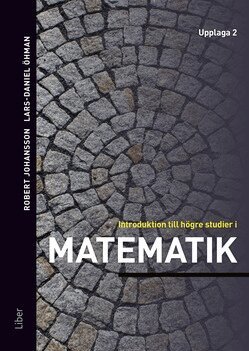
Denna lärobok är i första hand en introduktion till matematikstudier på universitetsnivå. Bevis ingår som en central del och boken lägger stor vikt vid att förmedla och lära ut innebörden av matematiska begrepp. Boken innehåller därför utförliga förklaringar och exempel, och presenterar ofta metoder och formler från flera olika synvinklar. Boken repeterar även valda delar av gymnasiets matematikkurser, men behandlar matematiken på ett mer stringent sätt.
En vanlig missuppfattning är att matematik bara handlar om tal och beräkningar. I denna bok tar författarna fasta på att resonemang och argumentation är en minst lika viktig del av matematiken. Boken riktar sig i första hand till nybörjarstudenter på civilingenjörsutbildningar och kandidat- eller magisterprogram i matematik, matematisk statistik och närliggande ämnen.
Sagt om bokenBokens layout är ändamålsenlig och de välmotiverade svartvita illustrationerna tydliga. Ett bra sakregister kompletterar. Andra gymnasierepetitionsböcker finns – denna är en av de mer lättförståeliga, och lämplig både i lärarledd undervisning och för självstudier." Ola Svärd, lektör, BTJ-häftet nr 23, 2017.
Om författarnaRobert Johansson är lektor i matematik och prefekt för institutionen för matematik och matematisk statistik vid Umeå universitet. Han har ett brett intresse för matematik och gränslandet mellan matematik och datavetenskap. Han har tidigare som studierektor varit involverad i utvecklings- och kvalitetsarbete inom grundutbildningen, och är utnämnd till meriterad lärare. Lars-Daniel Öhman är docent och lektor i matematik vid Umeå universitet. Utöver sin egen forskning och undervisning är han engagerad i didaktiska och populärvetenskapliga frågor, kursutveckling samt utveckling av kursmaterial, och är utnämnd till excellent lärare.
364 kr
441 kr
Läs direkt efter köp
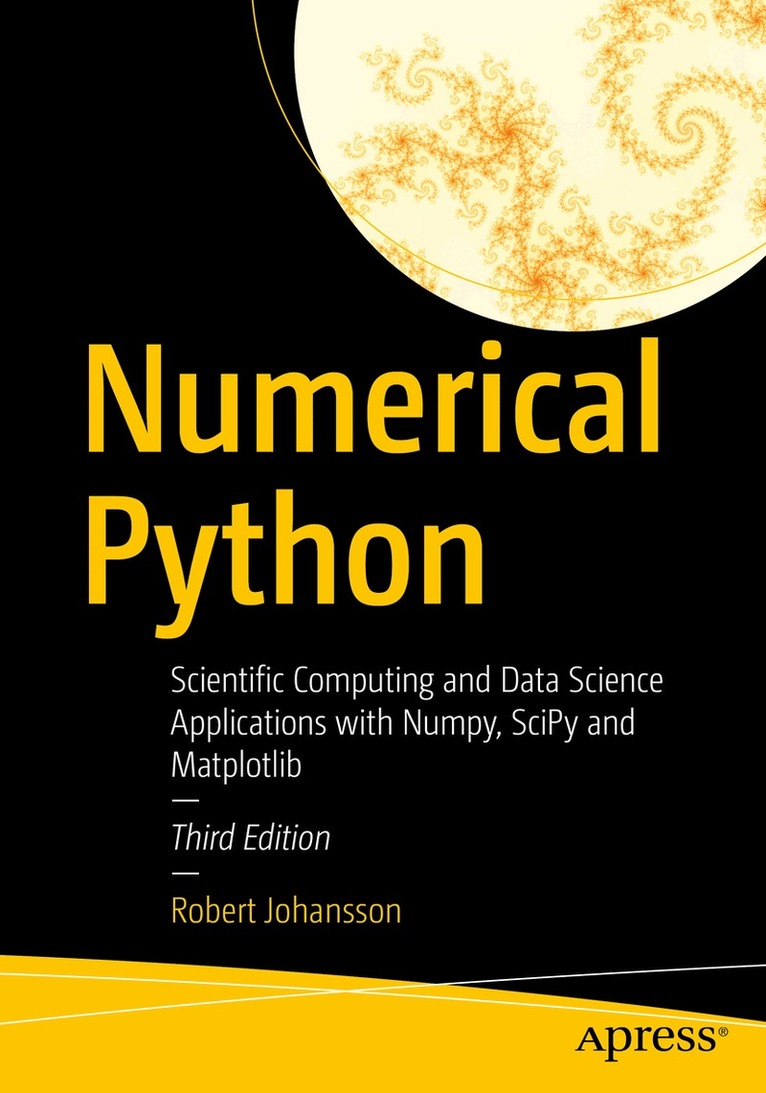
Learn how to leverage the scientific computing and data analysis capabilities of Python, its standard library, and popular open-source numerical Python packages like NumPy, SymPy, SciPy, matplotlib, and more. This book demonstrates how to work with mathematical modeling and solve problems with numerical, symbolic, and visualization techniques. It explores applications in science, engineering, data analytics, and more.
Numerical Python, Third Edition, presents many case study examples of applications in fundamental scientific computing disciplines, as well as in data science and statistics. This fully revised edition, updated for each library''s latest version, demonstrates Python''s power for rapid development and exploratory computing due to its simple and high-level syntax and many powerful libraries and tools for computation and data analysis.
After reading this book, readers will be familiar with many computing techniques, including array-based and symbolic computing, visualization and numerical file I/O, equation solving, optimization, interpolation and integration, and domain-specific computational problems, such as differential equation solving, data analysis, statistical modeling, and machine learning.
What You''ll Learn
Work with vectors and matrices using NumPyReview Symbolic computing with SymPyPlot and visualize data with MatplotlibPerform data analysis tasks with Pandas and SciPyUnderstand statistical modeling and machine learning with statsmodels and scikit-learnOptimize Python code using Numba and CythonWho This Book Is For
Developers who want to understand how to use Python and its ecosystem of libraries for scientific computing and data analysis.