Robert M. Solow - Böcker
Visar alla böcker från författaren Robert M. Solow. Handla med fri frakt och snabb leverans.
16 produkter
16 produkter
769 kr
Skickas inom 5-8 vardagar
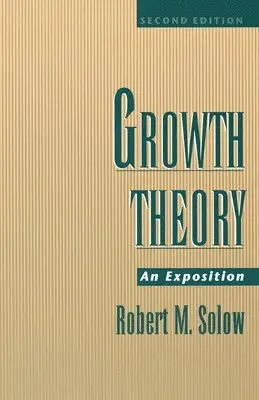
In the preface to the first edition of Growth Theory (copyright 1970), the author writes: "I have tried to give some feeling for the scope of aggregate theory of growth, a notion of technical details, and some idea of the directions in which future research is likely to go. About four years ago, the OUP NY economics editor suggested to Professor Solow that he bring this book up to date, because of the large amount of recent literature, often referred to as the "new growth theory," or more technically as "endogenous growth theory". This second edition of Growth Theory, which grew out of that conversation, begins with the author's Nobel Prize Lecture "Growth Theory and After" (1987) followed by the original six chapters of the first edition. The first edition appeared in 1970; the author maintains that basic growth theory is still best summarized in these chapters, using what is often classified as "exogenous growth theory." In the 70s, which happened to coincide witha worldwide productivity slowdown, very little new work occurred in growth theory. It wasn't until the 1980s that a surge of new writing appeared, with the work of Roemer, Lucas, and others, what the author refers to as "an astonishing burst of theoretical and empirical research that still continues." The author developed "a second half" of the book for this edition, six entirely new chpaters in which he discusses new growth theory (endogenous growth theory) and its relationship to exogenous theory. As a "bridge" between the two sets of chapters, he has written an essay entitled "Intermezzo" in which he discusses the relatively inactive period for growth theory in the 70s, before introducing the "new" endogenous theory of growth and contrasting it with earlier work. Solow is quick to agree that older growth theory can aptly be described as "exogenous," because the growth rate itself was left unexplained, or rather was considered a "given" (basically a result of the actual rate of labor-augmenting technology). But treating the growth rate as exogenous does not make it a permanent constant or inexplicable. Certainly things can be said about a variety of (exogenous) factors affecting the growth rate; nevertheless the "old" theory did not provide, or try to give, a systematic theory of the growth rate. To sum up, according to the author, the way to understand exogenous growth theory is to show how aggregate output adjusts to the rate of population growth and the rate of technological process, whatever they happen to be and for however long the persist (treated in Chapters 1-6 and the "Intermezzo").By contrast, the main contribution of the (new) endogenous grotwh theory is to propose a systematic theory of technological progress, a model that actually explains the rate of growth. It is the contention of the author that no theory of innovation or growth can come up with a formulaic way to arrive at a growth rate. For that reason he believes there is something arbitrary introduced into all endogenous theories of the rate of growth. They claim to explain more than they can be expected to do. Rather than trying to pin down determinants of any "steady-state" growth rate, exogenous growth theory describes trends and policies that increase growth, including the growth rate. For reasons made explicit in the book, the author deals with "AK"theory, convergence, and international cross-section studies, with only the passing attention he believes they deserve. In the "second half of the book," starting in Chapter 7, the author recasts the older (exogenous) model (Chapters 1-6) so that it can be more easily compared with new models. Chapters 8-11 takes a close analytical look at hte key models: Lucas (8); Roemer (9); Grossman/Helpman (10); Aghion and Howitt (11). In each chapter he shows how an unwarranted assumption creeps into these models that try to determin growth rate endogenously. The final chapter looks at lessons from the new growth theory and suggests where gaps may usefully be filled in future research. Despite his criticisms of the new growth theory, the author is quik to acknowledge outstanding contributions made by the new generation of theorists. This is an important book that will be required reading in graduate programs in macroeconomics as well as specific courses on growth theory, at both the undergraduate and graduate levels. No other book provides such a broad overviwe of the whole field and its evolution to the present.
657 kr
Tillfälligt slut
51 kr
Tillfälligt slut
577 kr
Skickas inom 7-10 vardagar
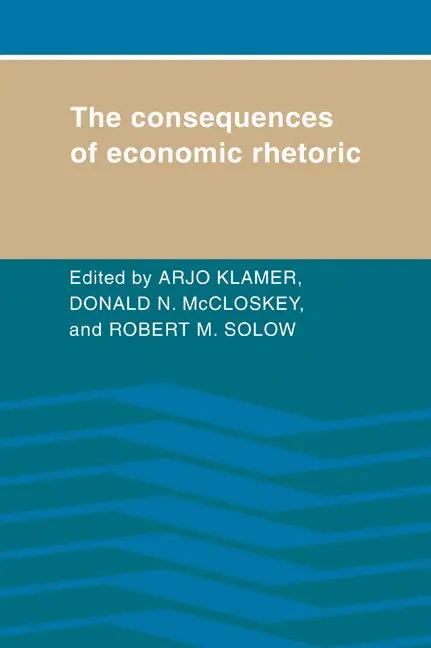
The field of economics proves to be a matter of metaphor and storytelling - its mathematics is metaphoric and its policy-making is narrative. Economists have begun to realize this and to rethink how they speak. This volume is the result of a conference held at Wellesley College, involving both theoretical and applied economists, that explored the consequences of the rhetoric and the conversation of the field of economics.
1 363 kr
Skickas inom 7-10 vardagar
The field of economics proves to be a matter of metaphor and storytelling - its mathematics is metaphoric and its policy-making is narrative. Economists have begun to realize this and to rethink how they speak. This volume is the result of a conference held at Wellesley College, involving both theoretical and applied economists, that explored the consequences of the rhetoric and the conversation of the field of economics.
726 kr
Skickas inom 7-10 vardagar
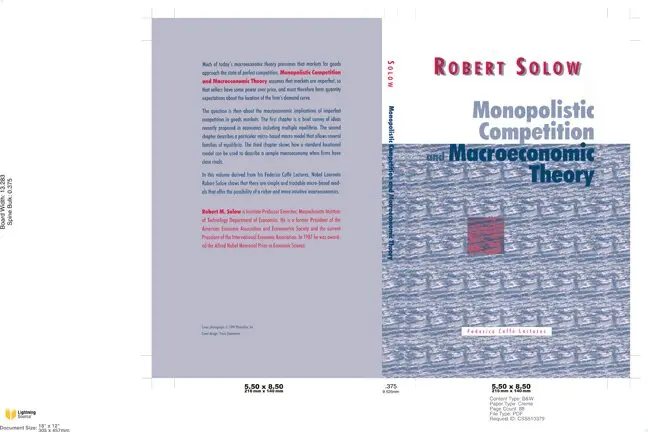
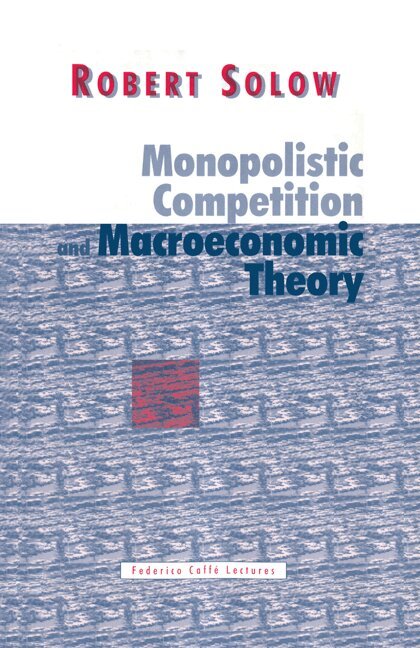
Much of today's conventional macroeconomic theory presumes that markets for goods approach the state of perfect competition. Monopolistic Competition and Macroeconomic Theory assumes that markets are imperfect, so that sellers have some power over price, and must therefore form quantity expectations about the location of the firm's demand curve. The question is then about the macroeconomic implications of imperfect competition in goods markets. The first chapter is a brief survey of ideas proposed in economics including multiple equilibria. The second chapter describes a particular micro-based macro model that allows several families of equilibria. The third chapter shows how a standard locational model can be used to describe a sample macroeconomy when firms have close rivals. In this volume derived from his Federico Caffe Lecture, Nobel Laureate Robert Solow shows that there are simple and tractable micro-based models that offer the possibility of a richer and more intuitive macroeconomics.
373 kr
Skickas inom 7-10 vardagar
Much of today's conventional macroeconomic theory presumes that markets for goods approach the state of perfect competition. Monopolistic Competition and Macroeconomic Theory assumes that markets are imperfect, so that sellers have some power over price, and must therefore form quantity expectations about the location of the firm's demand curve. The question is then about the macroeconomic implications of imperfect competition in goods markets. The first chapter is a brief survey of ideas proposed in economics including multiple equilibria. The second chapter describes a particular micro-based macro model that allows several families of equilibria. The third chapter shows how a standard locational model can be used to describe a sample macroeconomy when firms have close rivals. In this volume derived from his Federico Caffe Lecture, Nobel Laureate Robert Solow shows that there are simple and tractable micro-based models that offer the possibility of a richer and more intuitive macroeconomics.
1 289 kr
Skickas inom 3-6 vardagar
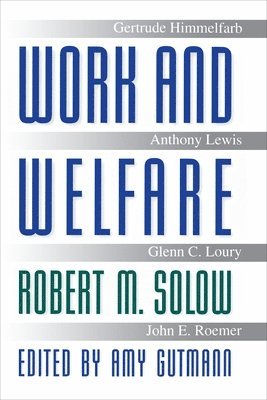
The Nobel Prize-winning economist Robert Solow directs his attention here to one of today's most controversial social issues: how to get people off welfare and into jobs. With characteristic eloquence, wit, and rigor, Solow condemns the welfare reforms recently passed by Congress and President Clinton for confronting welfare recipients with an unworkable choice--finding work in the current labor market or losing benefits. He argues that the only practical and fair way to move recipients to work is, in contrast, through an ambitious plan to guarantee that every able-bodied citizen has access to a job. Solow contends that the demand implicit in the 1996 Welfare Reform Act for welfare recipients to find work in the existing labor market has two crucial flaws. First, the labor market would not easily make room for a huge influx of unskilled, inexperienced workers. Second, the normal market adjustment to that influx would drive down earnings for those already in low-wage jobs.Solow concludes that it is legitimate to want welfare recipients to work, but not to want them to live at a miserable standard or to benefit at the expense of the working poor, especially since children are often the first to suffer. Instead, he writes, we should create new demand for unskilled labor through public-service employment and incentives to the private sector--in effect, fair "workfare." Solow presents widely ignored evidence that recipients themselves would welcome the chance to work. But he also points out that practical, morally defensible workfare would be extremely expensive--a problem that politicians who support the idea blithely fail to admit. Throughout, Solow places debate over welfare reform in the context of a struggle to balance competing social values, in particular self-reliance and altruism. The book originated in Solow's 1997 Tanner Lectures on Human Values at Princeton University. It includes reactions from the distinguished scholars Gertrude Himmelfarb, Anthony Lewis, Glenn Loury, and John Roemer, who expand on and take issue with Solow's arguments.Work and Welfare is a powerful contribution to debate about welfare reform and a penetrating look at the values that shape its course.
1 163 kr
Skickas inom 10-15 vardagar
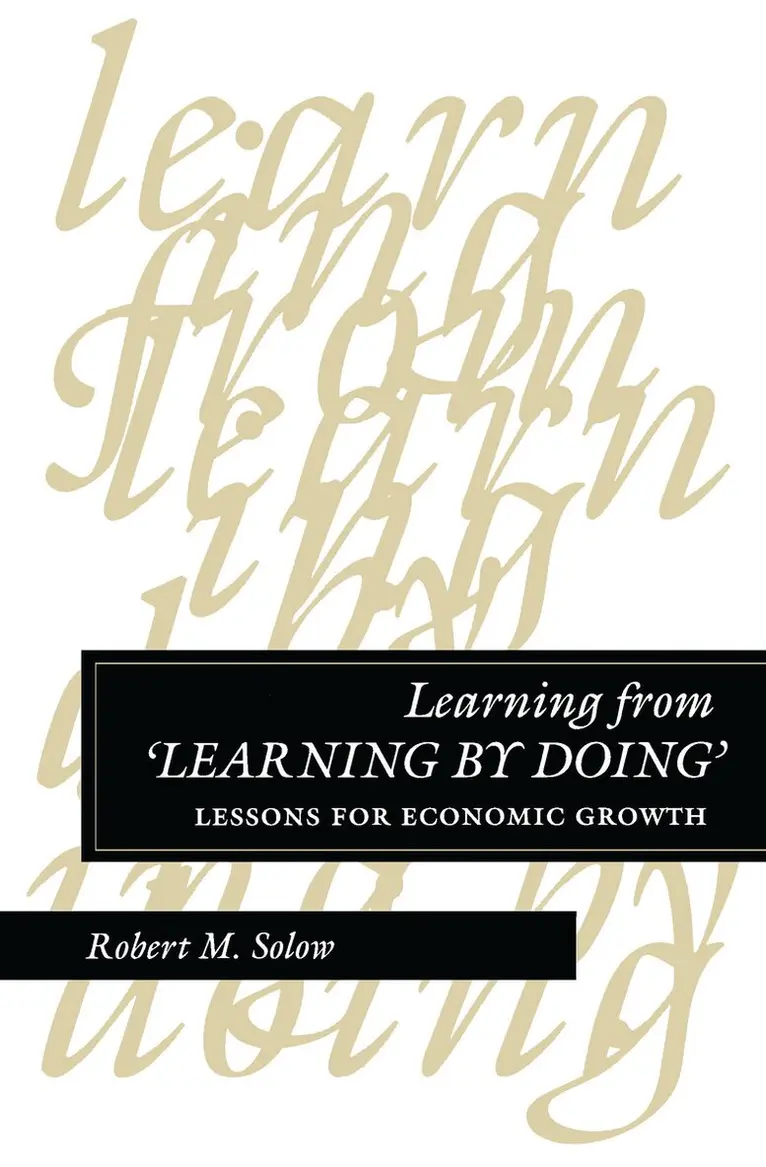
This book by a Nobel laureate in economics begins with a brief exposition of Kenneth J. Arrow's classic paper "The Economic Implications of Learning by Doing" (1962). It shows how Arrow's idea fits into the modern theory of economic growth, and uses it as a springboard for a critical consideration of spectacular recent developments that have made growth theory a dynamic topic today.The author then develops a new theory that combines learning by doing (identifying it with the concept of "continuous improvement") with a separate process of discrete "innovations." Learning by doing leads to a fairly smooth reduction in labor required per unit of output, tied to the rate of gross investment in new capital equipment. Innovations arrive at random; when one of them happens, the labor requirement takes a jump downward.This new model, simple as it is, does not lend itself to self-contained solution. The author accordingly presents the results of a series of computer simulations that exhibit the variety of paths the new model economy can follow, showing, among other things, that early good luck can have a persistent effect. The book concludes with some general reflections on policies for economic growth, drawn not from any one modeling exercise but from general experience with a variety of growth models. Of the four chapters of this book, the first two were presented as the Kenneth J. Arrow Lectures at Stanford University in 1993. The computer simulations were specially done for inclusion in this book. The final chapter on policies for economic growth was first presented as the Ernest Sturc Lecture at the Johns Hopkins School of Advanced International Studies in Washington in 1991.
278 kr
Skickas inom 7-10 vardagar
This book by a Nobel laureate in economics begins with a brief exposition of Kenneth J. Arrow's classic paper "The Economic Implications of Learning by Doing" (1962). It shows how Arrow's idea fits into the modern theory of economic growth, and uses it as a springboard for a critical consideration of spectacular recent developments that have made growth theory a dynamic topic today.The author then develops a new theory that combines learning by doing (identifying it with the concept of "continuous improvement") with a separate process of discrete "innovations." Learning by doing leads to a fairly smooth reduction in labor required per unit of output, tied to the rate of gross investment in new capital equipment. Innovations arrive at random; when one of them happens, the labor requirement takes a jump downward.This new model, simple as it is, does not lend itself to self-contained solution. The author accordingly presents the results of a series of computer simulations that exhibit the variety of paths the new model economy can follow, showing, among other things, that early good luck can have a persistent effect. The book concludes with some general reflections on policies for economic growth, drawn not from any one modeling exercise but from general experience with a variety of growth models. Of the four chapters of this book, the first two were presented as the Kenneth J. Arrow Lectures at Stanford University in 1993. The computer simulations were specially done for inclusion in this book. The final chapter on policies for economic growth was first presented as the Ernest Sturc Lecture at the Johns Hopkins School of Advanced International Studies in Washington in 1991.
482 kr
Skickas inom 10-15 vardagar
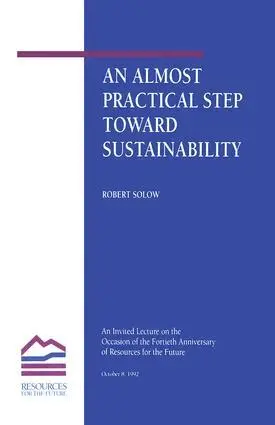
Nobel Laureate Robert Solow explores how changes in social accounting practice could contribute to more rational debate and action in crafting economic and environmental policy. A thoughtful work about the wise use of society's natural resources, intergenerational equity, and the translation of ideas about sustainability into real policy.
2 562 kr
Skickas inom 10-15 vardagar
Nobel Laureate Robert Solow explores how changes in social accounting practice could contribute to more rational debate and action in crafting economic and environmental policy. A thoughtful work about the wise use of society's natural resources, intergenerational equity, and the translation of ideas about sustainability into real policy.
547 kr
Skickas inom 7-10 vardagar
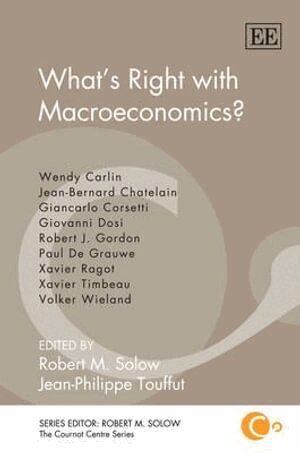
Global crises are very rare events. After the Great Depression and the Great Stagflation, new macroeconomic paradigms associated with a new policy regime emerged. This book addresses how some macroeconomic ideas have failed, and examines which theories researchers should preserve and develop. It questions how the field of economics - still reeling from the global financial crisis initiated in the summer of 2007 - will respond.The contributors, nine highly-renowned macroeconomists, highlight the virtues of eclectic macroeconomics over an authoritarian normative approach, and illustrate that macroeconomic reasoning can still be a useful tool for carrying out practical policy analysis. As for emerging research programmes, their wide-ranging chapters remind us that there are positive approaches to and reasons to believe in old-fashioned macroeconomics.This challenging and thought-provoking book will prove a stimulating read for researchers, academics and students of economics, as well as for professional economists.Contributors include: W. Carlin, J.-B. Chatelain, G. Corsetti, P. De Grauwe, G. Dosi, G. Fagiolo,R.J. Gordon, M. Napoletano, X. Ragot, A. Roventini, R.M. Solow, X. Timbeau, J.-P. Touffut, V. Wieland
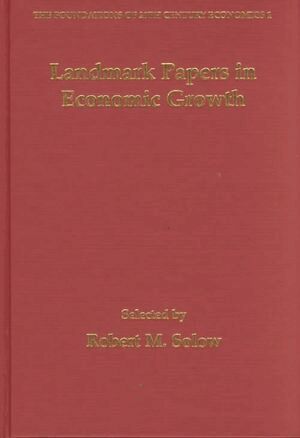
Del 1 - The Foundations of 20th Century Economics series
Landmark Papers in Economic Growth Selected By Robert M. Solow
Inbunden, Engelska, 2001
2 305 kr
Skickas inom 7-10 vardagar
Robert Solow has made a seminal contribution in the field of aggregative economics. This authoritative volume will be an important starting point for any researcher or professional economist seeking to understand how this branch of economics advanced in the twentieth century.
1 760 kr
Skickas inom 7-10 vardagar
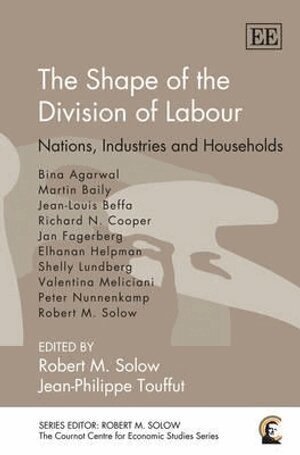
How is work divided up in the household, within an industry, a nation or between continents? What are the dynamics of the division of labour? The wide-ranging contributions to this book explore these questions from technological, capital and political perspectives. They include in-depth studies of gender, the firm, countries' economic specializations, ICTs, foreign direct investment and agriculture. In this book, ten distinguished contributors - economists, scholars and practitioners - take stock of the shape of the division of labour and provide useful policy recommendations. The Shape of the Division of Labour will interest researchers and students of international economics, labour economics, international trade and finance, as well as economists and public policy advisers and analysts.
459 kr
Skickas inom 7-10 vardagar
How is work divided up in the household, within an industry, a nation or between continents? What are the dynamics of the division of labour? The wide-ranging contributions to this book explore these questions from technological, capital and political perspectives. They include in-depth studies of gender, the firm, countries' economic specializations, ICTs, foreign direct investment and agriculture. In this book, ten distinguished contributors - economists, scholars and practitioners - take stock of the shape of the division of labour and provide useful policy recommendations. The Shape of the Division of Labour will interest researchers and students of international economics, labour economics, international trade and finance, as well as economists and public policy advisers and analysts.