Robert R. Korfhage – författare
Visar alla böcker från författaren Robert R. Korfhage. Handla med fri frakt och snabb leverans.
4 produkter
4 produkter
Häftad, Engelska, 2011
561 kr
Skickas inom 10-15 vardagar
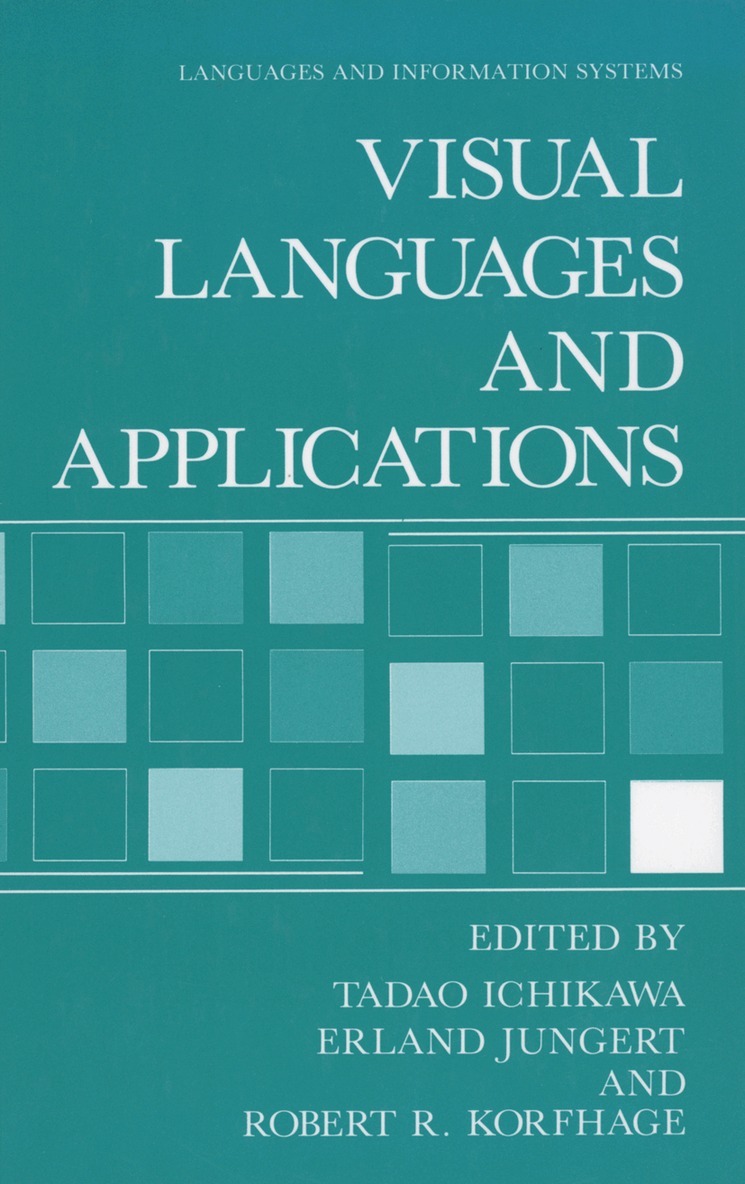
The interface between the user of a computer-based information system and the system itself has been evolving at a rapid rate. The use of a video screen, with its color and graphics capabilities, has been one factor in this evolution. The development of light pens, mice, and other screen image manipulation devices has been another. With these capabilities has come a natural desire to find more effective ways to make use of them. In particular, much work has gone into the development of interface systems that add visual elements such as icons and graphics to text. The desire to use these visual elements effectively in communication between the user and the system has resulted in a healthy competition of ideas and discussion of the principles governing the development and use of such elements. The present volume chronicles some of the more significant ideas that have recently been presented. The first volume in this series on the subject [Visual Languages (Chang, Ichikawa, and Ligomenides, eds. ), Plenum, 1986] covered work done in the early days of the field of visual languages. Here we represent ideas that have grown out of that early work, arranged in six sections: Theory, Design Systems, Visual Programming, Algorithm Animation, Simulation Animation, and Applications. I THEORY Fundamental to the concept of visual languages is the convIctIOn that diagrams and other visual representations can aid understanding and communication of ideas. We begin this volume with a chapter by Fanya S.
E-bok
PDF, Engelska, 2013708 kr
Läs direkt efter köp
The interface between the user of a computer-based information system and the system itself has been evolving at a rapid rate. The use of a video screen, with its color and graphics capabilities, has been one factor in this evolution. The development of light pens, mice, and other screen image manipulation devices has been another. With these capabilities has come a natural desire to find more effective ways to make use of them. In particular, much work has gone into the development of interface systems that add visual elements such as icons and graphics to text. The desire to use these visual elements effectively in communication between the user and the system has resulted in a healthy competition of ideas and discussion of the principles governing the development and use of such elements. The present volume chronicles some of the more significant ideas that have recently been presented. The first volume in this series on the subject [Visual Languages (Chang, Ichikawa, and Ligomenides, eds. ), Plenum, 1986] covered work done in the early days of the field of visual languages. Here we represent ideas that have grown out of that early work, arranged in six sections: Theory, Design Systems, Visual Programming, Algorithm Animation, Simulation Animation, and Applications. I THEORY Fundamental to the concept of visual languages is the convIctIOn that diagrams and other visual representations can aid understanding and communication of ideas. We begin this volume with a chapter by Fanya S.
E-bok
PDF, Engelska, 2014979 kr
Läs direkt efter köp
This text, designed for a second year calculus course, can follow any standard first year course in one-variable calculus. Its purpose is to cover the material most useful at this level, to maintain a balance between theory and practice, and to develop techniques and problem solving skills. The topics fall into several categories: Infinite series and integrals Chapter 1 covers convergence and divergence of series and integrals. It ?ontains proofs of basic convergence tests, relations between series and Integrals, and manipulation with geometric, exponential, and related series. Chapter 2 covers approximation of functions by Taylor polynomials, with emphasis on numerical approximations and estimates of remainders. Chapt~r 3 deals with power series, including intervals of convergence, expanSIOns of functions, and uniform convergence. It features calculations with s~ries by algebraic operations, substitution, and term-by-term differentiation and integration. Vector methods Vector algebra is introduced in Chapter 4 and applied to solid analytic geometry. The calculus of one-variable vector functions and its applications to space curves and particle mechanics comprise Chapter 5. Linear algebra Chapter 7 contains a practical introduction to linear algebra in two and three dimensions. We do not attempt a complete treatment of foundations, but rather limit ourselves to thoRe topics that have immediate application to calculus. The main topics are linear transformations in R2 and R3, their matrix representations, manipulation with matrices, linear systems, quadratic forms, and quadric surfaces. Differential calculus of several variables Chapter 6 contains preliminary material on sets in the plane and space, and the definition and basic properties of continuous functions. This is followed by partial derivatives with applications to maxima and minima. Chapter 8 continues with a careful treatment of differentiability and applications to tangent planes, gradients, directional derivatives, and differentials. Here ideas from linear algebra are used judiciously. Chapter 9 covers higher xii Preface order partial derivatives, Taylor polynomials, and second derivative tests for extrema. Multiple integrals In Chapters 10 and 11 we treat double and triple integrals intuitively, with emphasis on iteration, geometric and physical applications, and coordinate changes. In Chapter 12 we develop the theory of the Riemann integral starting with step functions. We continue with Jacobians and the change of variable formula, surface area, and Green''s Theorem. Differential equations Chapter 13 contains an elementary treatment of first order equations, with emphasis on linear equations, approximate solutions, and applications. Chapter 14 covers second order linear equations and first order linear systems, including matrix series solutions. These chapters can be taken up any time after Chapter 7. Complex analysis The final chapter moves quickly through basic complex algebra to complex power series, shortcuts using'' the complex exponential function, and applications to integration and differential equations. Features The key points of one-variable calculus are reviewed briefly as needed. Optional topics are scattered throughout, for example Stirling''s Formula, characteristic roots and vectors, Lagrange multipliers, and Simpson''s Rule for double integrals. Numerous worked examples teach practical skills and demonstrate the utility of the theory. We emphaRize Rimple line drawingR that a student can learn to do himself.
E-bok
PDF, Engelska, 2014756 kr
Läs direkt efter köp
Discrete Computational Structures describes discrete mathematical concepts that are important to computing, covering necessary mathematical fundamentals, computer representation of sets, graph theory, storage minimization, and bandwidth. The book also explains conceptual framework (Gorn trees, searching, subroutines) and directed graphs (flowcharts, critical paths, information network). The text discusses algebra particularly as it applies to concentrates on semigroups, groups, lattices, propositional calculus, including a new tabular method of Boolean function minimization. The text emphasizes combinatorics and probability. Examples show different techniques of the general process of enumerating objects. Combinatorics cover permutations, enumerators for combinations, Stirling numbers, cycle classes of permutations, partitions, and compositions. The book cites as example the interplay between discrete mathematics and computing using a system of distinct representatives (SDR) problem. The problem, originating from group theory, graph theory, and set theory can be worked out by the student with a network model involving computers to generate and analyze different scenarios. The book is intended for sophomore or junior level, corresponding to the course B3, "Introduction to Discrete Structures," in the ACM Curriculum 68, as well as for mathematicians or professors of computer engineering and advanced mathematics.