
Rod Scher – författare
Visar alla böcker från författaren Rod Scher. Handla med fri frakt och snabb leverans.
3 produkter
3 produkter

282 kr
Tillfälligt slut
Leveling the Playing Field explores the technologies that “trickle down” to the rest of us, those that were once the domain of the wealthy and powerful--and which therefore tended to make them even more wealthy and powerful. Now, though, these technologies--from books to computers to 3D printing and beyond--have become part of a common toolkit, one accessible to almost anyone, or at least to many more than had heretofore had access. This is what happens with most technologies: They begin in the hands of the few, and they end up in the hands of the many. Along the way, they sometimes transform the world.

375 kr
Skickas inom 3-6 vardagar
In 1982, a hobby sailor and retired geography professor named Marvin Creamer embarked on a very special circumnavigation: On his 36’ steel ketch, Globe Star, Creamer and his crew ventured out into the Atlantic a few days before Christmas on the first leg of the voyage, bound for Africa. On board they carried absolutely no navigation instruments of any kind: no LORAN, no GPS or AIS (civilian versions of which did not, in any case, exist in 1982), no sextant or astrolabe, no radar . . . nothing. They didn’t even have a clock on board. They had some rudimentary charts and maps of the trade winds and that was it. What they did carry with them was Marv’s blue-water sailing experience and his knowledge of the Earth, the stars, and of the winds and waves. Eighteen months later, Creamer returned, having shown the world—or as much of it as was paying any attention—that one could sail around the globe without using any instruments. Creamer’s intent was to prove that such a voyage could be successful, showing that ancient peoples—e.g., the Norse, the South Pacific Islanders, and possibly others—could well have traveled the world’s oceans using only their brains, their five senses, and the experience of multiple generations of their seafaring ancestors. The trip was ultimately successful, but Creamer was beset by almost-constant problems. That makes for an exciting tale, and provides some exceptional examples of seafaring ingenuity and sheer determination on the part of Creamer. The author was given exclusive access to Creamer’s diaries, photos, and other memorabilia by Creamer’s family.
392 kr
Skickas inom 3-6 vardagar
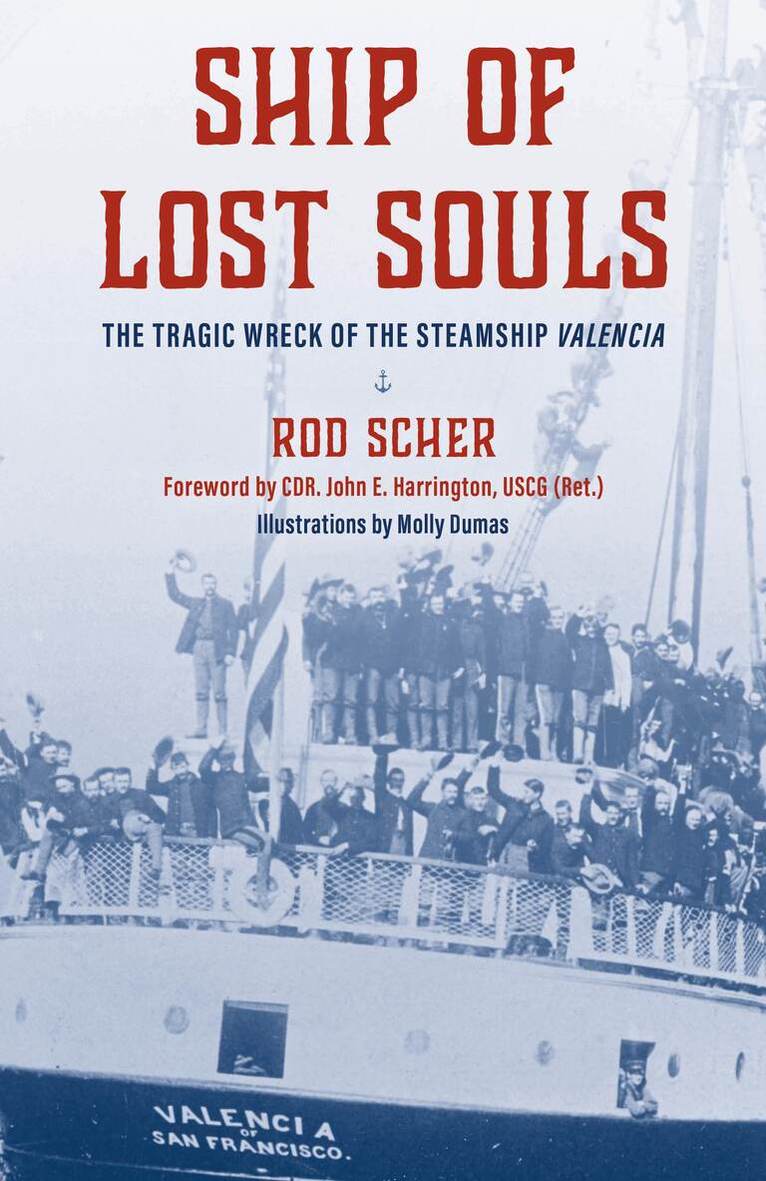
Of all the ships lost in what has come to be called the “Graveyard of the Pacific,” the story of the steamship Valencia is among the saddest. In January 1906, the Valencia set out from San Francisco, bound for Seattle with 108 passengers and some 65 crew aboard. Owing to bad weather and mistakes made by the captain, she struck a reef 11 miles off Cape Beale on the southwest coast of Vancouver Island. The ship’s hull was gashed open by the rocks. The tragedy was soon multiplied a hundredfold by a series of further mistakes and missteps. Ultimately, due in large part to the lack of lifesaving infrastructure in the rugged area where she ran aground, only thirty-seven survived.The wreck of the Valencia was an especially tragic one for a number of reasons. To begin with, most on board perished, including every woman and child, who had been lashed to the rigging high above the deck in an attempt to save them from the crashing waves. Additionally, the wreck itself was almost certainly avoidable, due almost entirely to navigational errors made by the captain. Finally, rescue efforts—such as they were—were hampered not just by the sea and the weather, but due to mistakes made by (and some say the cowardice of) the would-be rescuers.This book pieces together the story of the Valencia and her tragic end, weaving together not just the threads of the ill-fated voyage itself, but also relevant contextual history, including the development of radio technologies and lifesaving equipment and services that simply came too late to help the doomed voyagers.