Rogers Brubaker - Böcker
Visar alla böcker från författaren Rogers Brubaker. Handla med fri frakt och snabb leverans.
13 produkter
13 produkter
2 693 kr
Skickas inom 10-15 vardagar
In The Limits of Rationality Rogers Brubaker explores the intimate and ambiguous interplay between Max Weber's empirical work and his moral vision, between his historical and sociological analysis of the 'specific and peculiar rationalism' of modern Western civilization and his deeply ambivalent moral response to that rationalism. Weber's ideas about rationality are central to his sociological work, and they are central to his moral perspective. But these ideas are neither easily accessible nor easily understandable, in part because Weber never systematized them, in part because his work is usually encountered piecemeal and seldom studied in its entirety. Brubaker reconstructs Weber's rich but fragmented discussion of rationalism and rationalization in a systematic fashion, thereby illuminating his empirical and moral diagnosis of modernity - a diagnosis that remains unsurpassed in pathos and anyalytical power.
671 kr
Skickas inom 10-15 vardagar
In The Limits of Rationality Rogers Brubaker explores the intimate and ambiguous interplay between Max Weber's empirical work and his moral vision, between his historical and sociological analysis of the 'specific and peculiar rationalism' of modern Western civilization and his deeply ambivalent moral response to that rationalism. Weber's ideas about rationality are central to his sociological work, and they are central to his moral perspective. But these ideas are neither easily accessible nor easily understandable, in part because Weber never systematized them, in part because his work is usually encountered piecemeal and seldom studied in its entirety. Brubaker reconstructs Weber's rich but fragmented discussion of rationalism and rationalization in a systematic fashion, thereby illuminating his empirical and moral diagnosis of modernity - a diagnosis that remains unsurpassed in pathos and anyalytical power.
1 245 kr
Skickas inom 7-10 vardagar
The birthplace of the nation-state and modern nationalism at the end of the eighteenth century, Europe was supposed to be their graveyard at the end of the twentieth. Yet, far from moving beyond the nation-state, fin-de-siècle Europe has been moving back to the nation-state, most spectacularly with the disintegration of the Soviet Union, Yugoslavia, and Czechoslovakia into a score of nationally defined successor states. This massive reorganisation of political space along national lines has engendered distinctive, dynamically interlocking, and in some cases explosive forms of nationalism. Drawing on Pierre Bourdieu and the 'new institutionalist' sociology, and comparing contemporary nationalisms with those of interwar Europe, Rogers Brubaker provides a theoretically sophisticated and historically rich account of one of the most important problems facing the 'New Europe'.
271 kr
Skickas inom 7-10 vardagar
The birthplace of the nation-state and modern nationalism at the end of the eighteenth century, Europe was supposed to be their graveyard at the end of the twentieth. Yet, far from moving beyond the nation-state, fin-de-siècle Europe has been moving back to the nation-state, most spectacularly with the disintegration of the Soviet Union, Yugoslavia, and Czechoslovakia into a score of nationally defined successor states. This massive reorganisation of political space along national lines has engendered distinctive, dynamically interlocking, and in some cases explosive forms of nationalism. Drawing on Pierre Bourdieu and the 'new institutionalist' sociology, and comparing contemporary nationalisms with those of interwar Europe, Rogers Brubaker provides a theoretically sophisticated and historically rich account of one of the most important problems facing the 'New Europe'.
286 kr
Skickas inom 7-10 vardagar
Despite a quarter-century of constructivist theorizing in the social sciences and humanities, ethnic groups continue to be conceived as entities and cast as actors. Journalists, policymakers, and researchers routinely frame accounts of ethnic, racial, and national conflict as the struggles of internally homogeneous, externally bounded ethnic groups, races, and nations. In doing so, they unwittingly adopt the language of participants in such struggles, and contribute to the reification of ethnic groups.In this timely and provocative volume, Rogers Brubaker—well known for his work on immigration, citizenship, and nationalism—challenges this pervasive and commonsense “groupism.” But he does not simply revert to standard constructivist tropes about the fluidity and multiplicity of identity. Once a bracing challenge to conventional wisdom, constructivism has grown complacent, even cliched. That ethnicity is constructed is commonplace; this volume provides new insights into how it is constructed. By shifting the analytical focus from identity to identifications, from groups as entities to group-making projects, from shared culture to categorization, from substance to process, Brubaker shows that ethnicity, race, and nation are not things in the world but perspectives on the world: ways of seeing, interpreting, and representing the social world.
384 kr
Skickas inom 10-15 vardagar
The difference between French and German definitions of citizenship is instructive—and, for millions of immigrants from North Africa, Turkey, and Eastern Europe, decisive. Rogers Brubaker shows how this difference—between the territorial basis of the French citizenry and the German emphasis on blood descent—was shaped and sustained by sharply differing understandings of nationhood, rooted in distinctive French and German paths to nation-statehood.
258 kr
Skickas inom 7-10 vardagar
Offering fresh perspectives on perennial questions of ethnicity, race, nationalism, and religion, Rogers Brubaker makes manifest the forces that shape the politics of diversity and multiculturalism today. In a lucid and wide-ranging analysis, he contends that three recent developments have altered the stakes and the contours of the politics of difference: the return of inequality as a central public concern, the return of biology as an asserted basis of racial and ethnic difference, and the return of religion as a key terrain of public contestation.“Grounds for Difference is a subtle, original, and comprehensive book. All the hallmarks of Brubaker’s earlier work, such as the conceptual clarity, the theoretical rigor—grounded in a well-researched and well-informed analysis—the crisp writing style, and the impeccable sociological reasoning are displayed here. There is a wealth of original ideas developed in this book that requires much careful reading and unpacking.”—Sinisa Malešević, H-Net Reviews“This is an imposing collection that will be another milestone in the literature of ethnicity and nationalism.”—Christian Joppke, University of Bern
439 kr
Skickas inom 7-10 vardagar
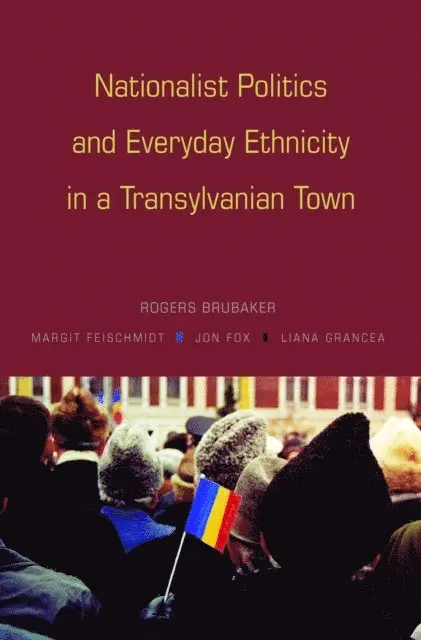
Situated on the geographic margins of two nations, yet imagined as central to each, Transylvania has long been a site of nationalist struggles. Since the fall of communism, these struggles have been particularly intense in Cluj, Transylvania's cultural and political center. Yet heated nationalist rhetoric has evoked only muted popular response. The citizens of Cluj--the Romanian-speaking majority and the Hungarian-speaking minority--have been largely indifferent to the nationalist claims made in their names. Based on seven years of field research, this book examines not only the sharply polarized fields of nationalist politics--in Cluj, Transylvania, and the wider region--but also the more fluid terrain on which ethnicity and nationhood are experienced, enacted, and understood in everyday life. In doing so the book addresses fundamental questions about ethnicity: where it is, when it matters, and how it works. Bridging conventional divisions of academic labor, Rogers Brubaker and his collaborators employ perspectives seldom found together: historical and ethnographic, institutional and interactional, political and experiential.Further developing the argument of Brubaker's groundbreaking Ethnicity without Groups, the book demonstrates that it is ultimately in and through everyday experience--as much as in political contestation or cultural articulation--that ethnicity and nationhood are produced and reproduced as basic categories of social and political life.
203 kr
Skickas inom 7-10 vardagar
In the summer of 2015, shortly after Caitlyn Jenner came out as transgender, the NAACP official and political activist Rachel Dolezal was "outed" by her parents as white, touching off a heated debate in the media about the fluidity of gender and race. If Jenner could legitimately identify as a woman, could Dolezal legitimately identify as black? Taking the controversial pairing of "transgender" and "transracial" as his starting point, Rogers Brubaker shows how gender and race, long understood as stable, inborn, and unambiguous, have in the past few decades opened up--in different ways and to different degrees--to the forces of change and choice. Transgender identities have moved from the margins to the mainstream with dizzying speed, and ethnoracial boundaries have blurred. Paradoxically, while sex has a much deeper biological basis than race, choosing or changing one's sex or gender is more widely accepted than choosing or changing one's race.Yet while few accepted Dolezal's claim to be black, racial identities are becoming more fluid as ancestry--increasingly understood as mixed--loses its authority over identity, and as race and ethnicity, like gender, come to be understood as something we do, not just something we have. By rethinking race and ethnicity through the multifaceted lens of the transgender experience--encompassing not just a movement from one category to another but positions between and beyond existing categories--Brubaker underscores the malleability, contingency, and arbitrariness of racial categories. At a critical time when gender and race are being reimagined and reconstructed, Trans explores fruitful new paths for thinking about identity.
187 kr
Skickas inom 7-10 vardagar
How the transgender experience opens up new possibilities for thinking about gender and raceIn the summer of 2015, shortly after Caitlyn Jenner came out as transgender, the NAACP official and political activist Rachel Dolezal was "outed" by her parents as white, touching off a heated debate in the media about the fluidity of gender and race. If Jenner could legitimately identify as a woman, could Dolezal legitimately identify as black?Taking the controversial pairing of “transgender” and “transracial” as his starting point, Rogers Brubaker shows how gender and race, long understood as stable, inborn, and unambiguous, have in the past few decades opened up—in different ways and to different degrees—to the forces of change and choice. Transgender identities have moved from the margins to the mainstream with dizzying speed, and ethnoracial boundaries have blurred. Paradoxically, while sex has a much deeper biological basis than race, choosing or changing one's sex or gender is more widely accepted than choosing or changing one’s race. Yet while few accepted Dolezal’s claim to be black, racial identities are becoming more fluid as ancestry—increasingly understood as mixed—loses its authority over identity, and as race and ethnicity, like gender, come to be understood as something we do, not just something we have. By rethinking race and ethnicity through the multifaceted lens of the transgender experience—encompassing not just a movement from one category to another but positions between and beyond existing categories—Brubaker underscores the malleability, contingency, and arbitrariness of racial categories.At a critical time when gender and race are being reimagined and reconstructed, Trans explores fruitful new paths for thinking about identity.
687 kr
Skickas inom 7-10 vardagar
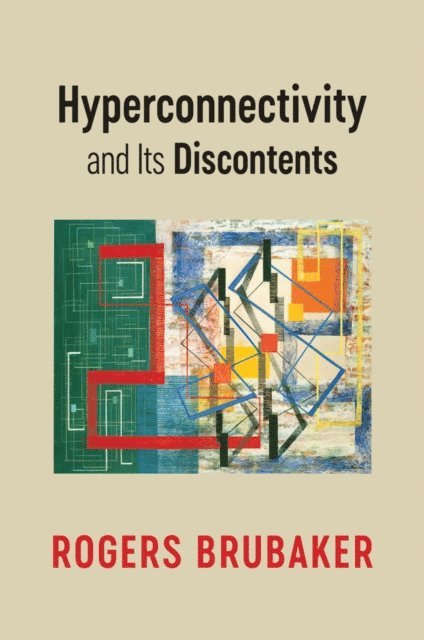
Digital hyperconnectivity is a defining fact of our time. The Silicon Valley dream of universal connection – the dream of connecting everyone and everything to everyone and everything else, everywhere and all the time – is rapidly becoming a reality. In this wide-ranging and sharply argued book, Rogers Brubaker develops an original interpretive account of the pervasive and unsettling changes brought about by hyperconnectivity. He traces transformations of the self, social relations, culture, economics, and politics, giving special attention to underexplored themes of abundance, miniaturization, convenience, quantification, and discipline. He shows how hyperconnectivity prepared us for the pandemic and how the pandemic, in turn, has prepared us for an even more fully digitally mediated future. Throughout, Brubaker underscores the ambivalence of digital hyperconnectivity, which opens up many new and exciting possibilities, yet at the same time threatens human freedom and flourishing.Hyperconnectivity and Its Discontents will be essential reading for everyone interested in the constellation of socio-technical forces that are profoundly remaking our world.
244 kr
Skickas inom 7-10 vardagar
Digital hyperconnectivity is a defining fact of our time. The Silicon Valley dream of universal connection – the dream of connecting everyone and everything to everyone and everything else, everywhere and all the time – is rapidly becoming a reality. In this wide-ranging and sharply argued book, Rogers Brubaker develops an original interpretive account of the pervasive and unsettling changes brought about by hyperconnectivity. He traces transformations of the self, social relations, culture, economics, and politics, giving special attention to underexplored themes of abundance, miniaturization, convenience, quantification, and discipline. He shows how hyperconnectivity prepared us for the pandemic and how the pandemic, in turn, has prepared us for an even more fully digitally mediated future. Throughout, Brubaker underscores the ambivalence of digital hyperconnectivity, which opens up many new and exciting possibilities, yet at the same time threatens human freedom and flourishing.Hyperconnectivity and Its Discontents will be essential reading for everyone interested in the constellation of socio-technical forces that are profoundly remaking our world.
208 kr
Kommande
From its obscure mid-twentieth-century origins in clinical assessments of intersex individuals, "gender identity" – understood as an inner sense of self that may or may not align with one's natal sex – has become central to the public and private culture of selfhood throughout the Western world. The category has been enacted in laws and regulations, encoded in organizational policies and routines, and embedded in everyday ways of thinking and talking. It has introduced a novel principle of social classification, created new possibilities for personhood, and come to rival or redefine the category of sex itself.These developments have provoked intense controversy. Disputes rage about the legitimacy of medical interventions for gender-dysphoric youth, the meaning and limits of gender self-determination, and the terms governing access to women's spaces and activities.Rogers Brubaker treats this hot topic in a cool manner, bringing much-needed analytical distance and conceptual clarity to a discussion dominated by polemics. Renowned for his foundational analyses of basic social categories, Brubaker sidesteps intractable debates about what gender identity ultimately is in order to show how the category actually works in medicine, law, data-gathering, and education. And he challenges prevailing understandings by demonstrating that despite its obvious instrumentalization by the right, most spectacularly in the US, the controversy over gender identity cannot be understood solely through a left–right lens.Wide-ranging and rigorous, this book will inject a healthy dose of reason into one of the most troubled and acrimonious debates of our time.