Rosa Eva Pruneda – författare
Visar alla böcker från författaren Rosa Eva Pruneda. Handla med fri frakt och snabb leverans.
5 produkter
5 produkter
Del 38 - Pure and Applied Mathematics: A Wiley Series of Texts, Monographs and Tracts
Orthogonal Sets and Polar Methods in Linear Algebra
Applications to Matrix Calculations, Systems of Equations, Inequalities, and Linear Programming
Inbunden, Engelska, 1999
2 510 kr
Skickas inom 5-8 vardagar
A unique, applied approach to problem solving in linear algebra Departing from the standard methods of analysis, this unique book presents methodologies and algorithms based on the concept of orthogonality and demonstrates their application to both standard and novel problems in linear algebra. Covering basic theory of linear systems, linear inequalities, and linear programming, it focuses on elegant, computationally simple solutions to real-world physical, economic, and engineering problems. The authors clearly explain the reasons behind the analysis of different structures and concepts and use numerous illustrative examples to correlate the mathematical models to the reality they represent. Readers are given precise guidelines for:* Checking the equivalence of two systems* Solving a system in certain selected variables* Modifying systems of equations* Solving linear systems of inequalities* Using the new exterior point method* Modifying a linear programming problem With few prerequisites, but with plenty of figures and tables, end-of-chapter exercises as well as Java and Mathematica programs available from the authors' Web site, this is an invaluable text/reference for mathematicians, engineers, applied scientists, and graduate students in mathematics.
Inbunden, Engelska, 1998
1 112 kr
Skickas inom 10-15 vardagar
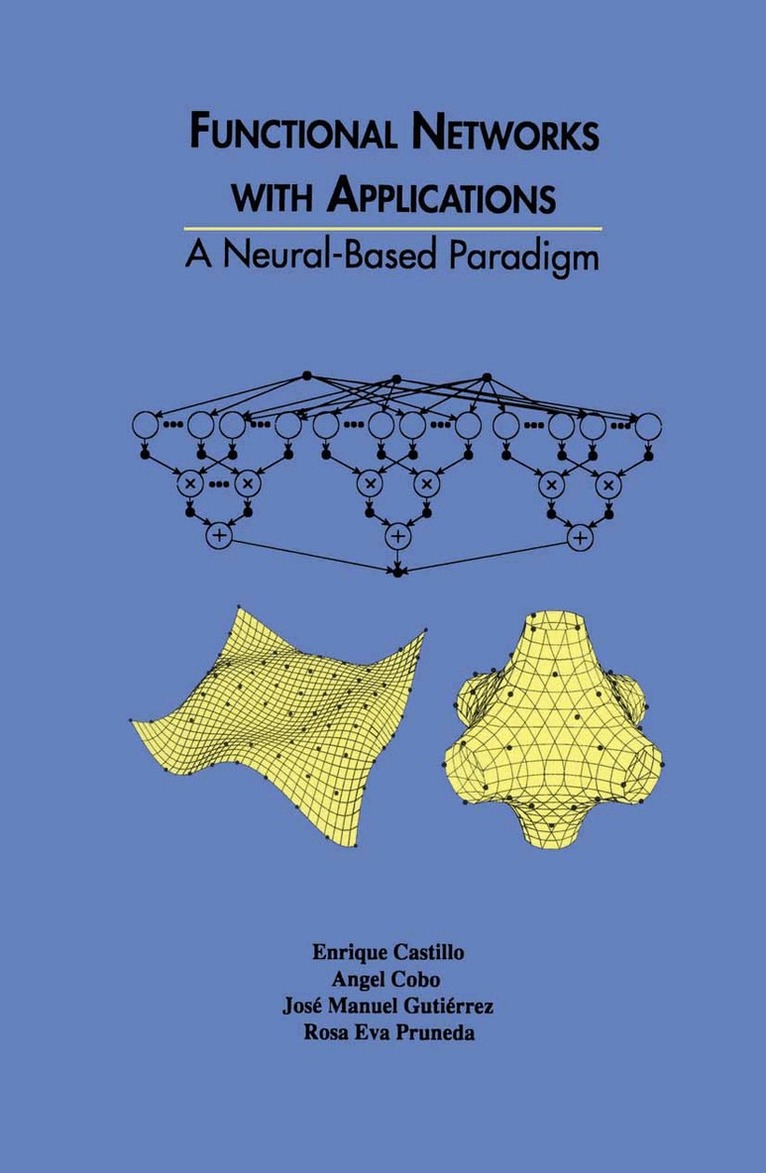
Artificial neural networks have been recognized as a powerful tool to learn and reproduce systems in various fields of applications. Neural net works are inspired by the brain behavior and consist of one or several layers of neurons, or computing units, connected by links. Each artificial neuron receives an input value from the input layer or the neurons in the previ ous layer. Then it computes a scalar output from a linear combination of the received inputs using a given scalar function (the activation function), which is assumed the same for all neurons. One of the main properties of neural networks is their ability to learn from data. There are two types of learning: structural and parametric. Structural learning consists of learning the topology of the network, that is, the number of layers, the number of neurons in each layer, and what neurons are connected. This process is done by trial and error until a good fit to the data is obtained. Parametric learning consists of learning the weight values for a given topology of the network. Since the neural functions are given, this learning process is achieved by estimating the connection weights based on the given information. To this aim, an error function is minimized using several well known learning methods, such as the backpropagation algorithm. Unfortunately, for these methods: (a) The function resulting from the learning process has no physical or engineering interpretation. Thus, neural networks are seen as black boxes.
E-bok
PDF, Engelska, 20112 895 kr
Läs direkt efter köp
A unique, applied approach to problem solving in linear algebra Departing from the standard methods of analysis, this unique book presents methodologies and algorithms based on the concept of orthogonality and demonstrates their application to both standard and novel problems in linear algebra. Covering basic theory of linear systems, linear inequalities, and linear programming, it focuses on elegant, computationally simple solutions to real-world physical, economic, and engineering problems. The authors clearly explain the reasons behind the analysis of different structures and concepts and use numerous illustrative examples to correlate the mathematical models to the reality they represent. Readers are given precise guidelines for: * Checking the equivalence of two systems * Solving a system in certain selected variables * Modifying systems of equations * Solving linear systems of inequalities * Using the new exterior point method * Modifying a linear programming problem With few prerequisites, but with plenty of figures and tables, end-of-chapter exercises as well as Java and Mathematica programs available from the authors'' Web site, this is an invaluable text/reference for mathematicians, engineers, applied scientists, and graduate students in mathematics.
Del 473 - Springer International Series in Engineering and Computer Science
Functional Networks with Applications
A Neural-Based Paradigm
Häftad, Engelska, 2013
1 082 kr
Skickas inom 10-15 vardagar
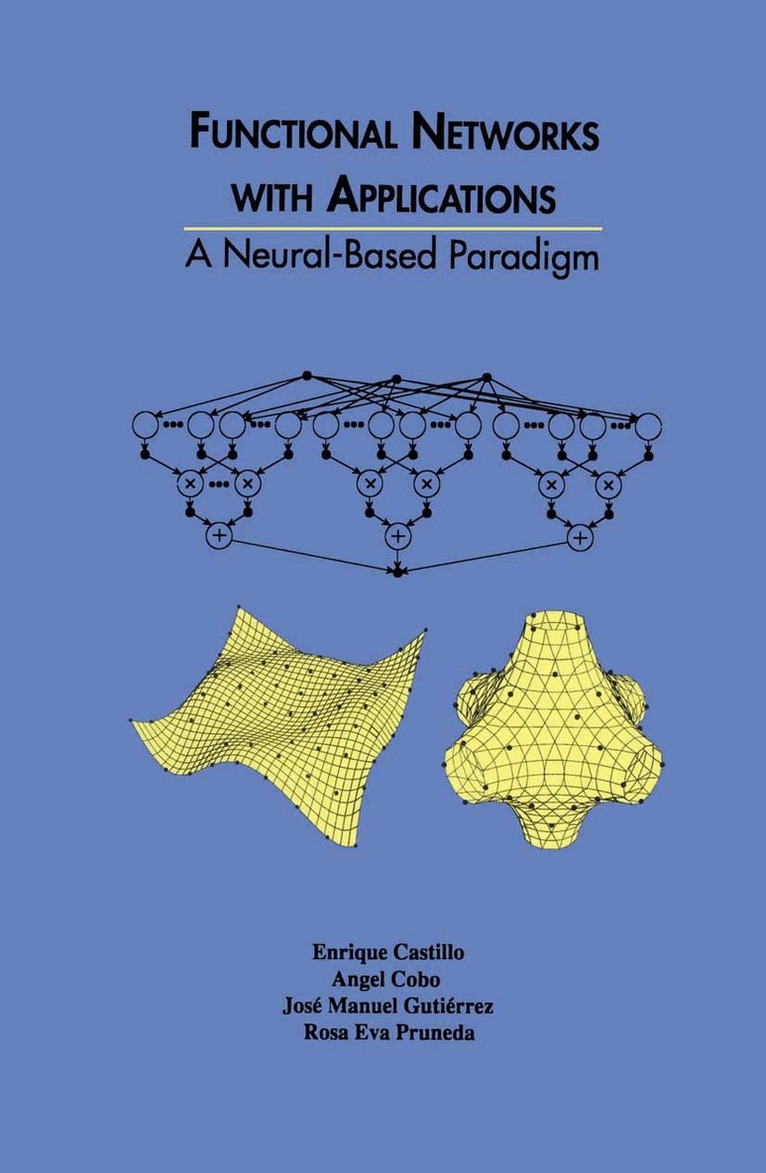
Artificial neural networks have been recognized as a powerful tool to learn and reproduce systems in various fields of applications. Neural net works are inspired by the brain behavior and consist of one or several layers of neurons, or computing units, connected by links. Each artificial neuron receives an input value from the input layer or the neurons in the previ ous layer. Then it computes a scalar output from a linear combination of the received inputs using a given scalar function (the activation function), which is assumed the same for all neurons. One of the main properties of neural networks is their ability to learn from data. There are two types of learning: structural and parametric. Structural learning consists of learning the topology of the network, that is, the number of layers, the number of neurons in each layer, and what neurons are connected. This process is done by trial and error until a good fit to the data is obtained. Parametric learning consists of learning the weight values for a given topology of the network. Since the neural functions are given, this learning process is achieved by estimating the connection weights based on the given information. To this aim, an error function is minimized using several well known learning methods, such as the backpropagation algorithm. Unfortunately, for these methods: (a) The function resulting from the learning process has no physical or engineering interpretation. Thus, neural networks are seen as black boxes.
E-bok
PDF, Engelska, 20121 416 kr
Läs direkt efter köp
Artificial neural networks have been recognized as a powerful tool to learn and reproduce systems in various fields of applications. Neural net works are inspired by the brain behavior and consist of one or several layers of neurons, or computing units, connected by links. Each artificial neuron receives an input value from the input layer or the neurons in the previ ous layer. Then it computes a scalar output from a linear combination of the received inputs using a given scalar function (the activation function), which is assumed the same for all neurons. One of the main properties of neural networks is their ability to learn from data. There are two types of learning: structural and parametric. Structural learning consists of learning the topology of the network, that is, the number of layers, the number of neurons in each layer, and what neurons are connected. This process is done by trial and error until a good fit to the data is obtained. Parametric learning consists of learning the weight values for a given topology of the network. Since the neural functions are given, this learning process is achieved by estimating the connection weights based on the given information. To this aim, an error function is minimized using several well known learning methods, such as the backpropagation algorithm. Unfortunately, for these methods: (a) The function resulting from the learning process has no physical or engineering interpretation. Thus, neural networks are seen as black boxes.