• Fri frakt över 249 kr
  • •
  • Snabba leveranser
  • •
  • Billiga böcker
Kundservice

Du är på sajten för privatpersoner.

Företag, bibliotek eller offentlig verksamhet?

Du handlar på classic.bokus.com, där alla dina funktioner finns intakta.
Till classic.bokus.com
Bokus logotyp. Gå till startsidan.
  • Erbjudanden
  • Student
  • Topplistor
  • Barn & ungdom
  • Bokus Play
  • E-böcker
  • Ljudböcker
  • Pocketböcker
  • Spel och pussel

Pocketfynda! Hundratals böcker för 49 kr/st →

Sidfot

Mina sidor

    Hjälp

    • Kundservice
    • Vanliga frågor och svar
    • Frakt och leverans
    • Retur vid ångerrätt
    • Reklamera vara
    • Betalning
    • Köpvillkor
    • Allmänna villkor
    • Information om webbplatsens tillgänglighet

    Om Bokus

    • Om oss
    • Pressrum
    • För studenter
    • För företag
    • För bibliotek och offentlig verksamhet
    • För leverantörer
    • Hållbarhet

    Populärt

    • Aktuella erbjudanden
    • Presentkort
    • Studentlitteratur
    • Nya böcker
    • Topplistor
    • Signerade böcker
    • Engelska böcker

    Inspiration

    • Boktips
    • BookTok
    • Barnbokskaraktärer
    • Populära författare
    Logotyp för Bokus
    Följ oss på Facebook (extern länk)Följ oss på Instagram (extern länk)Följ oss på YouTube (extern länk)Följ oss på TikTok (extern länk)
    bokus @ CookiesAnpassa cookiesIntegritetspolicyKöpvillkor
    Till Citymail hemsida (extern länk)Till Budbee hemsida (extern länk)Till Postnord hemsida (extern länk)Till Schenker hemsida (extern länk)Till Early Bird hemsida (extern länk)Till Walleys hemsida (extern länk)
    1. Data och IT
    2. Systemvetenskap och AI

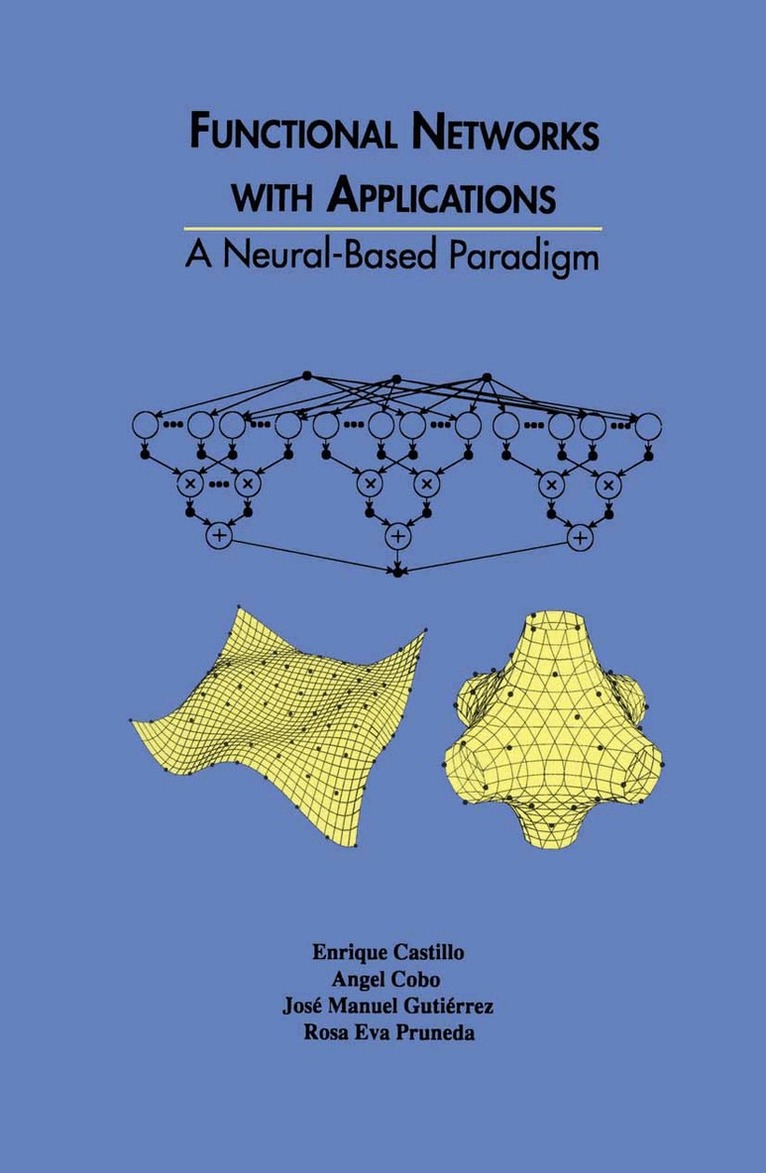
    Functional Networks with Applications

    A Neural-Based Paradigm

    AvEnrique Castillo,Angel Cobo

    Inbunden, Engelska, 1998

    Del i serien Springer International Series in Engineering and Computer Science

    1 110 kr

    Beställningsvara. Skickas inom 10-15 vardagar. Fri frakt över 249 kr.

    Fler format och utgåvor

    Häftad

    1 078 kr

    Beskrivning

    Artificial neural networks have been recognized as a powerful tool to learn and reproduce systems in various fields of applications. Neural net­ works are inspired by the brain behavior and consist of one or several layers of neurons, or computing units, connected by links. Each artificial neuron receives an input value from the input layer or the neurons in the previ­ ous layer. Then it computes a scalar output from a linear combination of the received inputs using a given scalar function (the activation function), which is assumed the same for all neurons. One of the main properties of neural networks is their ability to learn from data. There are two types of learning: structural and parametric. Structural learning consists of learning the topology of the network, that is, the number of layers, the number of neurons in each layer, and what neurons are connected. This process is done by trial and error until a good fit to the data is obtained. Parametric learning consists of learning the weight values for a given topology of the network. Since the neural functions are given, this learning process is achieved by estimating the connection weights based on the given information. To this aim, an error function is minimized using several well known learning methods, such as the backpropagation algorithm. Unfortunately, for these methods: (a) The function resulting from the learning process has no physical or engineering interpretation. Thus, neural networks are seen as black boxes.

    Produktinformation

    • Utgivningsdatum:1998-10-31
    • Mått:155 x 235 x 23 mm
    • Vikt:655 g
    • Format:Inbunden
    • Språk:Engelska
    • Serie:Springer International Series in Engineering and Computer Science
    • Antal sidor:309
    • Upplaga:1999
    • Förlag:Kluwer Academic Publishers
    • ISBN:9780792383321

    Utforska kategorier

    • Systemvetenskap och AI inom Data och IT

    Innehållsförteckning

    • I Neural Networks.- 1 Introduction to Neural Networks.- II Functional Networks.- 2 Introduction to Functional Networks.- 3 Functional Equations.- 4 Some Functional Network Models.- 5 Model Selection.- III Applications.- 6 Applications to Time Series.- 7 Applications to Differential Equations.- 8 Applications to CAD.- 9 Applications to Regression.- IV Computer Programs.- 10 Mathematica Programs.- 11 A Java Applet.- Notation.- References.