Rudi Visker - Böcker
Visar alla böcker från författaren Rudi Visker. Handla med fri frakt och snabb leverans.
6 produkter
6 produkter
Del 155 - Phaenomenologica
Truth and Singularity
Taking Foucault into Phenomenology
Inbunden, Engelska, 1999
2 101 kr
Skickas inom 10-15 vardagar
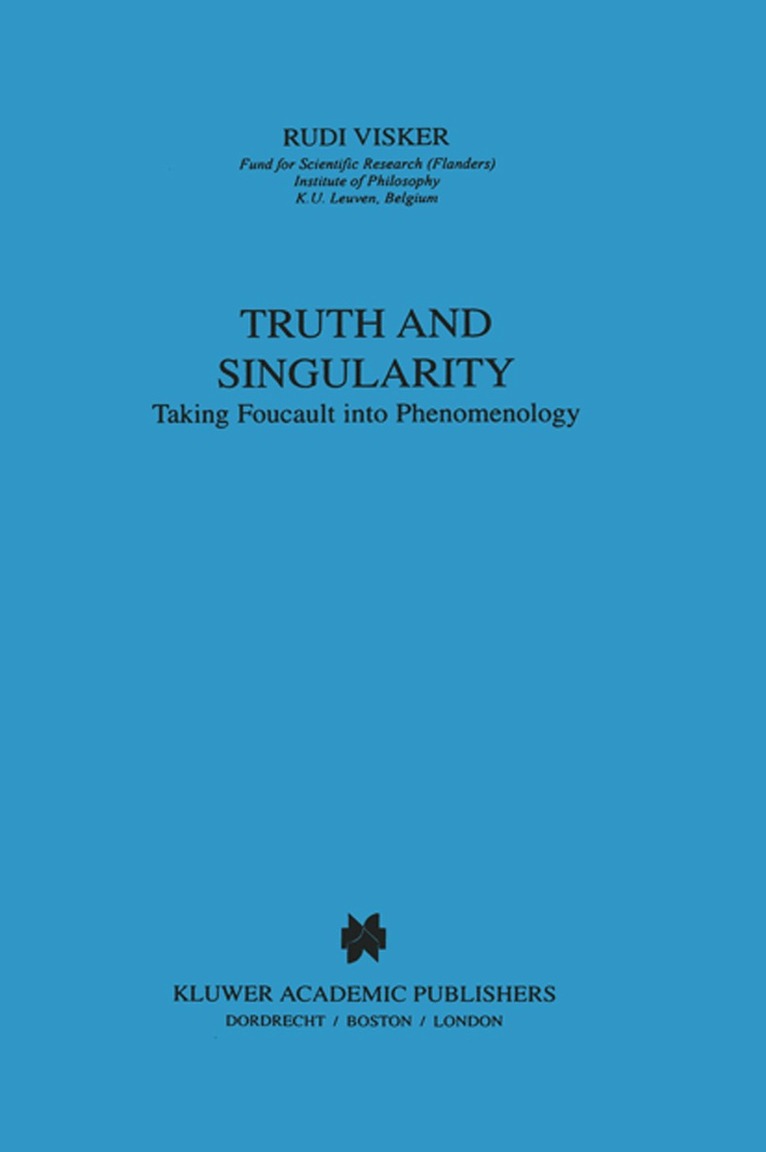
The aim of these essays is to disentangle the opposition between universalism and relativism in which so many debates in philosophy have found themselves caught. Unsurprisingly so, for, as this volume shows, what is in fact returning in these discussions and manoeuvring them into a pre-set course is the very ambiguity which they seek to repress. The name of that ambiguity is, of course, "the subject", but a subject whose finitude seems to have left it with a burden which it did not wait for philosophy to take over. Racism, ethnocentrism and multiculturalism owe their dynamics to a tension at the heart of the subjectivity of a subject which not only lost its place at the centre, but also found its place outside that centre to be less than comfortable. As the collision between phenomenology (Heidegger, Merleau-Ponty, Sartre, Levinas) and post-structuralism (Foucault, Lacan, Derrida) enacted in this volume forces one to conclude, such a decentred subject is all but dead. It is attached to "something" to which it does not access and from which it cannot rid itself, because it is that to which it owes its singularity.
Del 155 - Phaenomenologica
Truth and Singularity
Taking Foucault into Phenomenology
Häftad, Engelska, 2000
2 101 kr
Skickas inom 10-15 vardagar
THE PART OF THE SUBJECT At the origin of these essays, an increasing weariness produced by all those attempts to oppose what came to be known as Foucault's 'post structuralism' to phenomenology - as if the two were incompatible and as if one could only proceed with thought after having chosen sides. And an equal reluctance to join those who pretended they could carryon as they had before since, quite obviously, there were no sides to choose, 'Foucault' being but the latest example of a relativism that one could easily ignore since it had, like all relativism, already refuted itself by daring to speak. And, finally, behind that weariness and that reluctance, a suspicion that what these two reactions to 'Foucault' had in common was a refusal to go 'toward the things themselves' and thus a refusal to approach the texts that we refer to by that proper name as we would approach other phenomena: not as the body-object of a thought that we would have to locate as coming either 'before' or 'after' phenomenology, but as a series of statements that appear to us in a certain way and whose appearing reveals to us something about our own, finite being.
Del 175 - Phaenomenologica
Inhuman Condition
Looking for Difference after Levinas and Heidegger
Inbunden, Engelska, 2004
1 578 kr
Skickas inom 10-15 vardagar
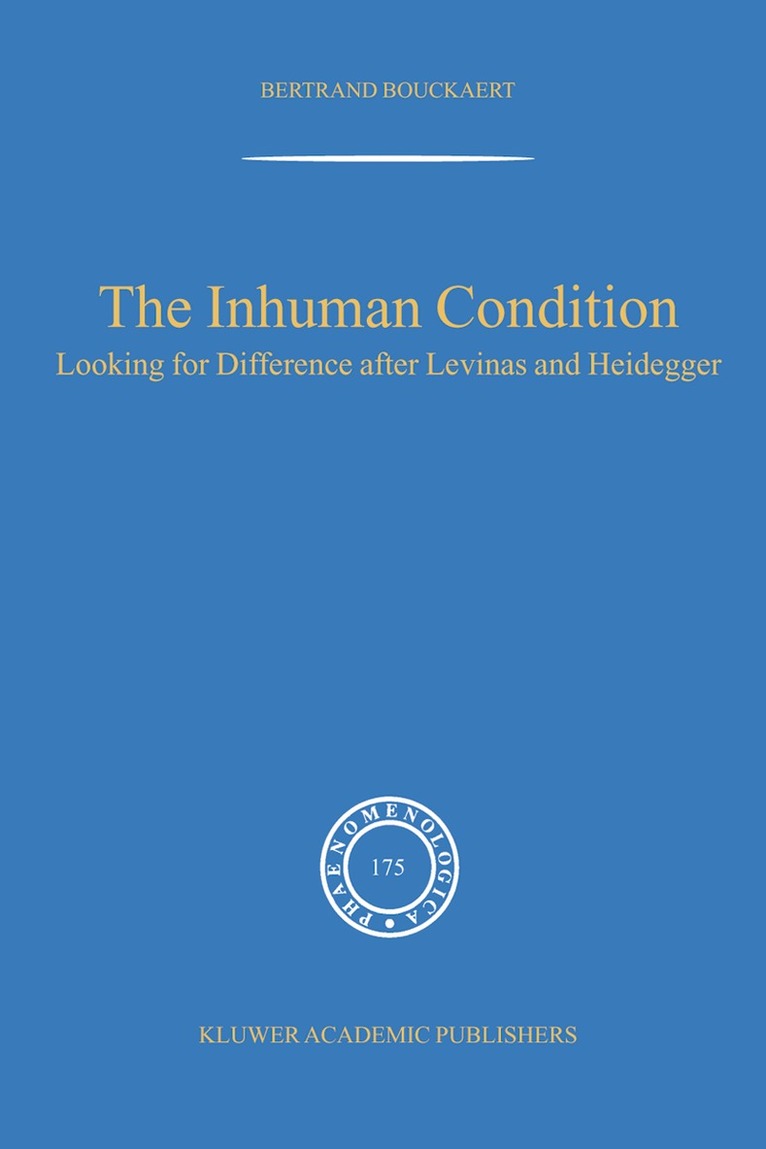
At the origin of this volume, a simple question: what to make of that surprisingly monotonous series of statements produced by our societies and our philosophers that all converge in one theme - the importance of difference?To clarify the meaning of the difference at stake here, we have tried to rephrase it in terms of the two major and mutually competing paradigms provided by the history of phenomenology only to find both of them equally unable to accommodate this difference without violence. Neither the ethical nor the ontological approach can account for a subject that insists on playing a part of its own rather than following the script provided for it by either Being or the Good. What appears to be, from a Heideggerian or Levinasian perspective, an unwillingness to open up to what offers to deliver us from the condition of subjectivity is analysed in these pages as a structure in its own right. Far from being the wilful, indifferent and irresponsive being its critics have portrayed it to be, the so-called 'postmodern' subject is essentially finite, not even able to assume the transcendence to which it owes its singularity. This inability is not a lack - it points instead to a certain unthought shared by both Heidegger and Levinas which sets the terms for a discussion no longer our own. Instead of blaming Heidegger for underdeveloping 'being-with', we should rather stress that his account of mineness may be, in the light of contemporary philosophy, what stands most in need of revision. And, instead of hailing Levinas as the critic whose stress on the alterity of the Other corrects Heidegger's existential solipsism, the problems into which Levinas runs in defining that alterity call for a different diagnosis and a corresponding change in the course that phenomenology has taken since. Instead of preoccupying itself with the invisible, we should focus on the structures of visibility that protect us from its terror.The result? An account of difference that is neither ontological nor ethical, but 'mè-ontological', and that can help us understand some of the problems our societies have come to face (racism, sexism, multiculturalism, pluralism). And, in the wake of this, an unexpected defence of what is at stake in postmodernism and in the question it has refused to take lightly: who are we? Finally, an homage to Arendt and Lyotard who, if read through each other's lenses, give an exact articulation to the question with which our age struggles: how to think the 'human condition' once one realizes that there is an 'inhuman' side to it which, instead of being its mere negation, turns out to be that without which it would come to lose its humanity?
Del 175 - Phaenomenologica
Inhuman Condition
Looking for Difference after Levinas and Heidegger
Häftad, Engelska, 2004
1 578 kr
Skickas inom 10-15 vardagar
At the origin of this volume, a simple question: what to make of that surprisingly monotonous series of statements produced by our societies and our philosophers that all converge in one theme - the importance of difference?To clarify the meaning of the difference at stake here, we have tried to rephrase it in terms of the two major and mutually competing paradigms provided by the history of phenomenology only to find both of them equally unable to accommodate this difference without violence. Neither the ethical nor the ontological approach can account for a subject that insists on playing a part of its own rather than following the script provided for it by either Being or the Good. What appears to be, from a Heideggerian or Levinasian perspective, an unwillingness to open up to what offers to deliver us from the condition of subjectivity is analysed in these pages as a structure in its own right. Far from being the wilful, indifferent and irresponsive being its critics have portrayed it to be, the so-called 'postmodern' subject is essentially finite, not even able to assume the transcendence to which it owes its singularity. This inability is not a lack - it points instead to a certain unthought shared by both Heidegger and Levinas which sets the terms for a discussion no longer our own. Instead of blaming Heidegger for underdeveloping 'being-with', we should rather stress that his account of mineness may be, in the light of contemporary philosophy, what stands most in need of revision. And, instead of hailing Levinas as the critic whose stress on the alterity of the Other corrects Heidegger's existential solipsism, the problems into which Levinas runs in defining that alterity call for a different diagnosis and a corresponding change in the course that phenomenology has taken since. Instead of preoccupying itself with the invisible, we should focus on the structures of visibility that protect us from its terror.The result? An account of difference that is neither ontological nor ethical, but 'mè-ontological', and that can help us understand some of the problems our societies have come to face (racism, sexism, multiculturalism, pluralism). And, in the wake of this, an unexpected defence of what is at stake in postmodernism and in the question it has refused to take lightly: who are we? Finally, an homage to Arendt and Lyotard who, if read through each other's lenses, give an exact articulation to the question with which our age struggles: how to think the 'human condition' once one realizes that there is an 'inhuman' side to it which, instead of being its mere negation, turns out to be that without which it would come to lose its humanity?
314 kr
Skickas inom 3-6 vardagar
The reception of Michel Foucault's work has often been divided between two unsatisfactory alternatives. On the one hand there are those who admire the detail of his concrete analysis, but wonder how the political and ethical commitments they seem to rely on can be justified. On the other, there are those who deny the need for normative foundations, but also find it difficult to explain what makes Foucault's archaeologies and genealogies critical. Rudi Visker's book is not only a lucid and elegant survey of Foucault's corpus, from his early work on madness to the History of Sexuality, but also a major intervention in this debate.Reading Foucault against the Heideggarian backdrop to his work, Visker shows that Foucault's target is not order as such, but rather the production of ordering systems which cannot acknowledge their own conditions of possibility. Exploring along the way such intriguing issues as the ambivalence of Foucault's concepts of truth and power, and his philosophically provocative use of quotation marks, Visker portrays Foucault as neither relativist nor positivist, neither activist nor detached observer. Instead, Foucault emerges as the inventor of a new analysis of our modern mechanisms of control and exclusion: precisely of 'genealogy as critique'.
Del 175 - Phaenomenologica
Inhuman Condition
Looking for Difference after Levinas and Heidegger
Häftad, Engelska, 2014
1 578 kr
Skickas inom 10-15 vardagar
At the origin of this volume, a simple question: what to make of that surprisingly monotonous series of statements produced by our societies and our philosophers that all converge in one theme - the importance of difference?To clarify the meaning of the difference at stake here, we have tried to rephrase it in terms of the two major and mutually competing paradigms provided by the history of phenomenology only to find both of them equally unable to accommodate this difference without violence. Neither the ethical nor the ontological approach can account for a subject that insists on playing a part of its own rather than following the script provided for it by either Being or the Good. What appears to be, from a Heideggerian or Levinasian perspective, an unwillingness to open up to what offers to deliver us from the condition of subjectivity is analysed in these pages as a structure in its own right. Far from being the wilful, indifferent and irresponsive being its critics have portrayed it to be, the so-called 'postmodern' subject is essentially finite, not even able to assume the transcendence to which it owes its singularity. This inability is not a lack - it points instead to a certain unthought shared by both Heidegger and Levinas which sets the terms for a discussion no longer our own. Instead of blaming Heidegger for underdeveloping 'being-with', we should rather stress that his account of mineness may be, in the light of contemporary philosophy, what stands most in need of revision. And, instead of hailing Levinas as the critic whose stress on the alterity of the Other corrects Heidegger's existential solipsism, the problems into which Levinas runs in defining that alterity call for a different diagnosis and a corresponding change in the course that phenomenology has taken since. Instead of preoccupying itself with the invisible, we should focus on the structures of visibility that protect us from its terror.The result? An account of difference that is neither ontological nor ethical, but 'mè-ontological', and that can help us understand some of the problems our societies have come to face (racism, sexism, multiculturalism, pluralism). And, in the wake of this, an unexpected defence of what is at stake in postmodernism and in the question it has refused to take lightly: who are we? Finally, an homage to Arendt and Lyotard who, if read through each other's lenses, give an exact articulation to the question with which our age struggles: how to think the 'human condition' once one realizes that there is an 'inhuman' side to it which, instead of being its mere negation, turns out to be that without which it would come to lose its humanity?