Ruth Macklin - Böcker
Visar alla böcker från författaren Ruth Macklin. Handla med fri frakt och snabb leverans.
11 produkter
11 produkter
Against Relativism
Cultural Diversity and the Search for Ethical Universals in Medicine
Inbunden, Engelska, 1999
581 kr
Skickas inom 5-8 vardagar
This book provides an analysis of the debate surrounding the facts of cultural diversity, the charge of "ethical imperialism", and the thesis that ethics must be viewed as relative to particular cultures or societies. Macklin examines the role of cultural traditions when used as a defense against critical ethical judgements. She explores key issues in health and medicine seen through the lens of cultural diversity: the physician-patient relationship, disclosing a diagnosis of fatal illness, informed consent, brain death and organ transplantation, rituals surrounding birth and death, female genital mutilation, sex selection of offspring, fertility regulation, and biomedical research involving human subjects. Among the conclusions she reaches are that ethical universals exist, but they should not be confused with ethical absolutes; and that the existence of ethical universals is compatible with a variety of culturally relative interpretations. Some rights related to medicine and healthcare ought to be considered human rights. Illustrative examples are drawn from the author's experience serving on international ethical review committees and her travels to a dozen countries in Africa, Asia, and Latin America, where she conducted educational workshops and carried out her own research.
1 128 kr
Skickas inom 5-8 vardagar
This is a collection of Ruth Macklin's previously published articles that appeared in scholarly journals or as chapters in books. Dr. Macklin's pioneering work in ethics and global health spans more than two decades. The articles in this volume range from a chapter in a book published in 1989 to a journal article currently in press. The essays fall into two broad categories: policy and practice, and multinational research. Topics in the first category include cultural beliefs and attitudes regarding family planning, long-acting contraception, abortion, and more broadly, policies and practices affecting women's health. Two essays dealing with justice focus on HIV/AIDS: how developing country governments might distribute medications fairly to all who are in need; and what obligations do industrialized countries and world leaders have to provide affordable medications to developing countries. A theme that runs throughout the essays is a defense of the universality of ethical principles, despite cultural differences that exist around the globe. The section on multinational research includes articles on international ethics guidance documents, such as the Declaration of Helsinki; discussion of the obligations of researchers and sponsors when they conduct research in developing countries; what constitutes exploitation when research is conducted in resource-poor countries; and, as in the first section of the book, the application of universal ethical principles to the global research enterprise. The author criticizes the view that double standards in research are acceptable: one standard for rich countries, and a lower standard for developing countries. Several essays deal with sensitive and controversial ethical aspects of research on reproductive health and HIV/AIDS.
1 064 kr
Skickas inom 10-15 vardagar
Del 2 - Cambridge Law, Medicine and Ethics
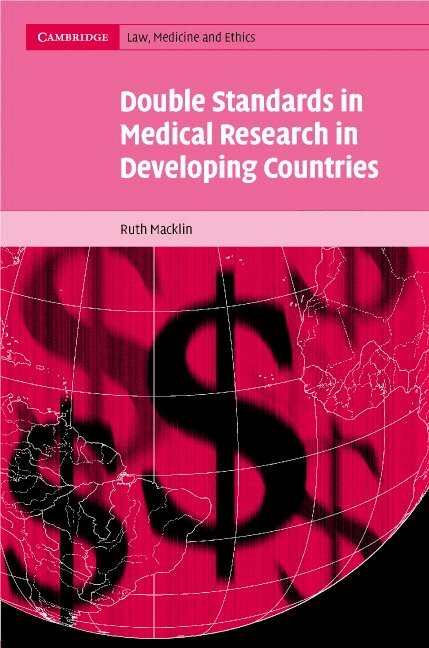
Double Standards in Medical Research in Developing Countries
Häftad, Engelska, 2004
712 kr
Skickas inom 7-10 vardagar
This book examines the ethical controversies that have surrounded the design and conduct of international medical research sponsored by industrialized countries or industry, and carried out in developing countries. The chief concern is that research subjects in developing countries may be exploited because sponsors of research employ double standards. One debate focuses on whether the standard of care provided to subjects of medical research in developing countries should be the same as what research subjects receive in North America and Europe. Other concerns are whether the process of obtaining informed consent in developing countries is adequate, and whether prior ethical review of research meets standards that are well established in the industrialized world. Recent international developments show that essential medications can be made affordable and accessible to developing countries, and that double standards need not prevail.
Del 2 - Cambridge Law, Medicine and Ethics
Double Standards in Medical Research in Developing Countries
Inbunden, Engelska, 2004
956 kr
Skickas inom 7-10 vardagar
This book examines the ethical controversies that have surrounded the design and conduct of international medical research sponsored by industrialized countries or industry, and carried out in developing countries. The chief concern is that research subjects in developing countries may be exploited because sponsors of research employ double standards. One debate focuses on whether the standard of care provided to subjects of medical research in developing countries should be the same as what research subjects receive in North America and Europe. Other concerns are whether the process of obtaining informed consent in developing countries is adequate, and whether prior ethical review of research meets standards that are well established in the industrialized world. Recent international developments show that essential medications can be made affordable and accessible to developing countries, and that double standards need not prevail.
1 096 kr
Skickas inom 10-15 vardagar
The place of drugs in American society is a problem more apt to evoke diatribe than dialog. With the support of the Na tional Science Foundation's program on Ethics and Values in Science and Technology, and the National Endowment for the Humanities' program on Science, Technology, and Human Values, * The Hastings Center was able to sponsor such dialog as part of a major research into the ethics of drug use that spanned two years. We assembled a Research Group from leaders in the scientific, medical, legal, and policy com munities, leavened with experts in applied ethics, and brought them together several times a year to discuss the moral, legal and social issues posed by nontherapeutic drug use. At times we also called on other experts when we needed certain issues clarified. We did not try to reach a consensus, yet several broad areas of agreement emerged: That our society's response to nontherapeutic drug use has been irrational and inconsistent; that our attempts at control have been clumsy and ill-informed; that many complex moral values are entwined in the debate and cannot be reduced to a simple conflict between individual liberty and state paternalism. Of course each paper should be read as the statement of that particular author or authors. The views expressed in this book do not necessarily represent the views of The Hastings Center, the National Science Foundation, or the National En dowment for the Humanities.
433 kr
Skickas inom 5-8 vardagar
536 kr
Skickas inom 10-15 vardagar
The place of drugs in American society is a problem more apt to evoke diatribe than dialog. With the support of the Na tional Science Foundation's program on Ethics and Values in Science and Technology, and the National Endowment for the Humanities' program on Science, Technology, and Human Values, * The Hastings Center was able to sponsor such dialog as part of a major research into the ethics of drug use that spanned two years. We assembled a Research Group from leaders in the scientific, medical, legal, and policy com munities, leavened with experts in applied ethics, and brought them together several times a year to discuss the moral, legal and social issues posed by nontherapeutic drug use. At times we also called on other experts when we needed certain issues clarified. We did not try to reach a consensus, yet several broad areas of agreement emerged: That our society's response to nontherapeutic drug use has been irrational and inconsistent; that our attempts at control have been clumsy and ill-informed; that many complex moral values are entwined in the debate and cannot be reduced to a simple conflict between individual liberty and state paternalism. Of course each paper should be read as the statement of that particular author or authors. The views expressed in this book do not necessarily represent the views of The Hastings Center, the National Science Foundation, or the National En dowment for the Humanities.
1 096 kr
Skickas inom 10-15 vardagar
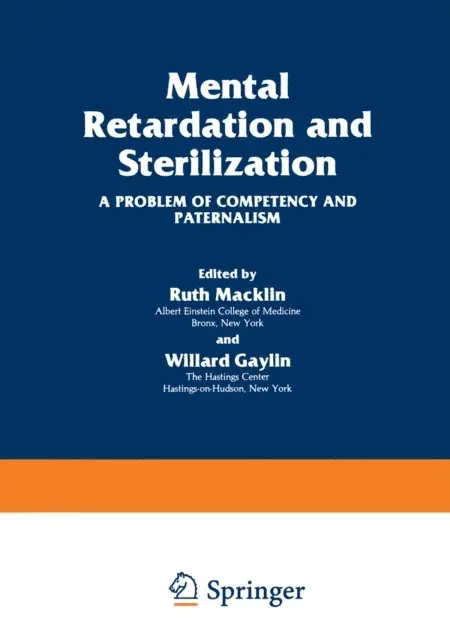
1 This book is the product of a one-year project conducted by the Hastings Center, Institute of Society, Ethics and the Life Sciences, during 1976-1977. The Behavior Control Research Group-an ongoing, interdisciplinary working group com posed of philosophers, psychiatrists, psychologists, social sci entists, and lawyers-met four times over the course of the year with special consultants with expertise in the field of mental retardation. At those meetings, participants gave in formal presentations, which were followed by group discus sion. As the project progressed, formal papers were delivered and subjected to further critical commentary. This volume, in two related parts, represents the deliberations of the group as a whole, and then offers individual papers prepared by some scholars in order to give a sense of the kind of specific arguments on which the general conclusions were based. We undertook the project to examine: (1) questions of competence and consent; and (2) the practical implications, lThe project, entitled "Ethical Issues in the Care and Treatment of the Mildly Mentally Retarded," was supported by the EVI5T program of the National Science Foundation under Grant No. 05576-14793. Any Opinions, findings, conclusions, or recommendations expressed herein are those of the authors and do not necessarily reflect the views of the National Science Foundation. ix x PREFACE in terms of care and treatment, that evolve from differing definitions and models applied to mental retardation.
1 096 kr
Skickas inom 10-15 vardagar
This volume is one outcome of a two-year study conducted by the Behavioral Studies Research Group of The Hastings 1 Center. It is divided into three parts to reflect the several facets of the interdisciplinary project from which it stems. In the opening chapter Willard Gaylin and Ruth Macklin, who di rected the study, describe its basic conception and structure, which centered around three programs to conduct research into aspects of violence and aggressive behavior, programs aborted in the early 1970s because they were politically and IThis project was supported by the EVIST Program of the National Science Foundation under Grant No. 05577-17072, and by a joint award by the National Endowment for the Humanities. Any opinions, findings, conclu sions, or recommendations expressed herein are those of the authors and do not necessarily reflect the views of the National Science Foundation or the National Endowment for the Humanities. Other published outcomes are the edited transcripts of two of the case-study workshops conducted under this project: "Researching Violence: Science, Politics, and Public Contro versy," Special Supplement, The Hastings Center Report 9 (April 1979); and "The XYY Controversy: Researching Violence and Genetics," Special Sup plement, The Hastings Center Report 10 (August 1980). Copies of these tran scripts are available for purchase from The Hastings Center, 360 Broadway, Hastings-on-Hudson, NY 10706. ix PREFACE x socially controversial.
370 kr
Skickas inom 11-20 vardagar
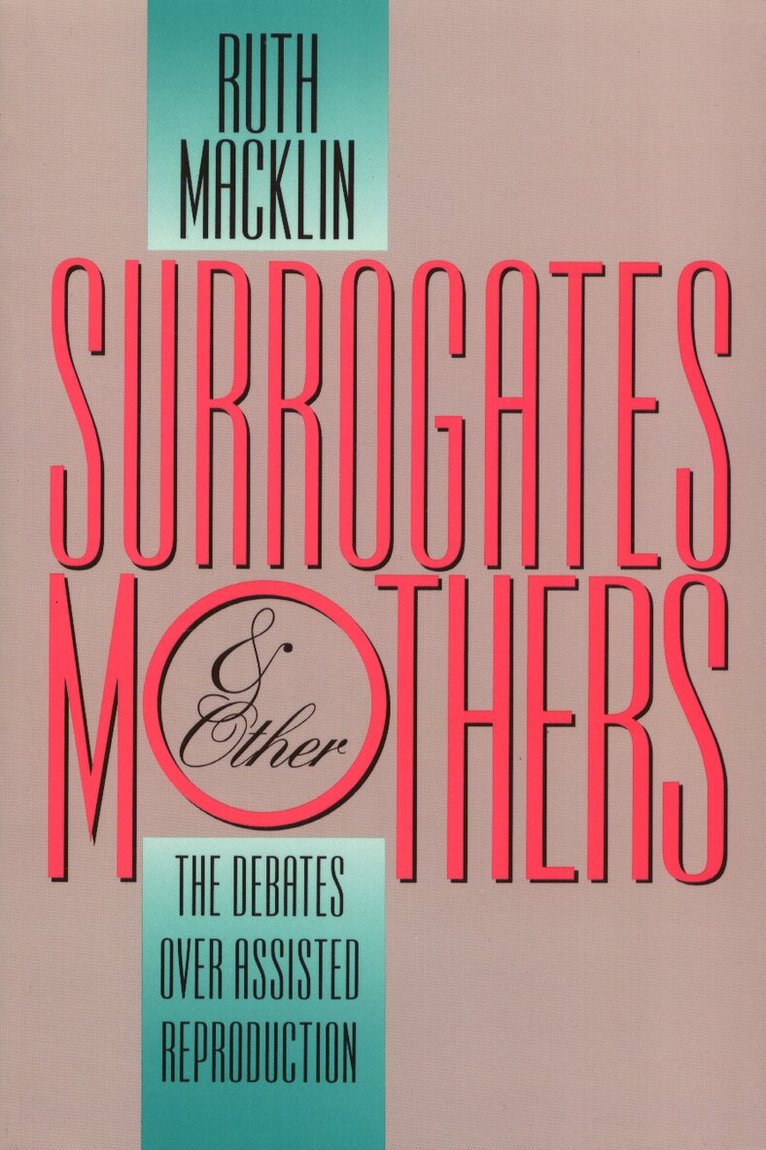
Developments in new reproductive technologies have confounded public policy and created legal and ethical quandaries for professionals and ordinary citizens alike. Drawing from the most current medical, psychiatric, legal, and bioethical literature, Ruth Macklin, noted author and philosopher, presents the arguments surrounding these advances through the voices of fictional characters. The episodes she narrates are based on real-life situations, both from her personal experience as a hospital ethicist and from the public arena, where such controversial court cases as that of Baby M have sparked a multitude of disparate opinions on surrogacy, in vitro fertilization, and egg and sperm donor program.Macklin's hypoethical tale centers on Bonnie and Larry, an infertile couple longing for a child. As the couple's quest to become parents begins, they discover that Bonnie is physically incapable of carrying a pregnancy to term. Desperate to explore their options, Bonnie and Larry attempt adoption but are rejected by the agency without explanation. Finally, they contemplate surrogacy as their last chance to have a child. Seeking advice and answers, they consult health professionals, lawyers, pastoral counselors, and a bioethicist. In the course of this complicated and often painful decision-making process, they attend meetings of a government task force on reproduction where they hear both radical and liberal feminist positions.Their experiences with friends, family members, two surrogates, hospital ethics committees, and special interest groups underscore the difficulty of coming to a consensus on such issues as AIDS, the right to privacy, premenstrual syndrome, the violation of surrogate contracts, and the responsibilities of therapists and physicians to their patients and to the community at large.