Ruth Meyer – författare
91 kr
Skickas
230 kr
Skickas inom 5-8 vardagar
181 kr
Läs direkt efter köp
340 kr
Läs direkt efter köp
351 kr
Läs direkt efter köp
3 033 kr
Läs direkt efter köp
Das um 1400 im Dominikanerkloster Nürnberg entstandene Prosalegendar "Der Heiligen Leben" war die verbreitetste volkssprachliche Legendensammlung des europäischen Mittelalters. Es ist in knapp 200 Handschriften und 33 oberdeutschen und 8 niederdeutschen Druckauflagen überliefert und war im gesamten deutschsprachigen Raum wie in den Niederlanden und in Skandinavien verbreitet. Das Werk stellt eine große Ausnahme unter den deutschen Legendaren dar, weil es nicht auf lateinische Quellen, sondern letztlich fast ausschließlich auf deutsche Vers- und Prosalegenden zurückgeht ("Passional", "Märterbuch", Hartmanns von Aue "Gregorius", Ebernands von Erfurt "Heinrich und Kunigunde", Reinbots von Durne "Georg" usw.). Es galt als volkssprachliches hagiographisches Quellenbuch schlechthin (Meistersinger, Jakob Mennel usw.) und wurde auf Grund seiner großen Popularität 1535 auch zum Ziel einer Spottschrift Luthers. Der überlieferungsgeschichtlichen Ausgabe (in zwei Bänden) liegt die älteste und zuverlässigste Sommerteilhandschrift, Oxford, Bodleian Library, Ms. Laud. 443, zugrunde. Band II: Der Winterteil erscheint in einigen Jahren und wird ein Personen- und Ortsregister enthalten.
4 100 kr
Skickas inom 10-15 vardagar
5 213 kr
Läs direkt efter köp
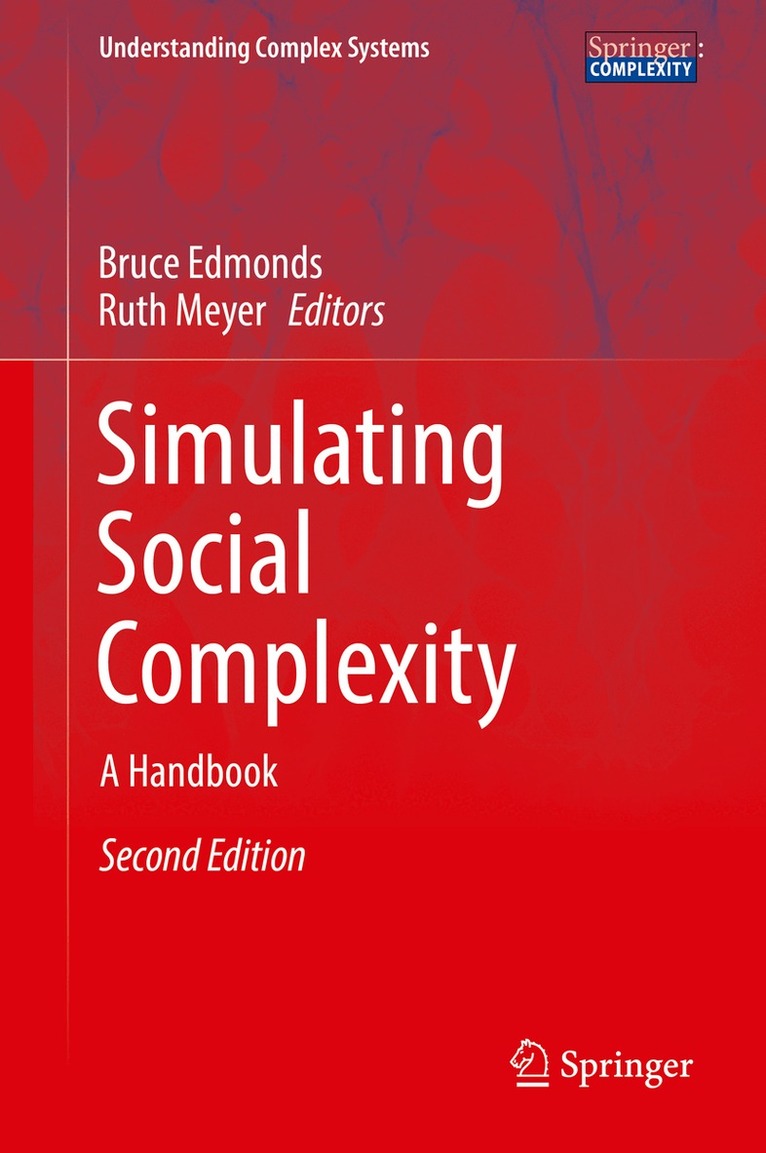
This volume examines all aspects of using agent or individual-based simulation. This approach represents systems as individual elements having their own set of differing states and internal processes. The interactions between elements in the simulation represent interactions in the target systems. What makes this "social" is that it can represent an observed society.
Social systems include all those systems where the components have individual agency but also interact with each other. This includes human societies and groups, but also increasingly socio-technical systems where the internet-based devices form the substrate for interaction. These systems are central to our lives, but are among the most complex known. This poses particular problems for those who wish to understand them. The complexity often makes analytic approaches infeasible but, on the other hand, natural language approaches are also inadequate for relating intricate cause and effect. This is why individual and agent-based computational approaches hold out the possibility of new and deeper understanding of such systems.
This handbook marks the maturation of this new field. It brings together summaries of the best thinking and practices in this area from leading researchers in the field and constitutes a reference point for standards against which future methodological advances can be judged.
This second edition adds new chapters on different modelling purposes and applying software engineering methods to simulation development. Revised existing content will keep the book up-to-date with recent developments. This volume will help those new to the field avoid "reinventing the wheel" each time, and give them a solid and wide grounding in the essential issues. It will also help those already in the field by providing accessible overviews of current thought. The material is divided into four sections: Introduction, Methodology, Mechanisms, and Applications. Each chapter starts with a very brief section called ‘Why read this chapter?’ followed by an abstract, which summarizes the content of the chapter. Each chapter also ends with a section on ‘Further Reading’.
Whilst sometimes covering technical aspects, this second edition of Simulating Social Complexity is designed to be accessible to a wide range of researchers, including both those from the social sciences as well as those with a more formal background. It will be of use as a standard reference text in the field and also be suitable for graduate level courses.
4 100 kr
Skickas inom 10-15 vardagar
Sommerteil
3 308 kr
Skickas inom 5-8 vardagar
2 071 kr
Skickas inom 5-8 vardagar
1 977 kr
Läs direkt efter köp
Social systems are among the most complex known. This poses particular problems for those who wish to understand them. The complexity often makes analytic approaches infeasible and natural language approaches inadequate for relating intricate cause and effect. However, individual- and agent-based computational approaches hold out the possibility of new and deeper understanding of such systems.
Simulating Social Complexity examines all aspects of using agent- or individual-based simulation. This approach represents systems as individual elements having each their own set of differing states and internal processes. The interactions between elements in the simulation represent interactions in the target systems. What makes these elements "social" is that they are usefully interpretable as interacting elements of an observed society. In this, the focus is on human society, but can be extended to include social animals or artificial agents where such work enhances our understanding of human society.
The phenomena of interest then result (emerge) from the dynamics of the interaction of social actors in an essential way and are usually not easily simplifiable by, for example, considering only representative actors.
The introduction of accessible agent-based modelling allows the representation of social complexity in a more natural and direct manner than previous techniques. In particular, it is no longer necessary to distort a model with the introduction of overly strong assumptions simply in order to obtain analytic tractability. This makes agent-based modelling relatively accessible to a range of scientists. The outcomes of such models can be displayed andanimated in ways that also make them more interpretable by experts and stakeholders.
This handbook is intended to help in the process of maturation of this new field. It brings together, through the collaborative effort of many leading researchers, summaries of the best thinking and practice in this area and constitutes a reference point for standards against which future methodological advances are judged.
This book will help those entering into the field to avoid "reinventing the wheel" each time, but it will also help those already in the field by providing accessible overviews of current thought. The material is divided into four sections: Introductory, Methodology, Mechanisms, and Applications. Each chapter starts with a very brief section called ‘Why read this chapter?’ followed by an abstract, which summarizes the content of the chapter. Each chapter also ends with a section of ‘Further Reading’ briefly describing three to eight items that a newcomer might read next.