• Fri frakt över 249 kr
  • •
  • Snabba leveranser
  • •
  • Billiga böcker
Kundservice

Du är på sajten för privatpersoner.

Företag, bibliotek eller offentlig verksamhet?

Du handlar på classic.bokus.com, där alla dina funktioner finns intakta.
Till classic.bokus.com
Bokus logotyp. Gå till startsidan.
  • Erbjudanden
  • Student
  • Topplistor
  • Barn & ungdom
  • Bokus Play
  • E-böcker
  • Ljudböcker
  • Pocketböcker
  • Spel & pussel

Upp till 25% på utvalda nyheter →

Sidfot

Mina sidor

    Hjälp

    • Kundservice
    • Vanliga frågor och svar
    • Frakt och leverans
    • Retur vid ångerrätt
    • Reklamera vara
    • Betalning
    • Köpvillkor
    • Allmänna villkor
    • Information om webbplatsens tillgänglighet

    Om Bokus

    • Om oss
    • Pressrum
    • För studenter
    • För företag
    • För bibliotek och offentlig verksamhet
    • För leverantörer
    • Hållbarhet

    Populärt

    • Aktuella erbjudanden
    • Presentkort
    • Studentlitteratur
    • Nya böcker
    • Topplistor
    • Signerade böcker
    • Engelska böcker

    Inspiration

    • Boktips
    • BookTok
    • Populära bokserier
    • Barnbokskaraktärer
    • Populära författare
    Logotyp för Bokus
    Följ oss på Facebook (extern länk)Följ oss på Instagram (extern länk)Följ oss på YouTube (extern länk)Följ oss på TikTok (extern länk)
    bokus @ CookiesAnpassa cookiesIntegritetspolicyKöpvillkor
    Till Citymail hemsida (extern länk)Till Budbee hemsida (extern länk)Till Postnord hemsida (extern länk)Till Schenker hemsida (extern länk)Till Early Bird hemsida (extern länk)Till Walleys hemsida (extern länk)
    1. Samhälle och politik
    2. Sociologi och antropologi
    3. Sociologi

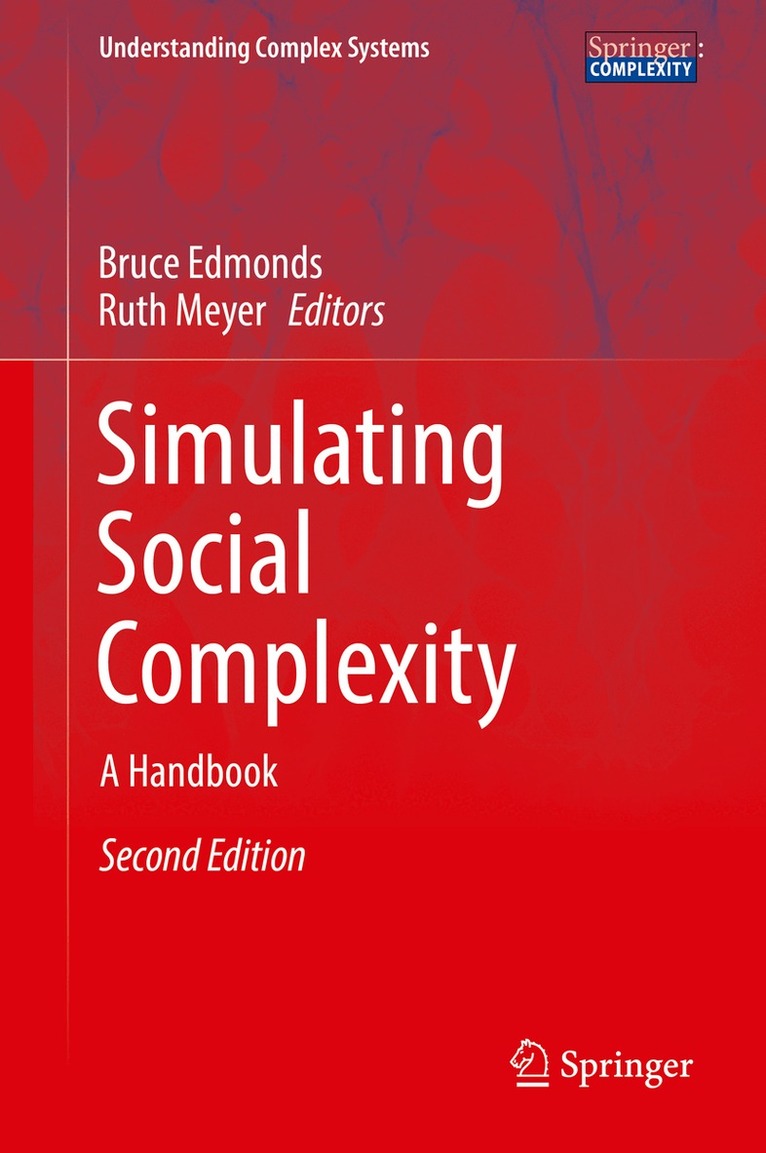
    Simulating Social Complexity

    A Handbook

    AvBruce Edmonds,Ruth Meyer

    Inbunden, Engelska, 2017

    Del i serien Understanding Complex Systems

    4 109 kr

    Beställningsvara. Skickas inom 10-15 vardagar. Fri frakt över 249 kr.

    Beskrivning

    This volume examines all aspects of using agent or individual-based simulation. This approach represents systems as individual elements having their own set of differing states and internal processes. The interactions between elements in the simulation represent interactions in the target systems. What makes this "social" is that it can represent an observed society.Social systems include all those systems where the components have individual agency but also interact with each other. This includes human societies and groups, but also increasingly socio-technical systems where the internet-based devices form the substrate for interaction. These systems are central to our lives, but are among the most complex known. This poses particular problems for those who wish to understand them. The complexity often makes analytic approaches infeasible but, on the other hand, natural language approaches are also inadequate for relating intricate cause and effect. This is why individual and agent-based computational approaches hold out the possibility of new and deeper understanding of such systems.This handbook marks the maturation of this new field. It brings together summaries of the best thinking and practices in this area from leading researchers in the field and constitutes a reference point for standards against which future methodological advances can be judged.This second edition adds new chapters on different modelling purposes and applying software engineering methods to simulation development. Revised existing content will keep the book up-to-date with recent developments. This volume will help those new to the field avoid "reinventing the wheel" each time, and give them a solid and wide grounding in the essential issues. It will also help those already in the field by providing accessible overviews of current thought. The material is divided into four sections: Introduction, Methodology, Mechanisms, and Applications. Each chapter starts with a very brief section called ‘Why read this chapter?’ followed by an abstract, which summarizes the content of the chapter. Each chapter also ends with a section on ‘Further Reading’.Whilst sometimes covering technical aspects, this second edition of Simulating Social Complexity is designed to be accessible to a wide range of researchers, including both those from the social sciences as well as those with a more formal background. It will be of use as a standard reference text in the field and also be suitable for graduate level courses.

    Produktinformation

    • Utgivningsdatum:2017-12-11
    • Mått:155 x 235 x 51 mm
    • Vikt:1 420 g
    • Format:Inbunden
    • Språk:Engelska
    • Serie:Understanding Complex Systems
    • Antal sidor:838
    • Upplaga:2
    • Förlag:Springer International Publishing AG
    • ISBN:9783319669472

    Utforska kategorier

    • Sociologi inom Samhälle och politik

    Mer om författaren

    Among his numerous responsibilities, Dr. Bruce Edmonds is the Director for the Centre of Policy Modeling at Manchester Metropolitan University.  He has edited numerous books for Springer; he's a member of the Dalton Research Institute and a board member for the European Complex Systems Society.Ruth Meyer is also a former Springer book editor.  She's a Research Associate at the Center of Policy Modeling at Manchester Metropolitan University.  Among others, her research interests lie in agent-based simulation and discrete-event simulation.

    Innehållsförteckning

    • Part1. Introduction.- Chapter1. Introduction.- Chapter2. Historical Introduction.- Chapter3. Types of Simulation.- Chapter4. Different Modelling Purposes.- Part2. Methodology.- Chapter5. Informal Approaches to Developing Simulations.- Chapter6. Applying software engineering methods to simulation development.- Chapter6. Checking Simulations.- Chapter7. Verifying and Validating simulations.- Chapter8. Understanding Simulation Results.- Chapter9. How many runs should one do .- Chapter10. Participatory Approaches.- Chapter11. Combining Analytic and Simulation Approaches.- Chapter12. Interpreting and Understanding Simulations.- Chapter13. Documenting Social Simulation Models: The ODD Protocol as a Standard.- Part3. Mechanisms.- Chapter14. Utility, Games, and Narratives.- Chapter15. Social Constraint.- Chapter16. Reputation.- Chapter17. Social Networks and Spatial Distribution.- Chapter18. Learning.- Chapter19. Evolutionary Mechanisms.- Part4. Applications.- Chapter20.Agent-based Modelling and Simulation Applied to Environmental Management.- Chapter21. Distributed Computer Systems.- Chapter22. Simulating Complexity of Animal Social Behaviour.- Chapter23. Agent-based Simulation as a Useful Tool for the Study of Markets.- Chapter24. Movement of People and Goods.- Chapter25. Modeling Power and Authority: An Emergentist View from Afghanistan.- Chapter26. Human Societies – Understanding Observed Social Phenomena.- Chapter27. Some pitfalls to beware when applying models to issues of policy relevance.