Ruth Whitehouse - Böcker
Visar alla böcker från författaren Ruth Whitehouse. Handla med fri frakt och snabb leverans.
3 produkter
3 produkter
441 kr
Skickas inom 7-10 vardagar
A concise, clearly written introduction to the early past of Britain and Europe from the beginnings up to the twelfth century AD, which presents archaeological research in a readily understandable form. Written, and originally published in 1973, for readers with no specialist knowledge or the subject, a major virtue of this book is the way in which it brings into focus all the separate strands of evidence to present a coherent narrative development. The account starts with a brief survey of human evolution and a consideration of the evidence of tool-making in the Old Stone Age. It goes on to describe the origins and spread of farming and the subsequent development of metallurgy and full urban civilization and the contribution made by the urban civilization of Rome to the development of Europe. It looks at the Migration Period through to the reestablishment of urban culture in northern Europe concluding with a brief description of conditions in the twelfth century.
1 232 kr
Skickas inom 7-10 vardagar
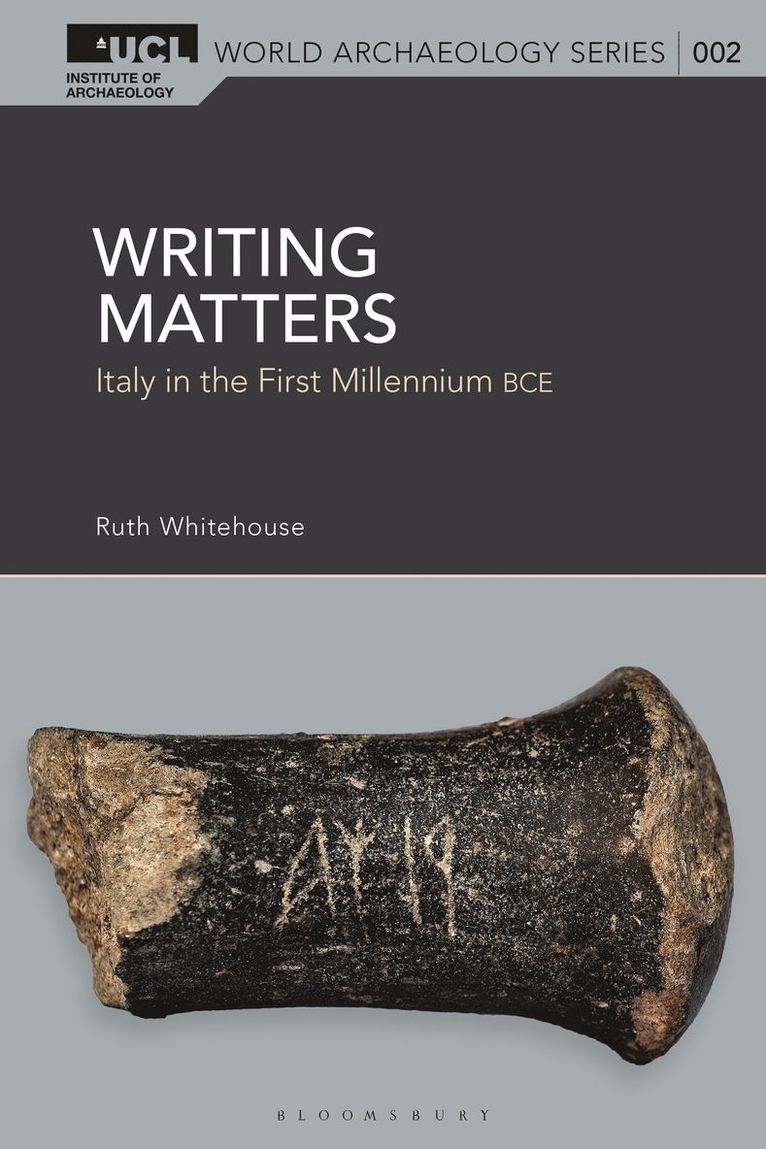
The epigraphy of 1st-millennium-BCE Italy has been studied for many years, but these studies have largely concentrated on the languages encoded in the inscriptions and their semantic meanings. This book takes a more holistic approach that looks not only at content, but also the archaeological contexts of the inscriptions and the materiality of their 'supports': the artefacts and monuments on which the inscriptions occur.The first writing in Italy was not a local invention, but was introduced by the Phoenicians and Greeks in the 9th–8th centuries BCE. It was taken up by number of indigenous communities over the subsequent centuries to write their own languages, before these were eventually submerged by the spread of Latin.In a series of theoretical, methodological and interpretative essays, Ruth Whitehouse explores what can be learned about how writing was used by these communities and what it meant to them. The bodies of data considered relate to Venetic and Raetic (the northeast), Lepontic (the northwest), Messapic (the southeast) and Etruscan (west central Italy, extending also into Campania in the south and the Po plain in the north). While not a comprehensive survey, there are enough different groups to allow a comparative approach to be adopted. Analysis of the datasets is able to reveal the similarities and differences between them, as well as identify features that were widespread in 1st-millennium-BCE Italy and others that were more idiosyncratic and specific to particular cultural groups. Placing materiality at the centre of study allows a reconsideration of the roles writing played in the lives of the individuals and groups who occupied Italy in the 1st millennium BCE.
499 kr
Kommande
The epigraphy of 1st-millennium-BCE Italy has been studied for many years, but these studies have largely concentrated on the languages encoded in the inscriptions and their semantic meanings. This book takes a more holistic approach that looks not only at content, but also the archaeological contexts of the inscriptions and the materiality of their 'supports': the artefacts and monuments on which the inscriptions occur.The first writing in Italy was not a local invention, but was introduced by the Phoenicians and Greeks in the 9th–8th centuries BCE. It was taken up by number of indigenous communities over the subsequent centuries to write their own languages, before these were eventually submerged by the spread of Latin.In a series of theoretical, methodological and interpretative essays, Ruth Whitehouse explores what can be learned about how writing was used by these communities and what it meant to them. The bodies of data considered relate to Venetic and Raetic (the northeast), Lepontic (the northwest), Messapic (the southeast) and Etruscan (west central Italy, extending also into Campania in the south and the Po plain in the north). While not a comprehensive survey, there are enough different groups to allow a comparative approach to be adopted. Analysis of the datasets is able to reveal the similarities and differences between them, as well as identify features that were widespread in 1st-millennium-BCE Italy and others that were more idiosyncratic and specific to particular cultural groups. Placing materiality at the centre of study allows a reconsideration of the roles writing played in the lives of the individuals and groups who occupied Italy in the 1st millennium BCE.