S. Falkow - Böcker
Visar alla böcker från författaren S. Falkow. Handla med fri frakt och snabb leverans.
13 produkter
13 produkter
1 096 kr
Skickas inom 10-15 vardagar
Del 82 - Current Topics in Microbiology and Immunology
Current Topics in Microbiology and Immunology
Volume 82
Häftad, Engelska, 2012
552 kr
Skickas inom 10-15 vardagar
1 096 kr
Skickas inom 10-15 vardagar
Immunoglobulin gene expression appears to include a number of unique features (Cohn, 1971; Gaily and Edelman, 1972; Hood et aI. , 1975). First, a variety of genetic and protein structural evidence suggests that two discrete genes - both a variable region gene and a constant region gene - specify each heavy chain and each light chain. This constitutes the twogene-one polypeptide hypothesis. Second, a single differentiated lymphocyte or plasma cell appears to express only one heavy chain allele and one light chain allele at a time. This is the only example of allelic exclusion known in mammalian cells except for X chromosome inactivation. Third, during the course of lymphocyte differentiation, there may be a switch of the heavy chain constant region gene expression but no change in the heavy chain variable region gene expression. Rarely, normal or malignant cells have been found which express two different heavy chain subclasses simul taneously (e. g. see Sledge et aI. , 1976). Fourth, the vast number of different antibodies which can be made by an individual animal has raised the question of whether the generation of diversity occurs during evolution or within the animal, i. e. germ line vs somatic variation. Other aspects of immunoglobulin gene ex pression may be similar to regulation of gene expression in many eukaryotic cells.
Del 77 - Current Topics in Microbiology and Immunology
Current Topics in Microbiology and Immunology
Häftad, Engelska, 2011
1 096 kr
Skickas inom 10-15 vardagar
1 096 kr
Skickas inom 10-15 vardagar
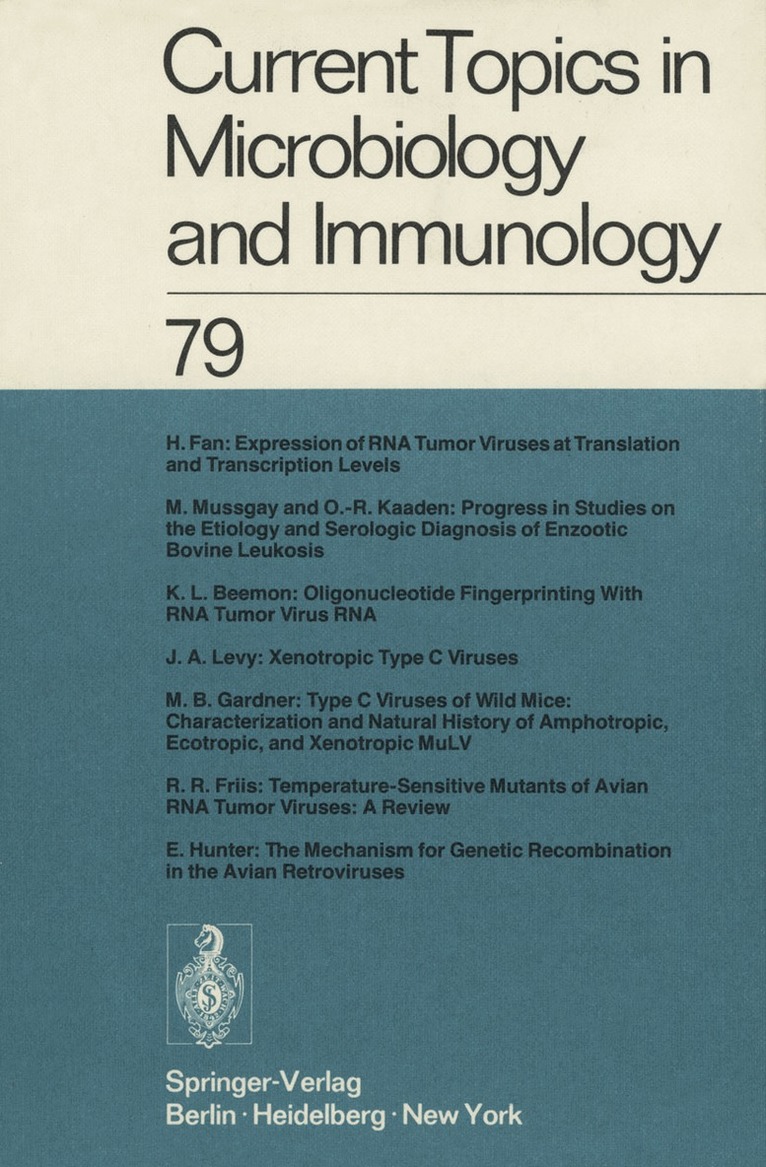
Del 79 - Current Topics in Microbiology and Immunology
Current Topics in Microbiology and Immunology
Volume 79
Häftad, Engelska, 2011
1 096 kr
Skickas inom 10-15 vardagar
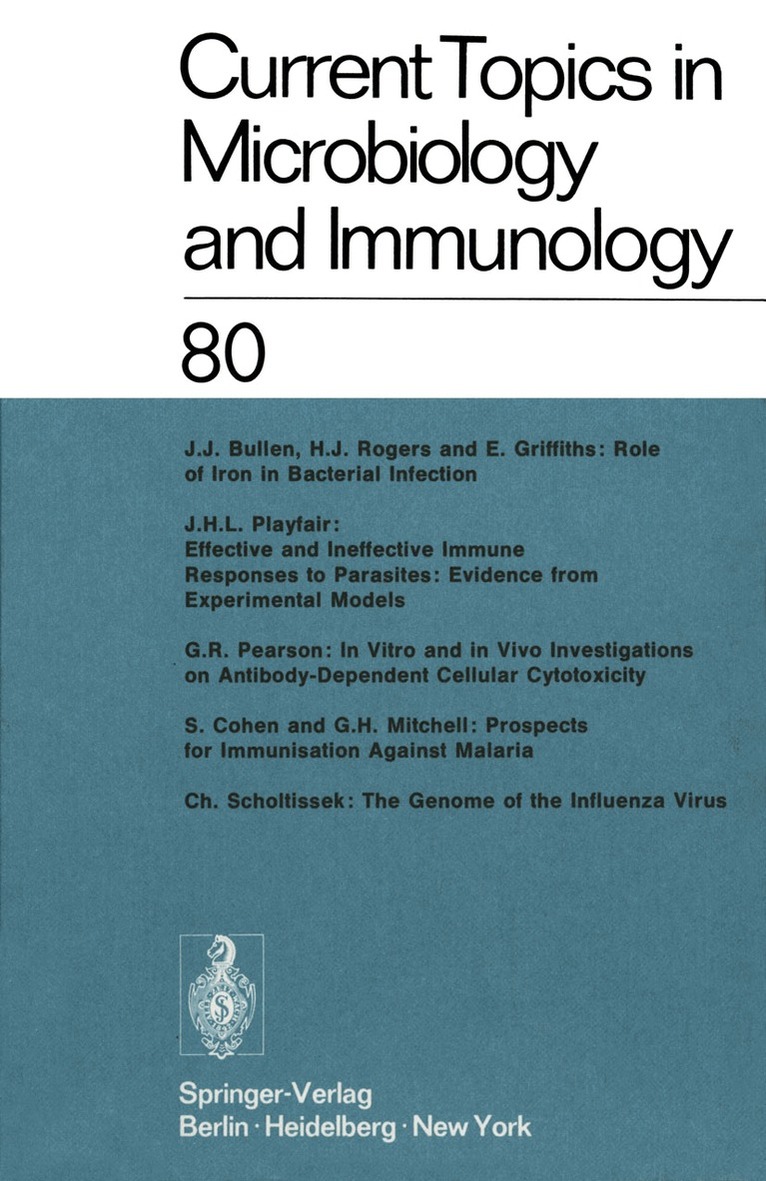
Del 80 - Current Topics in Microbiology and Immunology
Current Topics in Microbiology and Immunology
Volume 80
Häftad, Engelska, 2012
1 096 kr
Skickas inom 10-15 vardagar
Del 84 - Current Topics in Microbiology and Immunology
Current Topics in Microbiology and Immunology
Volume 84
Häftad, Engelska, 2012
552 kr
Skickas inom 10-15 vardagar
1 096 kr
Skickas inom 10-15 vardagar
The study of the genetic regulation of immune response to natural multidetermi nant immunogens was undertaken by the method of bidirectional selective breed ing of High or Low antibody responder lines of mice. Five Selections are described: Selection I, carried out for agglutinin responsiveness to sheep erythrocytes and pigeon erythrocytes alternated in each generation. Selection II, carried out for agglutinin responsiveness to sheep erythrocytes repeated in each generation. Selection III and Selection IV performed respectively for agglutinin response to flagellar or somatic antigens of Salmonella typhimurium and Salmonella oranienburg alternated in each generation. Selection V, performed for passive agglutinin response to bovine serum albumin and rabbit gamma globulin alternated in each generation. In each Selection the character investigated is polygenic. High and Low responder lines diverge progressively during the selective breeding. The maximal interline separation (selection limit) is reached in the 7th-16th generations. High and Low responder lines at selection limit are considered homozygous for the character submitted to se~ection. Their variance is therefore only due to environ mental effects. The difference in agglutinin titre between High and Low lines is 220-fold in Selection I, 103-fold in Selection II, 90-fold in Selection III, 85-fold in Selection IV and 275-fold in Selection V. The partition of genetic and environmental variances in the foundation popu lations of the five Selections is established. The proportion of genetic variance is 60% in Selection I; 49% in Selection II; 51% in Selection III; 47% in Selection IV and 76% in Selection V.
1 096 kr
Skickas inom 10-15 vardagar
1 096 kr
Skickas inom 10-15 vardagar
1.1 Classification of Togaviruses The family, Togaviridae, is composed of the alphaviruses, the flaviviruses, rubella (a rubivirus), and the pestiviruses (Fenner, 1976). Of these four genera, two (the alpha- and flaviviruses) are transmitted by blood-sucking arthropods, specif ically mosquitoes and ticks. Among the togaviruses, extensive studies of defective interfering (DI) particles have so far been carried out only with Sindbis virus (SV) and Semliki Forest virus (SFV), both members of the alphavirus genus. Since these viruses are so similar, in most cases it will be assumed that what is true of one is also true of the other. 1.2 Definition of Defective Interfering (DI) Particles Defective interfering viral particles, as defined by Huang (1973), have the follow ing properties: (1) they are deletion mutants and therefore lack large amounts of the genetic material present in the standard virus; (2) they contain the same viral structural proteins as standard virus; (3) they are unable to replicate alone; however, they are replicated in cells co-infected with standard virions; and (4) at the same time as they require standard virus to replicate, they inhibit the replication of standard virus and hence are interfering.
1 096 kr
Skickas inom 10-15 vardagar
1 096 kr
Skickas inom 10-15 vardagar