S. Padma Ishwarya – författare
2 876 kr
Skickas inom 10-15 vardagar
2 515 kr
Läs direkt efter köp
Essentials & Applications of Food Engineering provides a comprehensive understanding of food engineering operations and their practical and industrial utility. It presents pertinent case studies, solved numerical problems, and multiple choice questions in each chapter and serves as a ready reference for classroom teaching and exam preparations.
The first part of this textbook contains the introductory topics on units and dimensions, material balance, energy balance, and fluid flow. The second part deals with the theory and applications of heat and mass transfer, psychrometry, and reaction kinetics. The subsequent chapters of the book present the heat and mass transfer operations such as evaporation, drying, refrigeration, freezing, mixing, and separation. The final section focuses on the thermal, non-thermal, and nanotechnology-based novel food processing techniques, 3D food printing, active and intelligent food packaging, and fundamentals of CFD modeling.
Features
Features 28 case studies to provide a substantial understanding of the practical and industrial applications of various food engineering operations
Includes 178 solved numerical problems and 285 multiple choice questions
Highlights the application of mass balance in food product traceability and the importance of viscosity measurement in a variety of food products
Provides updated information on novel food processing techniques such as cold plasma, 3D food printing, nanospray drying, electrospraying, and electrospinning
The textbook is designed for undergraduate and graduate students pursuing Food Technology and Food Process Engineering courses. This book would also be of interest to course instructors and food industry professionals.
2 515 kr
Läs direkt efter köp
Essentials & Applications of Food Engineering provides a comprehensive understanding of food engineering operations and their practical and industrial utility. It presents pertinent case studies, solved numerical problems, and multiple choice questions in each chapter and serves as a ready reference for classroom teaching and exam preparations.
The first part of this textbook contains the introductory topics on units and dimensions, material balance, energy balance, and fluid flow. The second part deals with the theory and applications of heat and mass transfer, psychrometry, and reaction kinetics. The subsequent chapters of the book present the heat and mass transfer operations such as evaporation, drying, refrigeration, freezing, mixing, and separation. The final section focuses on the thermal, non-thermal, and nanotechnology-based novel food processing techniques, 3D food printing, active and intelligent food packaging, and fundamentals of CFD modeling.
Features
Features 28 case studies to provide a substantial understanding of the practical and industrial applications of various food engineering operations
Includes 178 solved numerical problems and 285 multiple choice questions
Highlights the application of mass balance in food product traceability and the importance of viscosity measurement in a variety of food products
Provides updated information on novel food processing techniques such as cold plasma, 3D food printing, nanospray drying, electrospraying, and electrospinning
The textbook is designed for undergraduate and graduate students pursuing Food Technology and Food Process Engineering courses. This book would also be of interest to course instructors and food industry professionals.
1 282 kr
Läs direkt efter köp
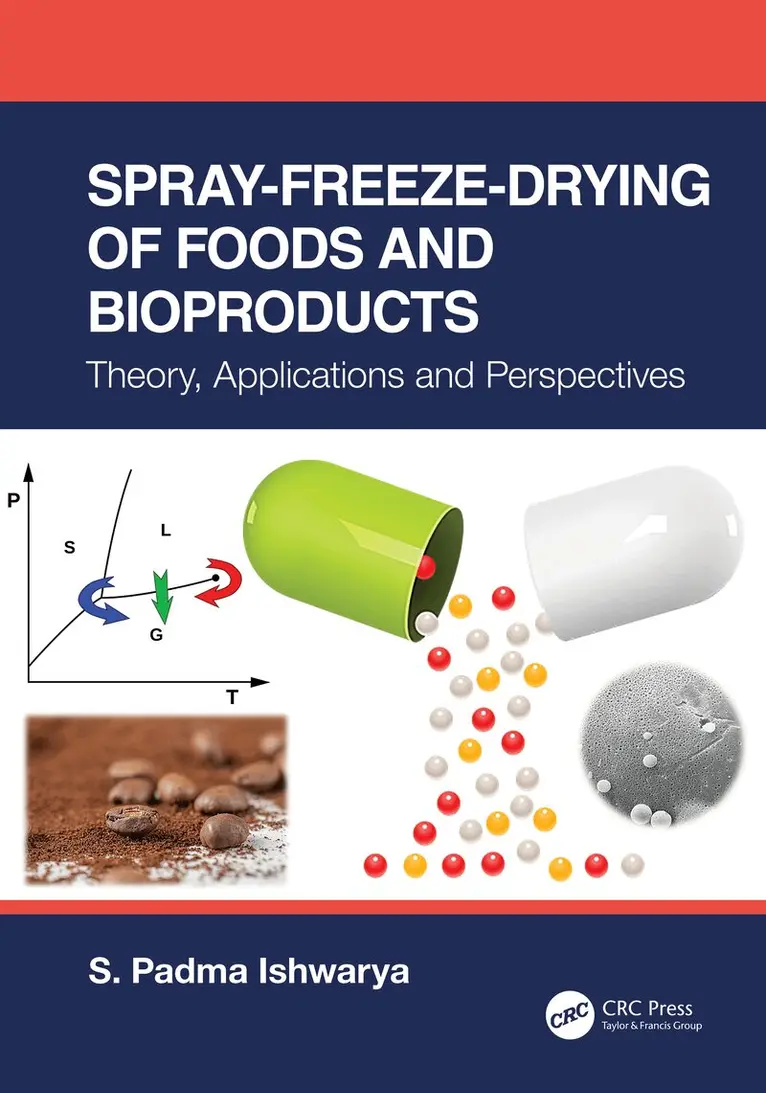
Spray-freeze-drying (SFD) is a synergistic drying technology that imbibes in it the merits of both spray drying and freeze-drying, whilst overcoming the limitations of these predecessor technologies. SFD produces uniquely powdered food and pharmaceutical products with porous microstructure and superior quality attributes. Owing to its atomization step and ultra-low-temperature operation, SFD is a competent drying technique for the production of valuable but sensitive bioactive components. Despite the costs and complexities involved, SFD has a competitive edge over the conventional drying techniques in providing distinctive product attributes. The applications of spray-freeze-drying in the area of food and bioproducts span across the product categories of instant food powders, dry flavors, active pharmaceutical ingredients, poorly water-soluble drugs, probiotics, proteins, enzymes and vaccines.
Spray-Freeze-Drying of Foods and Bioproducts: Theory, Applications and Perspectives is the first exclusive title on this interesting drying technique. It provides a comprehensive understanding of the fundamentals of SFD and its food and pharmaceutical applications.
The scope of this book, comprising 12 chapters, has been organizedunder four major headings: fundamentals of process-stages, applications with case-studies, recent advancements and the processing bottlenecks and solutions.
Key Features
Provides examples and case studies of nuances and intricacies associated with each stage of the spray-freeze-drying process
Highlights the applications of spray-freeze-drying in the production of food products including soluble coffee, dairy powders, probiotics and flavors
Serves as a ready-reckoner of characterization methods for spray-freeze-dried products
Contains 200+ illustrations and tabulations
The contents of this book are organized to cater to the knowledge needs of students, academicians, researchers and professionals in the food and pharmaceutical industry.
1 282 kr
Läs direkt efter köp
Spray-freeze-drying (SFD) is a synergistic drying technology that imbibes in it the merits of both spray drying and freeze-drying, whilst overcoming the limitations of these predecessor technologies. SFD produces uniquely powdered food and pharmaceutical products with porous microstructure and superior quality attributes. Owing to its atomization step and ultra-low-temperature operation, SFD is a competent drying technique for the production of valuable but sensitive bioactive components. Despite the costs and complexities involved, SFD has a competitive edge over the conventional drying techniques in providing distinctive product attributes. The applications of spray-freeze-drying in the area of food and bioproducts span across the product categories of instant food powders, dry flavors, active pharmaceutical ingredients, poorly water-soluble drugs, probiotics, proteins, enzymes and vaccines.
Spray-Freeze-Drying of Foods and Bioproducts: Theory, Applications and Perspectives is the first exclusive title on this interesting drying technique. It provides a comprehensive understanding of the fundamentals of SFD and its food and pharmaceutical applications.
The scope of this book, comprising 12 chapters, has been organizedunder four major headings: fundamentals of process-stages, applications with case-studies, recent advancements and the processing bottlenecks and solutions.
Key Features
Provides examples and case studies of nuances and intricacies associated with each stage of the spray-freeze-drying process
Highlights the applications of spray-freeze-drying in the production of food products including soluble coffee, dairy powders, probiotics and flavors
Serves as a ready-reckoner of characterization methods for spray-freeze-dried products
Contains 200+ illustrations and tabulations
The contents of this book are organized to cater to the knowledge needs of students, academicians, researchers and professionals in the food and pharmaceutical industry.
1 113 kr
Skickas inom 10-15 vardagar
2 176 kr
Skickas inom 10-15 vardagar