S Salmon – författare
Visar alla böcker från författaren S Salmon. Handla med fri frakt och snabb leverans.
3 produkter
3 produkter
E-bok
Engelska, 20053 206 kr
Läs direkt efter köp
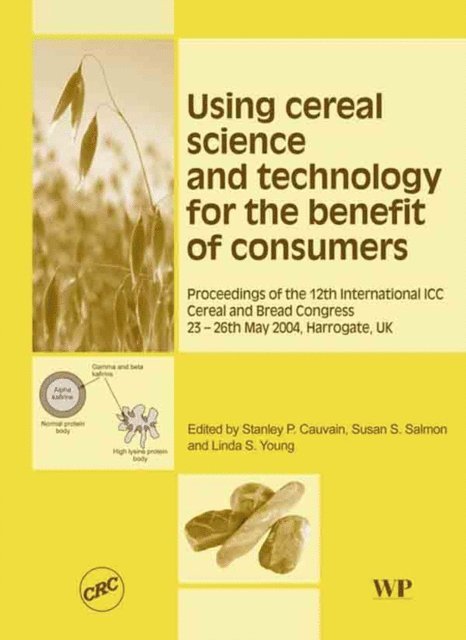
The Proceedings of the 12th International Cereal and Bread Congress provide a wide-ranging, comprehensive and up-to-date review of the latest advances in cereal science and technology with contributions from leading cereals institutes and individuals from around the world. They bring together all elements of the ''grain chain'' from breeding of new wheat varieties through the milling processes and on to the conversion of flour into baked products ready for the consumer at large. Evaluating and predicting wheat flour properties require new equipment and new techniques and these are covered in depth. Cereals other than wheat are given due consideration.The versatility of wheat flour and its conversion into food is reviewed across a whole spectrum of products. There is a strong emphasis on the use of wheat flour for bread making but with consideration of applications in the manufacture of cakes, cookies, pastries, extruded foods, pasta and noodles. The development process and the benefits to consumers are also addressed.The Editors and the Organising Committee have assembled a collection of high-quality papers which provide a showpiece for the latest developments in cereal science and technology.- Extensive collection of proceedings from the 12th International Cereal and Bread Congress- High-quality papers highlighting the most recent developments in cereal science and technology- Benefits for the industry and consumers are discussed
E-bok
PDF, Engelska, 20121 408 kr
Läs direkt efter köp
Transplantation of syngeneic (donor is a monozygous twin) or allogeneic (donor is an HLA-identical sibling) marrow provides the opportunity for aggressive antileukemic therapy without regard to marrow toxicity. Until 1975, marrow transplantation was carried out only after failure of all other therapy. Consequently, most patients were in advanced relapse. Six of 16 recipients of syngeneic marrow and 13 of 100 recipients of allogeneic marrow are still in remission after 5. 5-10 years [3, 7]. An actuarial survival curve of the first 100 patients grafted in Seattle after conditioning with cyclophos phamide (60 mg/kg on each of 2 successive days) and total body irradiation (1,000 rad) showed three periods of interest: (1) The first 4 months showed a rapid loss of patients associated with advanced illness, graft-versus-host disease, infections (in particular interstitial pneumonias), and recurrent leukemia; (2) from 4 months to 2 years, the curve showed a much slower rate of decline attributable primarily to recurrent leukemia; and (3) from 2-10 years, the curve was almost flat with a negligible loss of patients and no recurrent leukemia. This flat portion of the curve corresponded to 13% of the patients and indicates a strong probability that the majority of these survivors are cured of their disease [8]. Attempts at reducing the incidence of leukemic relapse after transplantation were made by a number of marrow transplant groups by added chemotherapy.
Häftad, Engelska, 2012
1 123 kr
Skickas inom 10-15 vardagar
Transplantation of syngeneic (donor is a monozygous twin) or allogeneic (donor is an HLA-identical sibling) marrow provides the opportunity for aggressive antileukemic therapy without regard to marrow toxicity. Until 1975, marrow transplantation was carried out only after failure of all other therapy. Consequently, most patients were in advanced relapse. Six of 16 recipients of syngeneic marrow and 13 of 100 recipients of allogeneic marrow are still in remission after 5. 5-10 years [3, 7]. An actuarial survival curve of the first 100 patients grafted in Seattle after conditioning with cyclophos phamide (60 mg/kg on each of 2 successive days) and total body irradiation (1,000 rad) showed three periods of interest: (1) The first 4 months showed a rapid loss of patients associated with advanced illness, graft-versus-host disease, infections (in particular interstitial pneumonias), and recurrent leukemia; (2) from 4 months to 2 years, the curve showed a much slower rate of decline attributable primarily to recurrent leukemia; and (3) from 2-10 years, the curve was almost flat with a negligible loss of patients and no recurrent leukemia. This flat portion of the curve corresponded to 13% of the patients and indicates a strong probability that the majority of these survivors are cured of their disease [8]. Attempts at reducing the incidence of leukemic relapse after transplantation were made by a number of marrow transplant groups by added chemotherapy.