Samrat Chatterjee - Böcker
Visar alla böcker från författaren Samrat Chatterjee. Handla med fri frakt och snabb leverans.
3 produkter
3 produkter
1 329 kr
Skickas inom 7-10 vardagar
Presents various challenges faced by security policy makers and risk analysts, and mathematical approaches that inform homeland security policy development and decision supportCompiled by a group of highly qualified editors, this book provides a clear connection between risk science and homeland security policy making and includes top-notch contributions that uniquely highlight the role of risk analysis for informing homeland security policy decisions. Featuring discussions on various challenges faced in homeland security risk analysis, the book seamlessly divides the subject of risk analysis for homeland security into manageable chapters, which are organized by the concept of risk-informed decisions, methodology for applying risk analysis, and relevant examples and case studies. Applied Risk Analysis for Guiding Homeland Security Policy and Decisions offers an enlightening overview of risk analysis methods for homeland security. For instance, it presents readers with an exploration of radiological and nuclear risk assessment, along with analysis of uncertainties in radiological and nuclear pathways. It covers the advances in risk analysis for border security, as well as for cyber security. Other topics covered include: strengthening points of entry; systems modeling for rapid containment and casualty mitigation; and disaster preparedness and critical infrastructure resilience. Highlights how risk analysis helps in the decision-making process for homeland security policyPresents specific examples that detail how various risk analysis methods provide decision support for homeland security policy makers and risk analystsDescribes numerous case studies from academic, government, and industrial perspectives that apply risk analysis methods for addressing challenges within the U.S. Department of Homeland Security (DHS)Offers detailed information regarding each of the five DHS missions: prevent terrorism and enhance security; secure and manage our borders; enforce and administer our immigration laws; safeguard and secure cyberspace; and strengthen national preparedness and resilienceDiscusses the various approaches and challenges faced in homeland risk analysis and identifies improvements and methodological advances that influenced DHS to adopt an increasingly risk-informed basis for decision-makingWritten by top educators and professionals who clearly illustrate the link between risk science and homeland security policy making Applied Risk Analysis for Guiding Homeland Security Policy and Decisions is an excellent textbook and/or supplement for upper-undergraduate and graduate-level courses related to homeland security risk analysis. It will also be an extremely beneficial resource and reference for homeland security policy analysts, risk analysts, and policymakers from private and public sectors, as well as researchers, academics, and practitioners who utilize security risk analysis methods.
641 kr
Skickas inom 10-15 vardagar
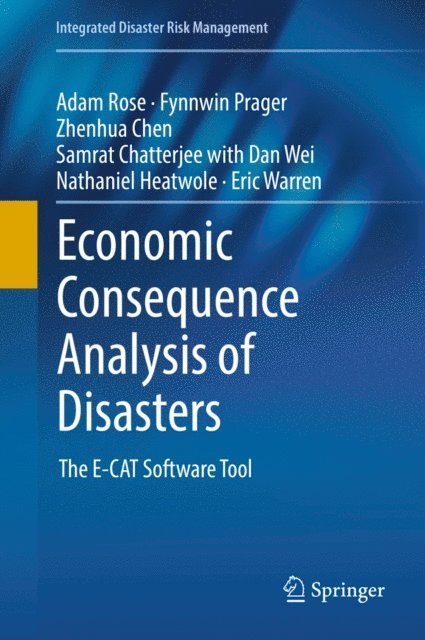
This study develops a methodology for rapidly obtaining approximate estimates of the economic consequences from numerous natural, man-made and technological threats. This software tool is intended for use by various decision makers and analysts to obtain estimates rapidly. It is programmed in Excel and Visual Basic for Applications (VBA) to facilitate its use. This tool is called E-CAT (Economic Consequence Analysis Tool) and accounts for the cumulative direct and indirect impacts (including resilience and behavioral factors that significantly affect base estimates) on the U.S. economy. E-CAT is intended to be a major step toward advancing the current state of economic consequence analysis (ECA) and also contributing to and developing interest in further research into complex but rapid turnaround approaches.The essence of the methodology involves running numerous simulations in a computable general equilibrium (CGE) model for each threat, yielding synthetic data for the estimation of a single regression equation based on the identification of key explanatory variables (threat characteristics and background conditions). This transforms the results of a complex model, which is beyond the reach of most users, into a "reduced form" model that is readily comprehensible. Functionality has been built into E-CAT so that its users can switch various consequence categories on and off in order to create customized profiles of economic consequences of numerous risk events. E-CAT incorporates uncertainty on both the input and output side in the course of the analysis.
641 kr
Skickas inom 10-15 vardagar
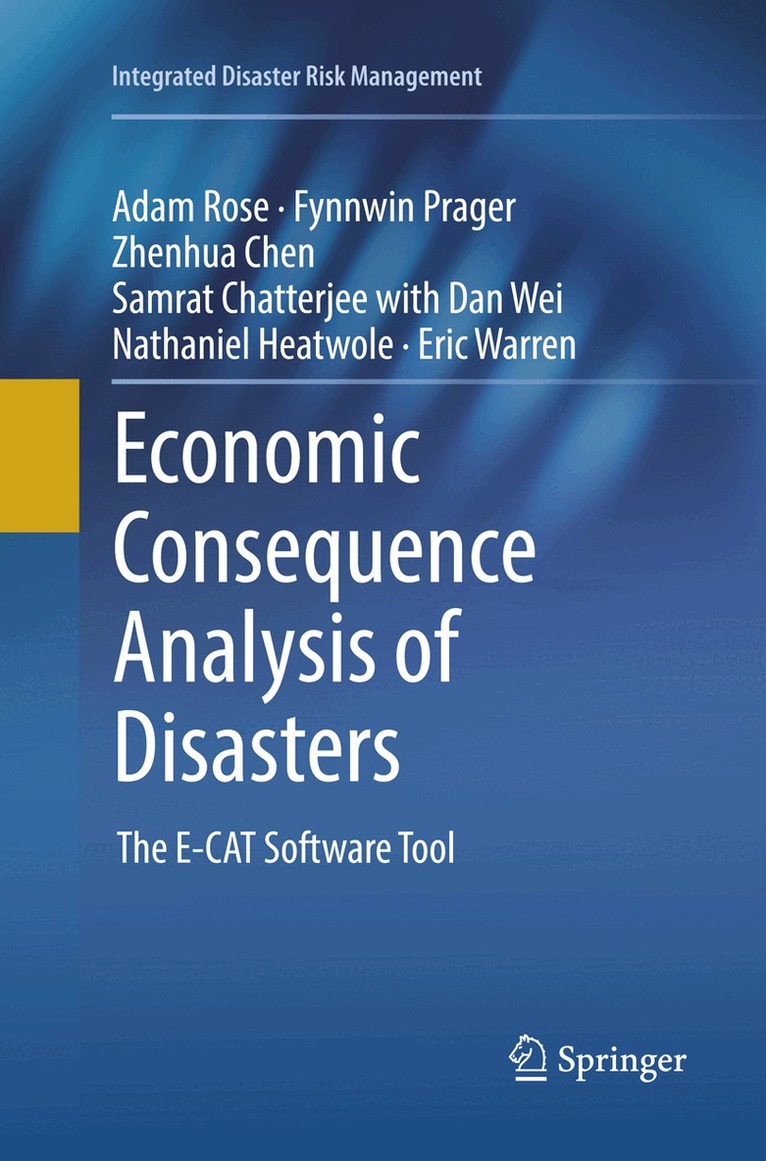
This study develops a methodology for rapidly obtaining approximate estimates of the economic consequences from numerous natural, man-made and technological threats. This software tool is intended for use by various decision makers and analysts to obtain estimates rapidly. It is programmed in Excel and Visual Basic for Applications (VBA) to facilitate its use. This tool is called E-CAT (Economic Consequence Analysis Tool) and accounts for the cumulative direct and indirect impacts (including resilience and behavioral factors that significantly affect base estimates) on the U.S. economy. E-CAT is intended to be a major step toward advancing the current state of economic consequence analysis (ECA) and also contributing to and developing interest in further research into complex but rapid turnaround approaches.The essence of the methodology involves running numerous simulations in a computable general equilibrium (CGE) model for each threat, yielding synthetic data for the estimation of a single regression equation based on the identification of key explanatory variables (threat characteristics and background conditions). This transforms the results of a complex model, which is beyond the reach of most users, into a "reduced form" model that is readily comprehensible. Functionality has been built into E-CAT so that its users can switch various consequence categories on and off in order to create customized profiles of economic consequences of numerous risk events. E-CAT incorporates uncertainty on both the input and output side in the course of the analysis.