Samuel L. Baily – författare
Visar alla böcker från författaren Samuel L. Baily. Handla med fri frakt och snabb leverans.
3 produkter
3 produkter
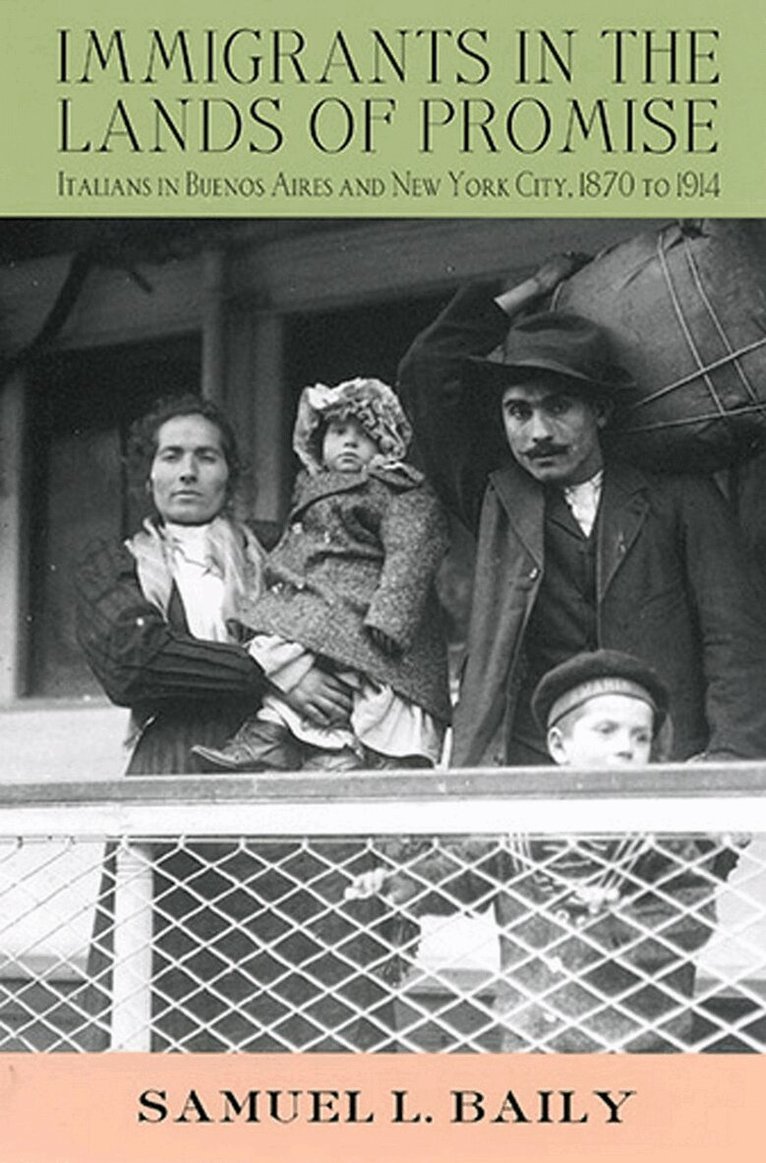
Immigrants in the Lands of Promise
Italians in Buenos Aires and New York City, 1870–1914
Inbunden, Engelska, 1999
1 136 kr
Skickas inom 10-15 vardagar
Most studies of immigration to the New World have focused on the United States. Samuel L. Baily's eagerly awaited book broadens that perspective through a comparative analysis of Italian immigrants to Buenos Aires and New York City before World War I. It is one of the few works to trace Italians from their villages of origin to different destinations abroad.Baily examines the adjustment of Italians in the two cities, comparing such factors as employment opportunities, skill levels, pace of migration, degree of prejudice, and development of the Italian community. Of the two destinations, Buenos Aires offered Italians more extensive opportunities, and those who elected to move there tended to have the appropriate education or training to succeed. These immigrants, who adjusted more rapidly than their North American counterparts, adopted a long-term strategy of investing savings in their New World home. In New York, in contrast, the immigrants found fewer skilled and white-collar jobs, more competition from previous immigrant groups, greater discrimination, and a less supportive Italian enclave. As a result, rather than put down roots, many sought to earn money as rapidly as possible and send their earnings back to family in Italy.Baily views the migration process as a global phenomenon. Building on his richly documented case studies, the author briefly examines Italian communities in San Francisco, Toronto, and Sao Paulo. He establishes a continuum of immigrant adjustment in urban settings, creating a landmark study in both immigration and comparative history.
Immigrants in the Lands of Promise
Italians in Buenos Aires and New York City, 1870–1914
Häftad, Engelska, 2004
338 kr
Skickas inom 10-15 vardagar
Most studies of immigration to the New World have focused on the United States. Samuel L. Baily's eagerly awaited book broadens that perspective through a comparative analysis of Italian immigrants to Buenos Aires and New York City before World War I. It is one of the few works to trace Italians from their villages of origin to different destinations abroad.Baily examines the adjustment of Italians in the two cities, comparing such factors as employment opportunities, skill levels, pace of migration, degree of prejudice, and development of the Italian community. Of the two destinations, Buenos Aires offered Italians more extensive opportunities, and those who elected to move there tended to have the appropriate education or training to succeed. These immigrants, who adjusted more rapidly than their North American counterparts, adopted a long-term strategy of investing savings in their New World home. In New York, in contrast, the immigrants found fewer skilled and white-collar jobs, more competition from previous immigrant groups, greater discrimination, and a less supportive Italian enclave. As a result, rather than put down roots, many sought to earn money as rapidly as possible and send their earnings back to family in Italy.Baily views the migration process as a global phenomenon. Building on his richly documented case studies, the author briefly examines Italian communities in San Francisco, Toronto, and Sao Paulo. He establishes a continuum of immigrant adjustment in urban settings, creating a landmark study in both immigration and comparative history.
Secondary Cities of Argentina
The Social History of Corrientes, Salta, and Mendoza, 1850-1910
Inbunden, Engelska, 1988
999 kr
Skickas inom 10-15 vardagar
This study of three Argentine provincial capitals introduces a new concept in Latin American urban studies: the historical role of secondary cities, settlements large enough to possess all the elements commonly associated with urban areas and yet too small to figure among a country's major cities. The principal contribution of the book is to explain how and why smaller cities grew. What determined and shaped their growth? How did local inhabitants, and especially the dominant social elites, react to internal and external influences? To what extent were they able to control growth? What relationships developed with the surrounding regions and the outside world? The study shows that secondary cities linked rural economies and inhabitants with the outside world while insulating the traditional rural environment from the changing character of large urban centers. In this intermediate position, economic relationships and social structure changed slowly, and only in response to outside innovations such as railroads. Continuity within the secondary centers thus reinforced conservatism, accentuated the gap between the major cities and the rest of the country, and contributed to the resistance to change that characterizes much of Latin American today. The book is illustrated with photographs and maps.