Sandra B. Lubarsky - Böcker
Visar alla böcker från författaren Sandra B. Lubarsky. Handla med fri frakt och snabb leverans.
3 produkter
3 produkter
1 057 kr
Tillfälligt slut
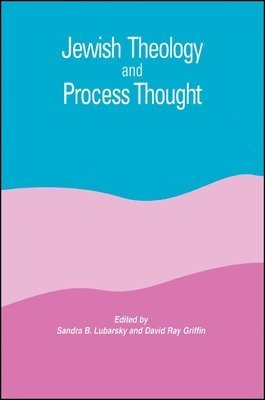
Presents essays by Jewish thinkers who have found process thought to be a useful framework for contemporary Jewish thought and a set of conversations between Jewish and Christian thinkers on the appropriateness of process thought for Judaism and Christianity.This collection constitutes the first extended discussion of the relationship between Judaism and process thought. In the last half century the philosophies of Alfred North Whitehead and Charles Hartshorne have become important sources for contemporary theological reflection. Recently, a number of Jewish thinkers have examined process thought as a potentially valuable resource for postmodern Jewish theology. This book brings together many Jewish thinkers who have pioneered this discussion.Jewish thinkers who have found process thought to be a useful framework for contemporary Jewish thought discuss issues that are primarily theological, such as God's transcendence and immanence, the problem of evil, the idea of revelation. Also included is a dialogue between Jewish and Christian thinkers on the appropriateness of process thought for their religious traditions. Critical reflection on the continuities and discontinuities between Judaism and the process model is also covered.
402 kr
Tillfälligt slut
Presents essays by Jewish thinkers who have found process thought to be a useful framework for contemporary Jewish thought and a set of conversations between Jewish and Christian thinkers on the appropriateness of process thought for Judaism and Christianity.This collection constitutes the first extended discussion of the relationship between Judaism and process thought. In the last half century the philosophies of Alfred North Whitehead and Charles Hartshorne have become important sources for contemporary theological reflection. Recently, a number of Jewish thinkers have examined process thought as a potentially valuable resource for postmodern Jewish theology. This book brings together many Jewish thinkers who have pioneered this discussion.Jewish thinkers who have found process thought to be a useful framework for contemporary Jewish thought discuss issues that are primarily theological, such as God's transcendence and immanence, the problem of evil, the idea of revelation. Also included is a dialogue between Jewish and Christian thinkers on the appropriateness of process thought for their religious traditions. Critical reflection on the continuities and discontinuities between Judaism and the process model is also covered.
549 kr
Skickas inom 5-8 vardagar
In the last twenty-five years, the effort to understand the ways of others has reinvigorated religious discussion on many levels. We have entered what has been described as the "Age of Dialogue." But what should be the nature of such dialogue? And what should be its goal? What exactly is the proper relationship between different communities of faith? In this book, Sandra B. Lubarsky offers some new answers to these timely questions. She begins with an affirmation of "veridical pluralism," the position that more than one tradition "speaks truth" - a "blessed fact" that enables us to enlarge our vision of truth through openness to the perceptions of others. Using the concept of "transformative dialogue" (a term borrowed from the theologian John B. Cobb, Jr.), she presents a method for the encounter of traditions in an age of religious pluralism - one which entails neither a loss of particularity nor a descent into relativism. In a Jewish contexts, Lubarsky argues that the Noachide Covenant, the premodern Jewish approach to non-Jews, is an inadequate framework for today's dialogue since it accords no independent value to any non-Jewish tradition. She then gives serious attention to the interreligious views of four seminal modern Jewish thinkers: Leo Baeck, Franz Rosenzweig, Martin Buber, and Mordecai Kaplan. Acknowledging our tremendous intellectual debt to them, she nevertheless calls for a move beyond tolerance and beyond mutual appreciation toward dialogue that may be transformative of our own traditions.