Sanjeev Sridharan – författare
Visar alla böcker från författaren Sanjeev Sridharan. Handla med fri frakt och snabb leverans.
4 produkter
4 produkter
Inbunden, Engelska, 2026
2 225 kr
Kommande
From Silos to Ecologies offers a new way to understand how knowledge is generated, interpreted, and used to address today’s most complex social challenges. It introduces the concept with clarity and purpose, showing why single studies, narrow methods, or rigid evaluation systems are no longer sufficient for problems shaped by complexity, uncertainty, and rapid change. The book also points to issues of evaluation capture and the problematic levels of independence.Drawing on realist evaluation, in which real-world problems, rugged landscapes, and underlying theories of solutions, serve as starting points for testing--as well as systems thinking, and practice--the book argues for approaches that are more adaptive and grounded in real-world contexts. Humility and the fallibility of knowledge generation are part of that approach. Through contributions from leading scholars and practitioners, the volume demonstrates how different forms of evidence can work together to support better decisions in areas such as maternal health, brain health, poverty reduction, and community-led innovation. Case studies from Canada, China, and India illustrate how an ecology of evidence helps practitioners navigate complexity, learn from local contexts, and design interventions that are both effective and sustainable—but are not one-size-fits-all solutions.A call for transformation runs throughout the book: moving from routine monitoring towards deeper explanation, from bureaucratic systems toward real (and not orchestrated) learning systems, and from isolated interventions toward solutions that reflect the lived realities of communities. From Silos to Ecologies is essential reading for scholars, students, evaluators, policymakers, and anyone seeking more meaningful ways to understand and improve the world around us.
E-bok
Engelska, 2017346 kr
Läs direkt efter köp
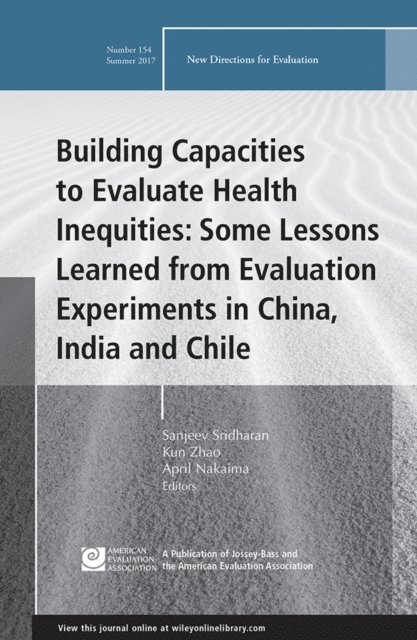
The World Health Organization defines health inequities as differences in health outcomes that are systematic, avoidable, and unjust; and the result of poor social policies, unfair economic arrangements, and bad politics. This volume describes the role that evaluations can play in addressing health inequities. A key focus is on the types of capacities that need to be built to evaluate inequities.Bringing alive these questions around evaluation capacities are theory and practice studies from China, Chile, and India.This volume: Focuses on inequities in evaluation capacity building initiatives. Argues evaluations can be interventions themselves. Explores how evaluations can have influence in addressing inequities. Recognizes that innovations in evaluation capacity experiments are occurring in diverse countries and we have the opportunity to learn from such initiatives. This is the 154th issue in the New Directions for Evaluation series from Jossey-Bass. It is an official publication of the American Evaluation Association.
E-bok
PDF, Engelska, 2017346 kr
Läs direkt efter köp
The World Health Organization defines health inequities as differences in health outcomes that are systematic, avoidable, and unjust; and the result of poor social policies, unfair economic arrangements, and bad politics. This volume describes the role that evaluations can play in addressing health inequities. A key focus is on the types of capacities that need to be built to evaluate inequities.Bringing alive these questions around evaluation capacities are theory and practice studies from China, Chile, and India.This volume: Focuses on inequities in evaluation capacity building initiatives. Argues evaluations can be interventions themselves. Explores how evaluations can have influence in addressing inequities. Recognizes that innovations in evaluation capacity experiments are occurring in diverse countries and we have the opportunity to learn from such initiatives. This is the 154th issue in the New Directions for Evaluation series from Jossey-Bass. It is an official publication of the American Evaluation Association.
Del 38 - Integrated Science
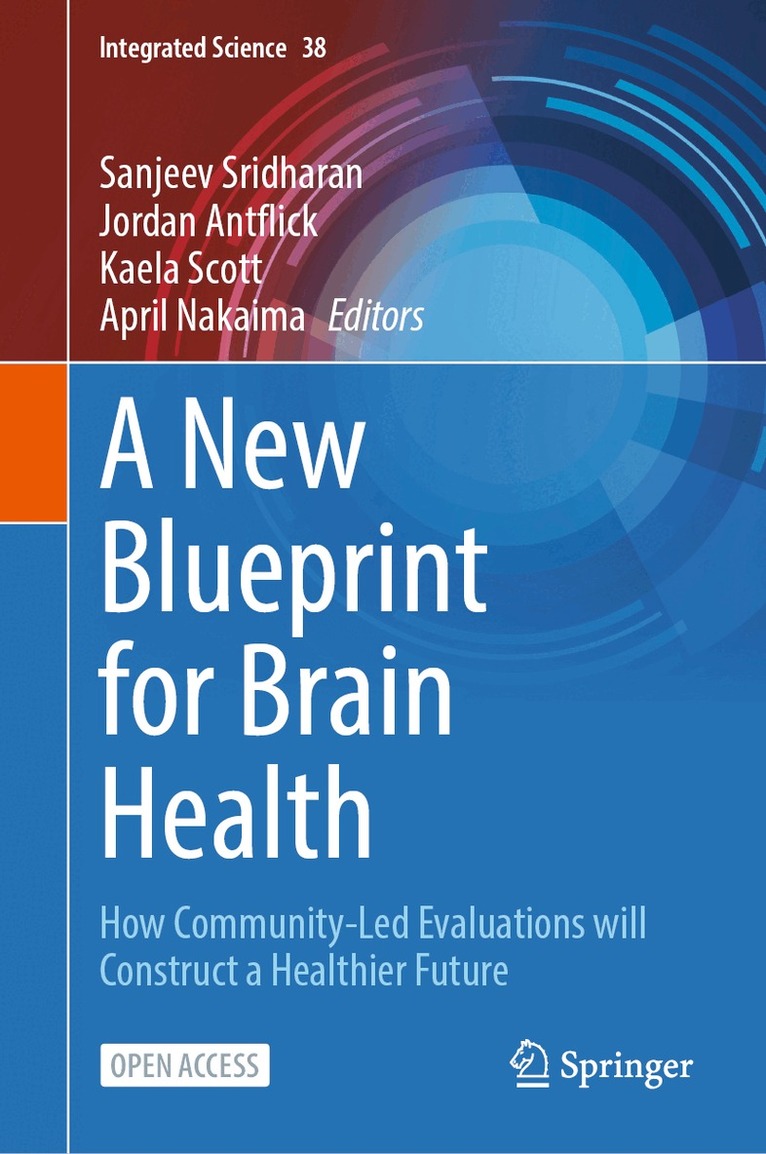
New Blueprint for Brain Health
How Community-Led Evaluations will Construct a Healthier Future
Inbunden, Engelska, 2025
565 kr
Skickas inom 10-15 vardagar
This open access book presents an integrative vision to achieve better brain health. Across the globe is a growing awareness of the impact of neurological conditions and mental health on wellbeing. Also as populations age, the number of people impacted by brain health conditions also grows, shining a light on the need for brain health “solutions” that are sustainable. Although the knowledge of what is working for a variety of brain health conditions continues to expand, we need to realize that not all solutions will come from medical research. What is needed to address brain health in a more sustainable way is a better understanding of the care that community provides and how a vision of better brain health will be found by deepening our understanding of the role of community and elevating the value of their contributions. Community organizations provide frontline care and have a tangible understanding of the needs that accompany the populations above. This means they are well equipped to provide local and accessible care. Community is a place in which brain health solutions can be delivered in a sustainable, effective, efficient, equitable and person-centered way. As such, the knowledge community organizations can contribute to the bigger picture of health care is important. This project responds to the need to better understand community care by highlighting how the role of evaluative thinking in the community sector can help us generate evidence to navigate towards better brain health futures. By first recognizing and then supporting community-led care, we can expand how we view and receive care.Along these lines, the book moves from a view of healthcare as being only delivered in hospitals and clinics to recognizing the continuum of care and integration of healthcare options. It provides a space for stories of health care solutions that indeed have connected health to the social and the community sectors. By exploring community interventions that have been integrated with biomedical/neuroscientific solutions, we will learn how integrated sustainable solutions can be created. The role of evaluation in helping facilitate the creation of such solutions also will be explored.This project is a partnership between the Ontario Brain Institute and the Evaluation Centre for Complex Health Interventions and reflects our collective learnings from our work in developmental evaluation and brain health.