Sanjit K. Mitra - Böcker
Visar alla böcker från författaren Sanjit K. Mitra. Handla med fri frakt och snabb leverans.
4 produkter
4 produkter
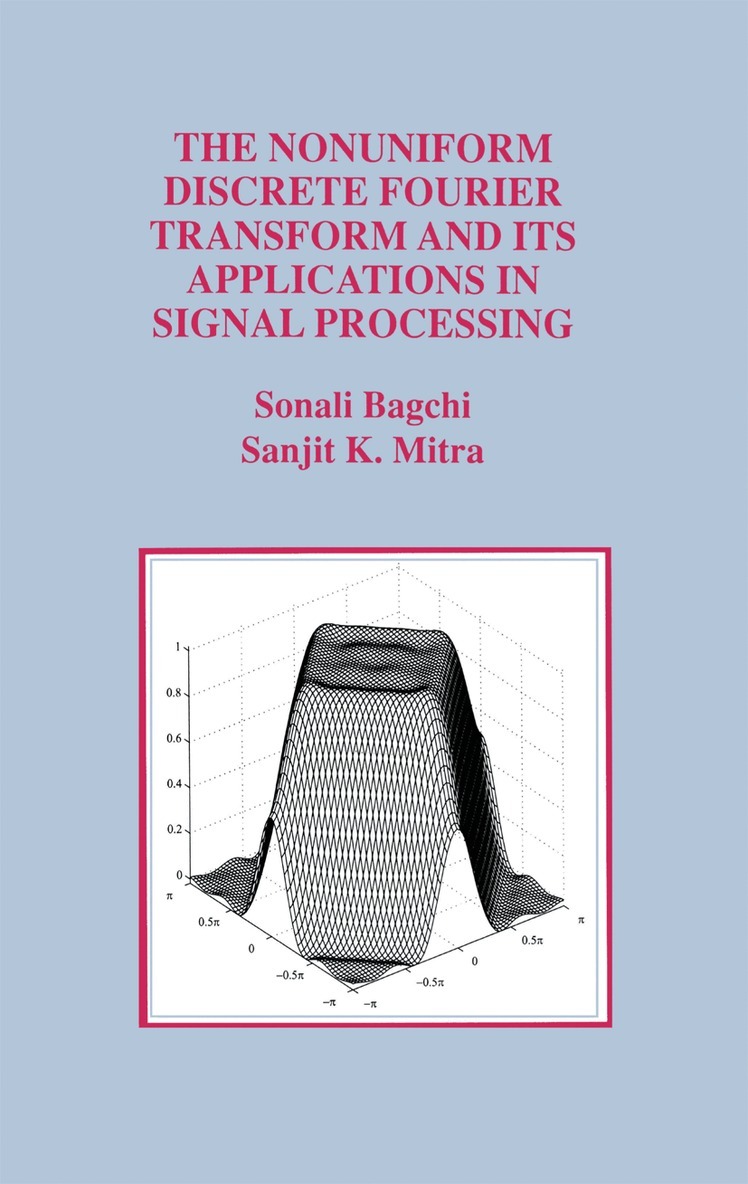
Nonuniform Discrete Fourier Transform and Its Applications in Signal Processing
Inbunden, Engelska, 1998
1 578 kr
Skickas inom 10-15 vardagar
The discrete Fourier transform (DFT) is a widely used tool in many branches of engineering and science, providing information about the spectral contents of a discrete-time signal at equally-spaced discrete frequency points. A generalization of DFT introduced in this text is the nonuniform discrete Fourier transform (NDFT), which can be used to obtain frequency domain information about a signal at arbitrarily chosen frequency points. The general properties of NDFT are discussed and a number of signal processing applications of NDFT are outlined. Applications discussed include the efficient design of one- and two-dimensional FIR digital filters, and antenna arrays, and detection of dual-tone multi-frequency(DTMF) signals. Chapter 1 introduces the problem of computing frequency samples of the z-transform of a finite-length sequence, and reviews the existing techniques. Chapter 2 develops the basics of the NDFT including its definition, properties and computational aspects. The NDFT is also extended to two dimensions. The ideas introduced here are utilized to develop applications of the NDFT in the following four chapters.Chapter 3 proposes a nonuniform frequency sampling technique for designing 1-D FIR digital filters. Design examples are presented for various types of filters. Chapter 4 utilizes the idea of the 2-D NDFT to design non separable 2-D FIR filters of various types. The resulting filters are compared with those designed by other existing methods and the performances of some of these filters are investigated by applying them to the decimation of digital images. Chapter 5 develops a design technique for synthesizing antenna patterns with nulls placed at desired angles to cancel interfering signals coming from these directions.
1 578 kr
Skickas inom 10-15 vardagar
This volume brings together in one place contributions which disclose the benefits resulting from multidimensional processing methods covering a wide range of applications, from low bit-rate video coding and multimedia information systems to improved quality and high definition television. Recently, it has been recognized that the improvement of the picture quality in current and advanced television systems requires well chosen signal processing algorithms, which are multidimensional in nature, within the demanding constraints of a real-time implementation. This volume aims to serve as a reference, providing insights into some of the most important issues of multidimensional processing of video signals, by presenting some of the latest developments in this fast moving field.
1 578 kr
Skickas inom 10-15 vardagar
A color time-varying image can be described as a three-dimensional vector (representing the colors in an appropriate color space) defined on a three-dimensional spatiotemporal space. In conventional analog television a one-dimensional signal suitable for transmission over a communication channel is obtained by sampling the scene in the vertical and tem poral directions and by frequency-multiplexing the luminance and chrominance informa tion. In digital processing and transmission systems, sampling is applied in the horizontal direction, too, on a signal which has been already scanned in the vertical and temporal directions or directly in three dimensions when using some solid-state sensor. As a conse quence, in recent years it has been considered quite natural to assess the potential advan tages arising from an entire multidimensional approach to the processing of video signals. As a simple but significant example, a composite color video signal, such as the conven tional PAL or NTSC signal, possesses a three-dimensional spectrum which, by using suitable three-dimensional filters, permits horizontal sampling at a rate which is less than that re quired for correctly sampling the equivalent one-dimensional signal. More recently it has been widely recognized that the improvement of the picture quality in current and advanced television systems requires well-chosen signal processing algorithms which are multidimen sional in nature within the demanding constraints of a real-time implementation.
Nonuniform Discrete Fourier Transform and Its Applications in Signal Processing
Häftad, Engelska, 2012
1 578 kr
Skickas inom 10-15 vardagar
The growth in the field of digital signal processing began with the simulation of continuous-time systems in the 1950s, even though the origin of the field can be traced back to 400 years when methods were developed to solve numerically problems such as interpolation and integration. During the last 40 years, there have been phenomenal advances in the theory and application of digital signal processing. In many applications, the representation of a discrete-time signal or a sys tem in the frequency domain is of interest. To this end, the discrete-time Fourier transform (DTFT) and the z-transform are often used. In the case of a discrete-time signal of finite length, the most widely used frequency-domain representation is the discrete Fourier transform (DFT) which results in a finite length sequence in the frequency domain. The DFT is simply composed of the samples of the DTFT of the sequence at equally spaced frequency points, or equivalently, the samples of its z-transform at equally spaced points on the unit circle. The DFT provides information about the spectral contents of the signal at equally spaced discrete frequency points, and thus, can be used for spectral analysis of signals. Various techniques, commonly known as the fast Fourier transform (FFT) algorithms, have been advanced for the efficient com putation of the DFT. An important tool in digital signal processing is the linear convolution of two finite-length signals, which often can be implemented very efficiently using the DFT.