Sara L. McClintock – författare
Visar alla böcker från författaren Sara L. McClintock. Handla med fri frakt och snabb leverans.
4 produkter
4 produkter
E-bok
Engelska, 2010226 kr
Läs direkt efter köp
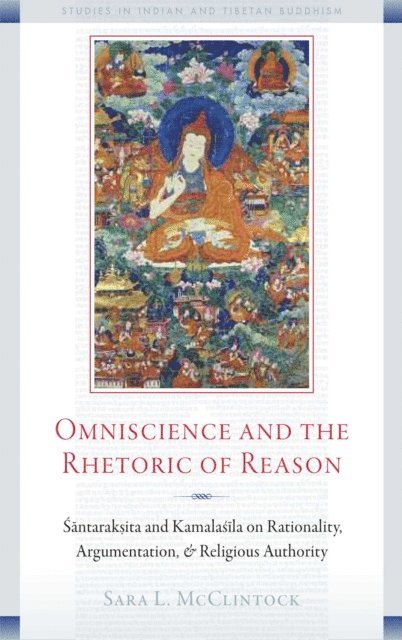
The great Buddhist scholars Santaraksita (725 - 88 CE.) and his disciple Kamalasila were among the most influential thinkers in classical India. They debated ideas not only within the Buddhist tradition but also with exegetes of other Indian religions, and they both traveled to Tibet during Buddhism''s infancy there. Their views, however, have been notoriously hard to classify. The present volume examines Santaraksita''s Tattvasamgraha and Kamalasila''s extensive commentary on it, works that cover all conceivable problems in Buddhist thought and portray Buddhism as a supremely rational faith. One hotly debated topic of their time was omniscience - whether it is possible and whether a rational person may justifiably claim it as a quality of the Buddha. Santaraksita and Kamalasila affirm both claims, but in their argumentation they employ divergent rhetorical strategies in different passages, advancing what appear to be contradictory positions. McClintock''s investigation of the complex strategies these authors use in defense of omniscience sheds light on the rhetorical nature of their enterprise, one that shadows their own personal views as they advance the arguments they deem most effective to convince the audiences at hand.
Inbunden, Engelska, 2024
289 kr
Skickas
Häftad, Engelska, 2026
410 kr
Skickas inom 3-6 vardagar
293 kr
Läs direkt efter köp
In Truth and Knowledge in an Empty World, sixteen leading experts in Buddhist philosophy tackle complex problems of how we can gain reliable knowledge when both the knower and what is known are empty of any intrinsic identity.The Dutch-Canadian philosopher Tom J. F. Tillemans has been influential in the field of Buddhist philosophy for decades, and the seventeen contributions to this volume celebrate that influence by engaging some of his core ideas about the nature and possibility of truth and knowledge, particularly in the Madhyamaka stream of Buddhist thought initiated in India by Nagarjuna and continued by Tibetan philosophers. Should Buddhists refrain from analyzing quotidian truths and thus remain content with popular opinion? Or should Buddhists seek ways to critique and reform customary truths in the interest of reducing ignorance? If the latter, what criteria should guide the critique? If, as Nagarjuna argues with his philosophy of emptiness, there are no metaphysical foundations for our epistemological practices, then to what may a Buddhist appeal in asserting that a given statement is either true or false? Readers will find here arguments about how Buddhists may avoid what Tom has labeled the "e;dismal slough"e; of relativism. Tillemans has offered a variety of such solutions in his publications over the years, and here scholars extend his analyses, at times vehemently disagreeing and at other times suggesting nuanced extension or improvement of his ideas. As a tribute to Tillemans, the book highlights what has been central to his work: the unceasing commitment to questioning received wisdom. As the volume's editor, Sara McClintock has provided a marvelous introduction that provides both an account of Tillemans' life and intellectual journey and a taste of the immense pleasure that may arise when having a philosophical conversation with Tom Tillemans. Contents Preface Introduction: Conversations with Tom Tillemans Part 1. Truth Epistemology for Madhyamikas: How Many Hairs Are Falling? Jay L. Garfield Candrakirti on the Couch: Why Madhyamikas Need Analysis Mark Siderits Materials for the Study of Cowherds: Are Their Beliefs Normative for Candrakirti? Dan Arnold Candrakirti's Tripartite Theory of Conventional Truths: A Case Against Typical-Atypical Readings Sonam Thakchoe Part 2. Knowledge Can Emptiness Be Understood Philosophically? Jose Ignacio Cabezon Self-Knowledge and Attachment: A View from Madhyamaka Jonardon Ganeri Bhaviveka's Proof Formulation in Light of Dignaga's Logic Shoryu Katsura Stairway to Ultimate Truth: Gyamarwa's Reinterpretation of the Satyadvayavibha?ga Chizuko Yoshimizu On Levels in Madhyamaka John Dunne One, Many, or Neither? Neither-One-Nor-Many Arguments in Dharmakirti's Philosophy of Mind Birgit Kellner Negative Dialectics in Madhyamaka Practice Kenneth Liberman Symmetric Existential Dependence Relations in Madhyamaka Jan Westerhoff Part 3. World Whose World Is This? Reflections on Customary Truth Sara McClintock The World Is Not Enough: An Early Tibetan Discussion on the Division of Customary Truth Pascale Hugon Unity of the Two Truths: Some Sources and Implications of a Central Buddhist Tantric Doctrine David Higgins Part 4. Reflections and Responses On Truth, Knowledge, Typical/Atypical Madhyamaka Philosophies, and the Science of Tuesdays Tom J. F. Tillemans Index About the Contributors