Sean Spence - Böcker
Visar alla böcker från författaren Sean Spence. Handla med fri frakt och snabb leverans.
3 produkter
3 produkter
1 556 kr
Skickas inom 7-10 vardagar
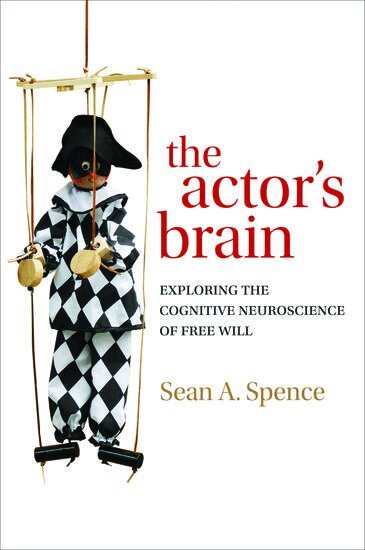
Is free will just an illusion? What is it within the brain that allows us to pursue our own actions and objectives? What is it about this organ that permits the emergence of seemingly purposeful behaviour, giving us the impression that we are 'free'? This book takes a journey through the anatomy and physiology, the structures and processes, of the human brain to demonstrate what is known about the control of voluntary behaviour, when it is 'normal' and when it breaks down. It starts by taking the reader from the basic 'hard' anatomy supporting simple hand and finger movement, through to the 'higher' structures of the human brain supporting the timing and selection of voluntary acts, and on towards a consideration of the complex distributed systems supporting voluntary behaviour (volition). Conditions elaborated upon along the way include the curious case of Dr Strangelove and his anarchic, wayward limb, the belief in alien control experienced by sufferers of schizophrenia, the seemingly inexplicable paralyses encountered in hysterical conversion patients, and the biological processes that enable us to lie to each other and engage in violence. The book concludes by examining some of the many varied attempts that human actors have made to expand such a volitional space, to enhance their own self-control and creativity.Written in an engaging and accessible style, but with its roots in hard science, the book will make fascinating reading for psychiatrists, neuroscientists, and philosophers, and anyone who has ever wondered whether we are really free.
Pathologies of Body, Self and Space
A Special Issue of Cognitive Neuropsychiatry
Häftad, Engelska, 2019
510 kr
Skickas inom 10-15 vardagar
What happens when the physical body and the subjective sense of self part company? How do we explain phantom limbs and alien abduction? What are the cognitive, neurobiological mechanisms that support such phenomena? In this special issue of Cognitive Neuropsychiatry, Spence and Halligan explore all these issues and more, with contributions drawn from an internationally renowned panel of authors, most of whom contributed to a symposium held in Sheffield, England in June 2001 ('The Neuropsychiatry of the Body in Space'). That meeting was primarily concerned with those bizarre and disturbing syndromes that arise when 'body' and 'self', soma and psyche are dissociated from each other, within or beyond the body's surface. Some disorders constrain the space of the body (as in neglect and dissociation syndromes), others seem to extend the boundaries (as with phantom limbs and autoscopy). Still others suggest a permeability of those boundaries (as in alien control and thought insertion, each occurring in schizophrenia). Finally, the body may itself be perceived as having passed into space, the most extreme exemplar being 'alien abduction'. Each paper contains a description of disturbed phenomenology and an account and critique of current cognitive neuropsychiatric findings.
Pathologies of Body, Self and Space
A Special Issue of Cognitive Neuropsychiatry
Inbunden, Engelska, 2002
1 333 kr
Skickas inom 10-15 vardagar
What happens when the physical body and the subjective sense of self part company? How do we explain phantom limbs and alien abduction? What are the cognitive, neurobiological mechanisms that support such phenomena? In this special issue of Cognitive Neuropsychiatry, Spence and Halligan explore all these issues and more, with contributions drawn from an internationally renowned panel of authors, most of whom contributed to a symposium held in Sheffield, England in June 2001 ('The Neuropsychiatry of the Body in Space'). That meeting was primarily concerned with those bizarre and disturbing syndromes that arise when 'body' and 'self', soma and psyche are dissociated from each other, within or beyond the body's surface. Some disorders constrain the space of the body (as in neglect and dissociation syndromes), others seem to extend the boundaries (as with phantom limbs and autoscopy). Still others suggest a permeability of those boundaries (as in alien control and thought insertion, each occurring in schizophrenia). Finally, the body may itself be perceived as having passed into space, the most extreme exemplar being 'alien abduction'. Each paper contains a description of disturbed phenomenology and an account and critique of current cognitive neuropsychiatric findings.