Seybolt - Böcker
Visar alla böcker från författaren Seybolt. Handla med fri frakt och snabb leverans.
2 produkter
2 produkter
668 kr
Skickas inom 5-8 vardagar
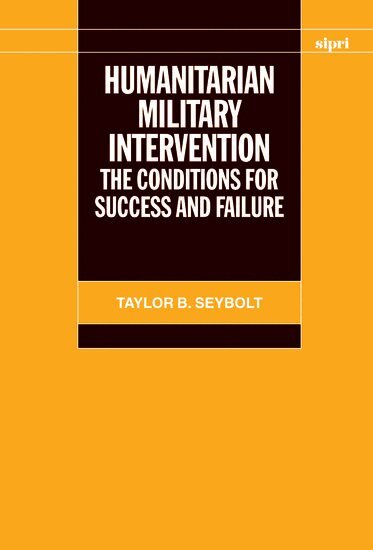
Military intervention in a conflict without a reasonable prospect of success is unjustifiable, especially when it is done in the name of humanity. Couched in the debate on the responsibility to protect civilians from violence and drawing on traditional 'just war' principles, the central premise of this book is that humanitarian military intervention can be justified as a policy option only if decision makers can be reasonably sure that intervention will do more good than harm. This book asks, 'Have past humanitarian military interventions been successful?' It defines success as saving lives and sets out a methodology for estimating the number of lives saved by a particular military intervention. Analysis of 17 military operations in six conflict areas that were the defining cases of the 1990s-northern Iraq after the Gulf War, Somalia, Bosnia and Herzegovina, Rwanda, Kosovo and East Timor-shows that the majority were successful by this measure. In every conflict studied, however, some military interventions succeeded while others failed, raising the question, 'Why have some past interventions been more successful than others?' This book argues that the central factors determining whether a humanitarian intervention succeeds are the objectives of the intervention and the military strategy employed by the intervening states. Four types of humanitarian military intervention are offered: helping to deliver emergency aid, protecting aid operations, saving the victims of violence and defeating the perpetrators of violence. The focus on strategy within these four types allows an exploration of the political and military dimensions of humanitarian intervention and highlights the advantages and disadvantages of each of the four types.Humanitarian military intervention is controversial. Scepticism is always in order about the need to use military force because the consequences can be so dire. Yet it has become equally controversial not to intervene when a government subjects its citizens to massive violation of their basic human rights. This book recognizes the limits of humanitarian intervention but does not shy away from suggesting how military force can save lives in extreme circumstances.
Counting Civilian Casualties
An Introduction to Recording and Estimating Nonmilitary Deaths in Conflict
Inbunden, Engelska, 2013
1 989 kr
Skickas inom 5-8 vardagar
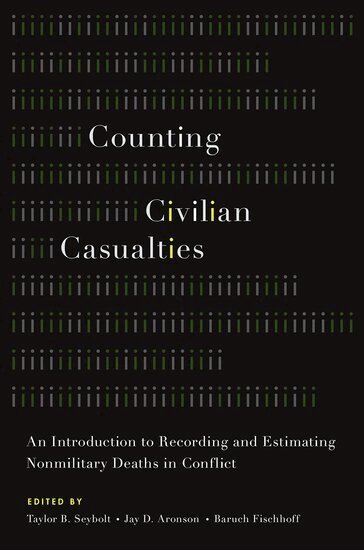
A popular myth emerged in the late 1990s: in 1900, wars killed one civilian for every eight soldiers, while contemporary wars were killing eight civilians for every one soldier. The neat reversal of numbers was memorable, and academic publications and UN documents regularly cited it. The more it was cited, the more trusted it became. In fact, however, subsequent research found no empirical evidence for the idea that the ratio of civilians to soldiers killed in war has changed dramatically. But while the ratios may not have changed, the political significance of civilian casualties has risen tremendously.Over the past century, civilians in war have gone from having no particular rights to having legal protections and rights that begin to rival those accorded to states. The concern for civilians in conflict has become so strong that governments occasionally undertake humanitarian interventions, at great risk and substantial cost, to protect strangers in distant lands. I n the early 1990s, the UN Security Council authorized military interventions to help feed and protect civilians in the Kurdish area of Iraq, Somalia, and Bosnia. And in May 2011 , Barack Obama 's National Security Advisor explained the United States' decision to support NATO's military intervention in these terms "When the president made this decision, there was an immediate threat to 700,000 Libyan civilians in the town of Benghazi. We've had a success here in terms of being able to protect those civilians."Counting Civilian Casualties aims to promote open scientific dialogue by high lighting the strengths and weaknesses of the most commonly used casualty recording and estimation techniques in an understandable format. Its thirteen chapters, each authoritative but accessible to nonspecialists, explore a variety of approaches, from direct recording to statistical estimation and sampling, to collecting data on civilian deaths caused by conflict. The contributors also discuss their respective advantages and disadvantages, and analyze how figures are used (and misused) by governments, rebels, human rights advocates, war crimes tribunals, and others. In addition to providing analysts with a broad range of tools to produce accurate data, this will be an in valuable resource for policymakers, military officials, jou rnalists, human rights activists, courts, and ordinary people who want to be more informed--and skeptical--consumers of casualty counts.