Sheilagh Ogilvie - Böcker
Visar alla böcker från författaren Sheilagh Ogilvie. Handla med fri frakt och snabb leverans.
8 produkter
8 produkter
2 797 kr
Skickas inom 5-8 vardagar
What role did women play in the pre-industrial European economy? Was it brought about by biology, culture, social institutions, or individual choices? And what were its consequences - for women, for men, for society at large? Women were key to the changes in the European economy between 1600 and 1800 that paved the way for industrialization. But we still know little about this female 'shadow economy' - and nothing quantitative or systematic.This book tackles these questions in a new way. It uses a unique micro-level database and rich qualitative sources to illuminate women's contribution to a particular pre-industrial economy: the German state of Württemberg, which was in many ways typical of early modern Europe. Markets expanded here between 1600 and 1800, opening opportunities outside the household for both women and men. But they were circumscribed by strong 'social networks' - local communities and rural guilds with state support. Modern political scientists have praised social networks for generating 'social capital' - shared norms and collective sanctions which benefit network insiders, and sometimes the whole society. But this book reveals the dark side of 'social capital': insiders excluded and harmed outsiders, especially women, to the detriment of the economy at large.Early modern European economies differed widely in their restrictions on the role of women. But the monocausal approaches (technological, cultural, institutional) that dominate the existing literature cannot explain these differences. This book proposes an alternative approach driven by the decision individual women themselves made as they negotiated a wide array of constraints and pressures (including technological, cultural, and institutional ones). We are not only brought closer to the 'bitter living' pre-industrial women scraped together , but find out how it came to be so bitter, and how restrictions on women inflicted a bitter living on everyone.
599 kr
Skickas inom 10-15 vardagar
The third volume of this three-volume history focuses on Germany's late but explosive economic transformation after 1800, the cycles of war, defeat, and dictatorship from 1914 to 1950, and the 'German miracle' after 1950. The picture is one of rapid change, but within a framework of recognizable long-term continuities. This book shows vividly how Germany participated in the rapid transformation, since 1800, of all western societies and economies while retaining distinctive features that had long characterized this central region of Europe. With original contributions from an international team of scholars, this volume represents some of the best work in the field.
1 065 kr
Skickas inom 7-10 vardagar
This collection of essays provides an introduction to 'proto-industrialization': the growth of export-oriented domestic industries which took place all over Europe between about 1500 and 1800. Often these industries expanded alongside agriculture, without advanced technology or centralised factories. Since the 1970s numerous theories have been proposed, arguing that proto-industrialization transformed demographic behaviour, social structure and traditional institutions, and was a major cause of capitalism and factory industrialisation. European Proto-Industrialization summarises the theories and criticisms, and includes chapters written by experts on different European countries. It provides an essential guide to an important, yet often confusing, field of economic and social history.
552 kr
Skickas inom 7-10 vardagar
This collection of essays provides an introduction to 'proto-industrialization': the growth of export-oriented domestic industries which took place all over Europe between about 1500 and 1800. Often these industries expanded alongside agriculture, without advanced technology or centralised factories. Since the 1970s numerous theories have been proposed, arguing that proto-industrialization transformed demographic behaviour, social structure and traditional institutions, and was a major cause of capitalism and factory industrialisation. European Proto-Industrialization summarises the theories and criticisms, and includes chapters written by experts on different European countries. It provides an essential guide to an important, yet often confusing, field of economic and social history.
422 kr
Skickas inom 7-10 vardagar
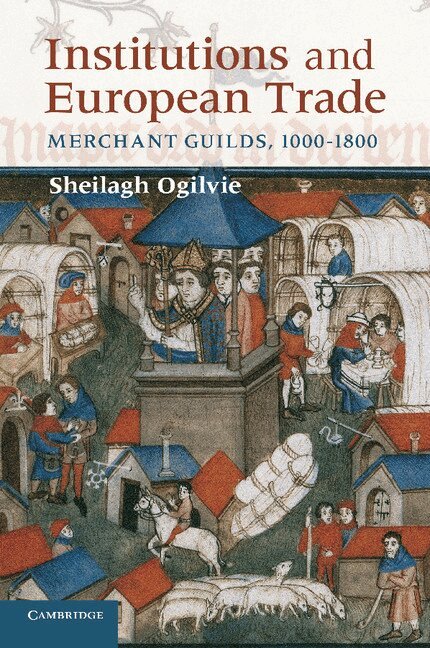
What was the role of merchant guilds in the medieval and early modern economy? Does their wide prevalence and long survival mean they were efficient institutions that benefited the whole economy? Or did merchant guilds simply offer an effective way for the rich and powerful to increase their wealth, at the expense of outsiders, customers and society as a whole? These privileged associations of businessmen were key institutions in the European economy from 1000 to 1800. Historians debate merchant guilds' role in the Commercial Revolution, economists use them to support theories about institutions and development, and policymakers view them as prime examples of social capital, with important lessons for modern economies. Sheilagh Ogilvie's magisterial new history of commercial institutions shows how scrutinizing merchant guilds can help us understand which types of institution made trade grow, why institutions exist, and how corporate privileges affect economic efficiency and human well-being.
1 350 kr
Skickas inom 7-10 vardagar
What was the role of merchant guilds in the medieval and early modern economy? Does their wide prevalence and long survival mean they were efficient institutions that benefited the whole economy? Or did merchant guilds simply offer an effective way for the rich and powerful to increase their wealth, at the expense of outsiders, customers and society as a whole? These privileged associations of businessmen were key institutions in the European economy from 1000 to 1800. Historians debate merchant guilds' role in the Commercial Revolution, economists use them to support theories about institutions and development, and policymakers view them as prime examples of social capital, with important lessons for modern economies. Sheilagh Ogilvie's magisterial new history of commercial institutions shows how scrutinizing merchant guilds can help us understand which types of institution made trade grow, why institutions exist, and how corporate privileges affect economic efficiency and human well-being.
291 kr
Skickas inom 7-10 vardagar
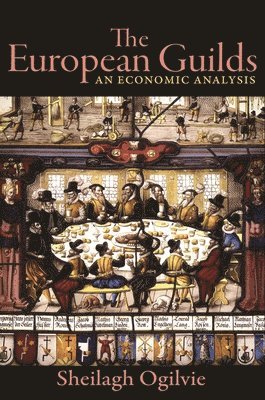
A comprehensive analysis of European craft guilds through eight centuries of economic historyGuilds ruled many crafts and trades from the Middle Ages to the Industrial Revolution, and have always attracted debate and controversy. They were sometimes viewed as efficient institutions that guaranteed quality and skills. But they also excluded competitors, manipulated markets, and blocked innovations. Did the advantages of guilds outweigh their costs? Analyzing thousands of guilds from 1000 to 1880, The European Guilds answers that question with vivid examples and clear economic reasoning. Sheilagh Ogilvie features the voices of honourable guild masters, underpaid journeymen, exploited apprentices, shady officials, and outraged customers, and follows the stories of the “vile encroachers”—women, migrants, Jews, gypsies, bastards, and others—desperate to work but hunted down by the guilds as illicit competitors. The European Guilds analyzes the toxic complicity between guild members and political elites, and shows how privileged institutions and exclusive networks prey on prosperity and stifle growth.
Controlling Contagion
Epidemics and Institutions from the Black Death to Covid
Inbunden, Engelska, 2025
372 kr
Skickas inom 7-10 vardagar
How human institutions—markets, states, communities, religions, guilds and families—have helped both to control and to exacerbate epidemics throughout history.How do societies tackle epidemic disease? In Controlling Contagion, Sheilagh Ogilvie answers this question by exploring seven centuries of pandemics, from the Black Death to Covid-19. For most of history, infectious diseases have killed many more people than famine or war, and in 2019 they still caused one death in four. Today, we deal with epidemics more successfully than our ancestors managed plague, smallpox, cholera or influenza. But we use many of the same approaches. Long before scientific medicine, human societies coordinated and innovated in response to biological shocks—sometimes well, sometimes badly.Ogilvie uses historical epidemics to analyse how human societies deal with “externalities”—situations where my action creates costs or benefits for others beyond those that I myself incur. Social institutions—markets, states, communities, religions, guilds, and families—help us manage the negative externalities of contagion and the positive externalities of social distancing, sanitation, and immunization. Ogilvie shows how each institution enables us to coordinate, innovate and inspire each other to limit contagion. But each institution also has weaknesses that can make things worse. Markets shut down voluntarily during every epidemic in history—but they also brought people together, spreading contagion. States mandated quarantines, sanitation, and immunization—but they also waged war and censored information, exacerbating epidemics. Religions admonished us to avoid infecting our neighbours—but they also preached against science and medical innovations. What decided the outcome, Ogilvie argues, was a temperate state, an adaptable market, and a strong civil society where a diversity of institutions played to their own strengths and checked each other’s flaws.