Sheng Xu – författare
1 009 kr
Läs direkt efter köp
This textbook is written for the first introductory course on scientific computing. It covers elementary numerical methods for linear systems, root finding, interpolation, numerical integration, numerical differentiation, least squares problems, initial value problems and boundary value problems. It includes short Matlab and Python tutorials to quickly get students started on programming. It makes the connection between elementary numerical methods with advanced topics such as machine learning and parallel computing.
This textbook gives a comprehensive and in-depth treatment of elementary numerical methods. It balances the development, implementation, analysis and application of a fundamental numerical method by addressing the following questions.
•Where is the method applied?•How is the method developed?•How is the method implemented?•How well does the method work?
The material in the textbook is made as self-contained and easy-to-follow as possible with reviews and remarks. The writing is kept concise and precise. Examples, figures, paper-and-pen exercises and programming problems are deigned to reinforce understanding of numerical methods and problem-solving skills.
1 009 kr
Läs direkt efter köp
This textbook is written for the first introductory course on scientific computing. It covers elementary numerical methods for linear systems, root finding, interpolation, numerical integration, numerical differentiation, least squares problems, initial value problems and boundary value problems. It includes short Matlab and Python tutorials to quickly get students started on programming. It makes the connection between elementary numerical methods with advanced topics such as machine learning and parallel computing.
This textbook gives a comprehensive and in-depth treatment of elementary numerical methods. It balances the development, implementation, analysis and application of a fundamental numerical method by addressing the following questions.
•Where is the method applied?•How is the method developed?•How is the method implemented?•How well does the method work?
The material in the textbook is made as self-contained and easy-to-follow as possible with reviews and remarks. The writing is kept concise and precise. Examples, figures, paper-and-pen exercises and programming problems are deigned to reinforce understanding of numerical methods and problem-solving skills.
918 kr
Läs direkt efter köp
Deep learning has achieved impressive results in image classification, computer vision, and natural language processing. To achieve better performance, deeper and wider networks have been designed, which increase the demand for computational resources. The number of floatingpoint operations (FLOPs) has increased dramatically with larger networks, and this has become an obstacle for convolutional neural networks (CNNs) being developed for mobile and embedded devices. In this context, Binary Neural Networks: Algorithms, Architectures, and Applications will focus on CNN compression and acceleration, which are important for the research community. We will describe numerous methods, including parameter quantization, network pruning, low-rank decomposition, and knowledge distillation. More recently, to reduce the burden of handcrafted architecture design, neural architecture search (NAS) has been used to automatically build neural networks by searching over a vast architecture space. Our book will also introduce NAS and binary NAS and its superiority and state-of-the-art performance in various applications, such as image classification and object detection. We also describe extensive applications of compressed deep models on image classification, speech recognition, object detection, and tracking. These topics can help researchers better understand the usefulness and the potential of network compression on practical applications. Moreover, interested readers should have basic knowledge of machine learning and deep learning to better understand the methods described in this book.
Key Features
Reviews recent advances in CNN compression and acceleration Elaborates recent advances on binary neural network (BNN) technologies Introduces applications of BNN in image classification, speech recognition, object detection, and more918 kr
Läs direkt efter köp
Deep learning has achieved impressive results in image classification, computer vision, and natural language processing. To achieve better performance, deeper and wider networks have been designed, which increase the demand for computational resources. The number of floatingpoint operations (FLOPs) has increased dramatically with larger networks, and this has become an obstacle for convolutional neural networks (CNNs) being developed for mobile and embedded devices. In this context, Binary Neural Networks: Algorithms, Architectures, and Applications will focus on CNN compression and acceleration, which are important for the research community. We will describe numerous methods, including parameter quantization, network pruning, low-rank decomposition, and knowledge distillation. More recently, to reduce the burden of handcrafted architecture design, neural architecture search (NAS) has been used to automatically build neural networks by searching over a vast architecture space. Our book will also introduce NAS and binary NAS and its superiority and state-of-the-art performance in various applications, such as image classification and object detection. We also describe extensive applications of compressed deep models on image classification, speech recognition, object detection, and tracking. These topics can help researchers better understand the usefulness and the potential of network compression on practical applications. Moreover, interested readers should have basic knowledge of machine learning and deep learning to better understand the methods described in this book.
Key Features
Reviews recent advances in CNN compression and acceleration Elaborates recent advances on binary neural network (BNN) technologies Introduces applications of BNN in image classification, speech recognition, object detection, and more1 347 kr
Skickas inom 10-15 vardagar
853 kr
Skickas inom 10-15 vardagar
2 128 kr
Skickas inom 10-15 vardagar
821 kr
Skickas inom 10-15 vardagar
285 kr
Läs direkt efter köp
285 kr
Läs direkt efter köp
256 kr
Skickas inom 7-10 vardagar
5 465 kr
Kommande
1 779 kr
Skickas inom 10-15 vardagar
2 194 kr
Läs direkt efter köp
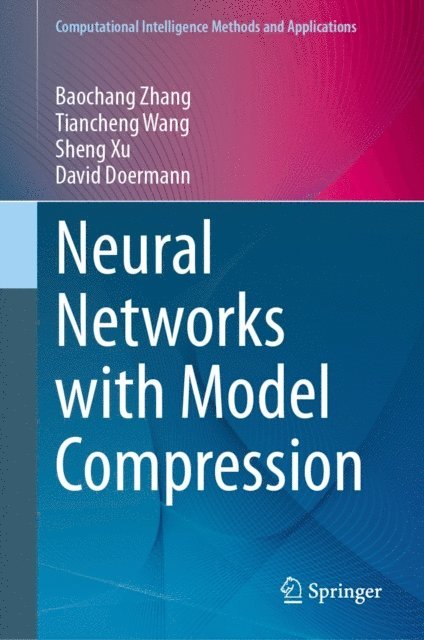
Deep learning has achieved impressive results in image classification, computer vision and natural language processing. To achieve better performance, deeper and wider networks have been designed, which increase the demand for computational resources. The number of floating-point operations (FLOPs) has increased dramatically with larger networks, and this has become an obstacle for convolutional neural networks (CNNs) being developed for mobile and embedded devices. In this context, our book will focus on CNN compression and acceleration, which are important for the research community. We will describe numerous methods, including parameter quantization, network pruning, low-rank decomposition and knowledge distillation. More recently, to reduce the burden of handcrafted architecture design, neural architecture search (NAS) has been used to automatically build neural networks by searching over a vast architecture space. Our book will also introduce NAS due to its superiority and state-of-the-art performance in various applications, such as image classification and object detection. We also describe extensive applications of compressed deep models on image classification, speech recognition, object detection and tracking. These topics can help researchers better understand the usefulness and the potential of network compression on practical applications. Moreover, interested readers should have basic knowledge about machine learning and deep learning to better understand the methods described in this book.
1 779 kr
Skickas inom 10-15 vardagar