Sherene Razack - Böcker
Visar alla böcker från författaren Sherene Razack. Handla med fri frakt och snabb leverans.
5 produkter
5 produkter
Looking White People in the Eye
Gender, Race, and Culture in Courtrooms and Classrooms
Häftad, Engelska, 1998
403 kr
Skickas inom 7-10 vardagar
In this book Sherene Razack explores what happens when whites look at non-whites, and in particular at non-white women. Most studies examining this encounter between dominant and subordinate groups focus on how it occurs in films, books, and popular culture. In contrast, Razack addresses how non-white women are viewed, and how they must respond, in classrooms and courtrooms. Examining the discussion of equity issues in the classroom and immigration and sexual violence cases in the courtroom, she argues that non-white women must often present themselves as culturally different instead of oppressed. Seen as victims of their own oppressive culture who must be pitied and rescued by white men and women, non-white women cannot then be seen as subjects. This book makes clear why we must be wary of educational and legal strategies that begin with saving 'Other' women. It offers powerful arguments for why it is important to examine who are the saviours and who are the saved, and what we must do to disrupt these historical relations of power.
Dark Threats and White Knights
The Somalia Affair, Peacekeeping, and the New Imperialism
Häftad, Engelska, 2004
401 kr
Skickas inom 7-10 vardagar
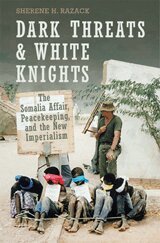
Somalia. March 4, 1993. Two Somalis are shot in the back by Canadian peacekeepers, one fatally.Barely two weeks later, sixteen-year-old Shidane Abukar Arone is tortured to death. Dozens of Canadian soldiers look on or know of the torture.The first reports of what became known in Canada as the Somalia Affair challenged national claims to a special expertise in peacekeeping and to a society free of racism. Today, however, despite a national inquiry into the deployment of troops to Somalia, what most Canadians are likely to associate with peacekeeping is the nation's glorious role as peacekeeper to the world. Moments of peacekeeping violence are attributed to a few bad apples, bad generals, and a rogue regiment.In Dark Threats and White Knights, Sherene H. Razack explores the racism implicit in the Somalia Affair and what it has to do with modern peacekeeping. Examining the records of military trials and the public inquiry, Razack weaves together two threads: that of the violence itself and what would drive men to commit such atrocities, and secondly, the ways in which peacekeeping violence is largely forgiven and ultimately forgotten. Race disappears from public memory and what is installed in its place is a story about an innocent, morally superior middle-power nation obliged to discipline and sort out barbaric third world nations. Modern peacekeeping, Razack concludes, maintains a colour line between a family of white nations constructed as civilized and a third world constructed as a dark threat, a world in which violence is not only condoned but seen as necessary.
Dark Threats and White Knights
The Somalia Affair, Peacekeeping, and the New Imperialism
Inbunden, Engelska, 2004
725 kr
Skickas inom 11-20 vardagar
Somalia. March 4, 1993. Two Somalis are shot in the back by Canadian peacekeepers, one fatally.Barely two weeks later, sixteen-year-old Shidane Abukar Arone is tortured to death. Dozens of Canadian soldiers look on or know of the torture.The first reports of what became known in Canada as the Somalia Affair challenged national claims to a special expertise in peacekeeping and to a society free of racism. Today, however, despite a national inquiry into the deployment of troops to Somalia, what most Canadians are likely to associate with peacekeeping is the nation's glorious role as peacekeeper to the world. Moments of peacekeeping violence are attributed to a few bad apples, bad generals, and a rogue regiment.In Dark Threats and White Knights, Sherene H. Razack explores the racism implicit in the Somalia Affair and what it has to do with modern peacekeeping. Examining the records of military trials and the public inquiry, Razack weaves together two threads: that of the violence itself and what would drive men to commit such atrocities, and secondly, the ways in which peacekeeping violence is largely forgiven and ultimately forgotten. Race disappears from public memory and what is installed in its place is a story about an innocent, morally superior middle-power nation obliged to discipline and sort out barbaric third world nations. Modern peacekeeping, Razack concludes, maintains a colour line between a family of white nations constructed as civilized and a third world constructed as a dark threat, a world in which violence is not only condoned but seen as necessary.
467 kr
Skickas inom 7-10 vardagar
The fear and violence that followed the events of September 11, 2001 touched lives all around the world, even in places that few would immediately associate with the global war on terror. In At the Limits of Justice, twenty-nine contributors from six countries explore the proximity of terror in their own lives and in places ranging from Canada and the United States to Jamaica, Palestine/Israel, Australia, Guyana, Chile, Pakistan, and across the African continent.In this collection, female scholars of colour – including leading theorists on issues of indigeneity, race, and feminism – examine the political, social, and personal repercussions of the war on terror through contributions that range from testimony and poetry to scholarly analysis. Inspired by both the personal and the global impact of this violence within the war on terror, they expose the way in which the war on terror is presented as a distant and foreign issue at the same time that it is deeply present in the lives of women and others all around the world.An impassioned but rigorous examination of issues of race and gender in contemporary politics, At the Limits of Justice is also a call to create moral communities which will find terror and violence unacceptable.
Dying from Improvement
Inquests and Inquiries Into Indigenous Deaths in Custody
Häftad, Engelska, 2015
388 kr
Skickas inom 7-10 vardagar
No matter where in Canada they occur, inquiries and inquests into untimely Indigenous deaths in state custody often tell the same story. Repeating details of fatty livers, mental illness, alcoholic belligerence, and a mysterious incapacity to cope with modern life, the legal proceedings declare that there are no villains here, only inevitable casualties of Indigenous life.But what about a sixty-seven-year-old man who dies in a hospital in police custody with a large, visible, purple boot print on his chest? Or a barely conscious, alcoholic older man, dropped off by police in a dark alley on a cold Vancouver night? Or Saskatoon’s infamous and lethal starlight tours, whose victims were left on the outskirts of town in sub-zero temperatures? How do we account for the repeated failure to care evident in so many cases of Indigenous deaths in custody?In Dying from Improvement, Sherene H. Razack argues that, amidst systematic state violence against Indigenous people, inquiries and inquests serve to obscure the violence of ongoing settler colonialism under the guise of benevolent concern. They tell settler society that it is caring, compassionate, and engaged in improving the lives of Indigenous people – even as the incarceration rate of Indigenous men and women increases and the number of those who die in custody rises.Razack’s powerful critique of the Canadian settler state and its legal system speaks to many of today’s most pressing issues of social justice: the treatment of Indigenous people, the unparalleled authority of the police and the justice system, and their systematic inhumanity towards those whose lives they perceive as insignificant.