Shuichirou Ike - Böcker
Visar alla böcker från författaren Shuichirou Ike. Handla med fri frakt och snabb leverans.
3 produkter
3 produkter
2 577 kr
Skickas inom 10-15 vardagar
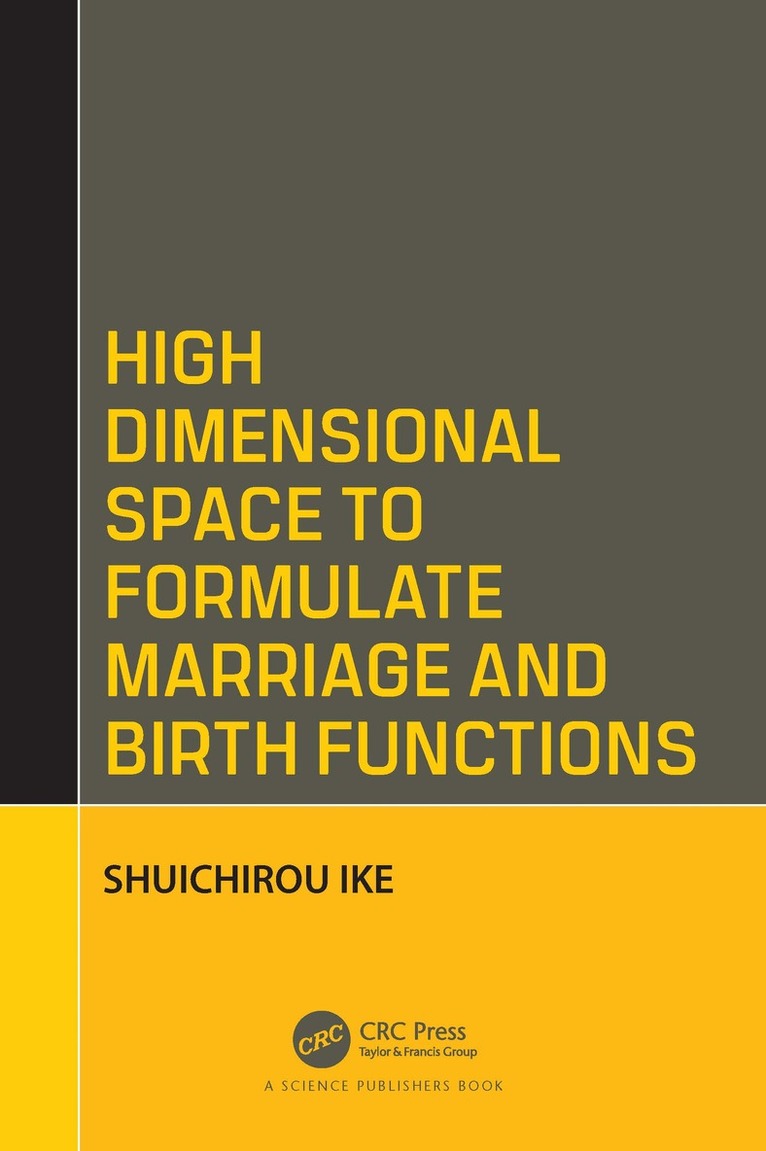
With the collapse of Demographic Transition Theory, new theories of population must not just be explanations, but should be falsifiable theories which can compute the number of occurrences of marriages and births. This book reviews computable marriage and birth function using dynamic properties. To do that, the functions are defined in high dimensional space. The reaction-diffusion equation of the number of children in a space is applied to these phenomena, providing solutions to many problems concerning a decline in fertility. The functions are developed as stochastic maps based on the present behaviors of successive behaviors in a geographical space. As we assume that there is an inter-dependence of human behaviors, we use the law of dynamics concerning the function of marriage and birth. The exact mathematical definition of interactions in a space naturally implies a causal relation. For the function concerning the number of children of parents, two geographical-dimensional spaces are required. The decline in fertility in Belgium due to different languages is explained, and the longer fertility period in Brittany is explained by the Laplacian of the diffusion equation. Depending on the degree of symbolic control over behaviors, we need to add the degree of the dimension of the space. For the marriage function, we add age as a biological dimension to the geographical space. In this higher dimensional space, the mapping from neighboring present marriages to neighboring successive marriages is no less than that of the marriage function. These chain reactions caused the baby boom as an exothermal reaction-diffusion. Birth functions require one to add the marriage-age dimension to two geographical and age dimensions so that it is a five dimensional hypersurface. It can, thus, determine birth probabilities of a female who married at a certain age. The phenomenon of modern fertility decline may only be the result of these chain reactions. These processes are solely dependent upon time-space, and not on socioeconomic conditions. This is the very reason why we are able to predict it mathematically. The book provides a new thinking in fertility decline for demographic research. Readers need to be aware that the fertility decline experienced throughout the modern era is a spatial pattern formation (as a reaction-diffusion). The author hopes new mathematical applications in human activities are developed through these new models.
1 143 kr
Skickas inom 10-15 vardagar
With the collapse of Demographic Transition Theory, new theories of population must not just be explanations, but should be falsifiable theories which can compute the number of occurrences of marriages and births. This book reviews computable marriage and birth function using dynamic properties. To do that, the functions are defined in high dimensional space. The reaction-diffusion equation of the number of children in a space is applied to these phenomena, providing solutions to many problems concerning a decline in fertility. The functions are developed as stochastic maps based on the present behaviors of successive behaviors in a geographical space. As we assume that there is an inter-dependence of human behaviors, we use the law of dynamics concerning the function of marriage and birth. The exact mathematical definition of interactions in a space naturally implies a causal relation. For the function concerning the number of children of parents, two geographical-dimensional spaces are required. The decline in fertility in Belgium due to different languages is explained, and the longer fertility period in Brittany is explained by the Laplacian of the diffusion equation. Depending on the degree of symbolic control over behaviors, we need to add the degree of the dimension of the space. For the marriage function, we add age as a biological dimension to the geographical space. In this higher dimensional space, the mapping from neighboring present marriages to neighboring successive marriages is no less than that of the marriage function. These chain reactions caused the baby boom as an exothermal reaction-diffusion. Birth functions require one to add the marriage-age dimension to two geographical and age dimensions so that it is a five dimensional hypersurface. It can, thus, determine birth probabilities of a female who married at a certain age. The phenomenon of modern fertility decline may only be the result of these chain reactions. These processes are solely dependent upon time-space, and not on socioeconomic conditions. This is the very reason why we are able to predict it mathematically. The book provides a new thinking in fertility decline for demographic research. Readers need to be aware that the fertility decline experienced throughout the modern era is a spatial pattern formation (as a reaction-diffusion). The author hopes new mathematical applications in human activities are developed through these new models.
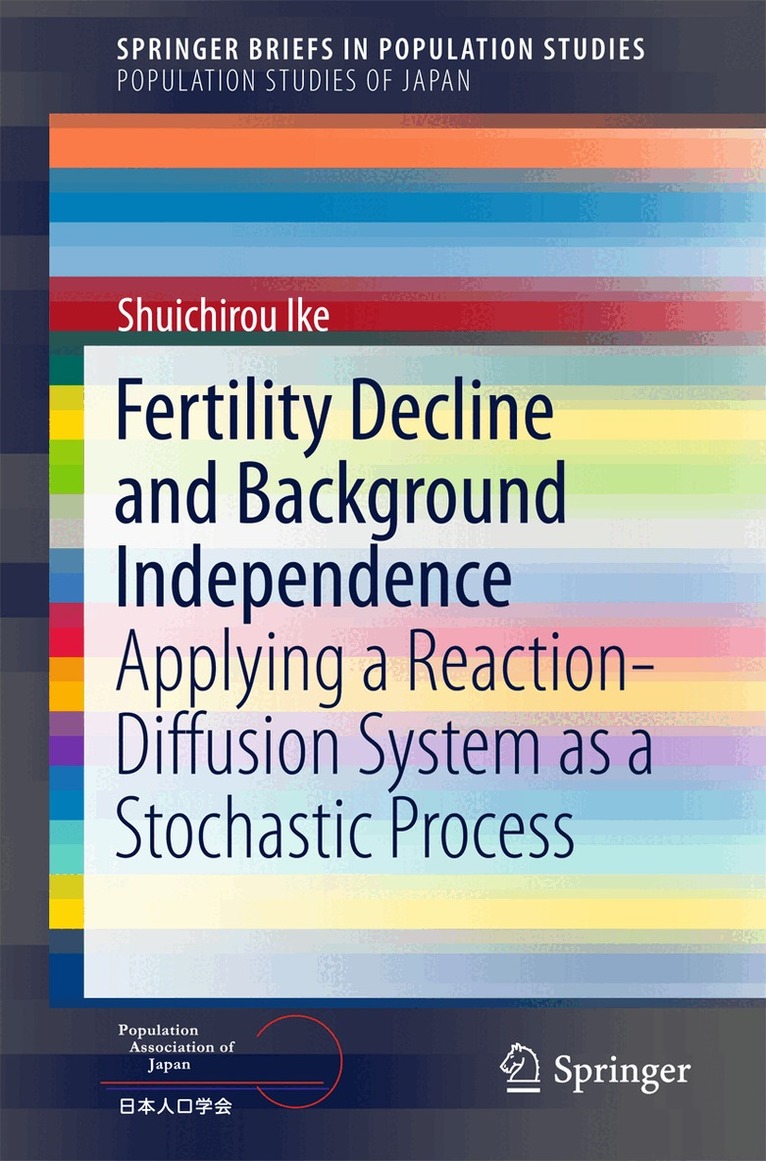
Fertility Decline and Background Independence
Applying a Reaction-Diffusion System as a Stochastic Process
Häftad, Engelska, 2015
536 kr
Skickas inom 10-15 vardagar
In this book the author maintains that fertility declines independently of its “background”. Normally, fertility decline is thought to occur as a result of alteration in the socioeconomic background such as the decline of the infant mortality rate, urbanization, the level of literacy, and so on. This point of view has been regarded as equivalent to “demographic transition”. However, the concept of demographic transition is so superficial, naïve and unscientific that it should be applied merely to the ostensible demographic phenomena, not to the mechanisms of fertility decline. The author regards this way of thinking, i.e., that the occurrence of fertility decline is dependent on socioeconomic background, as the “background dependence” of fertility decline. On the contrary, there is considerable counterevidence to the background dependence of fertility decline. The argument is made that background dependence lacks positive evidence and predictability and consequently, is falsifiable. That decisive counterevidence is introduced in this book. The author revives the diffusion hypothesis of fertility decline at the point of the number of children per couple as the reaction–diffusion process in a mathematical equation. Fertility decline in Europe in the eighteenth and nineteenth centuries occurred as a reaction–diffusion process independent of socioeconomic background. In Japan as well, fertility (the number of children per couple) declined independently of background. This book provides ample evidences persuasively demonstrating this independence of fertility in Japan. The occurrence of marriage is also independent of socioeconomic background. Thus the author formalizes the marriage function as an integral equation of marriage probability, as a result, it demonstrates a better fit with the observed data than does any other marriage function. Occurrence of marriage is almost solely dependent on the density of marriages that occur in a givensubspace.