Sinai Robins - Böcker
Visar alla böcker från författaren Sinai Robins. Handla med fri frakt och snabb leverans.
5 produkter
5 produkter
483 kr
Skickas inom 10-15 vardagar
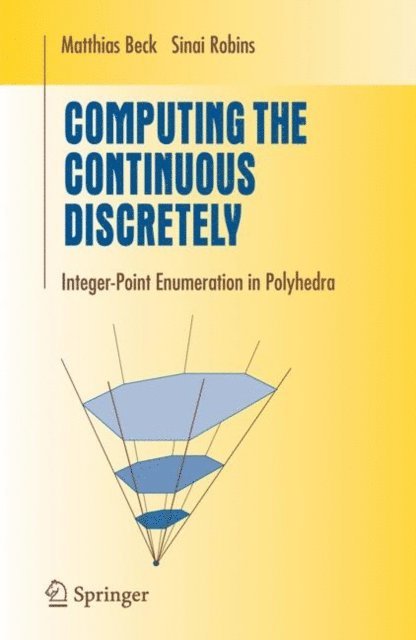
The world is continuous, but the mind is discrete. David Mumford We seek to bridge some critical gaps between various ?elds of mathematics by studying the interplay between the continuous volume and the discrete v- ume of polytopes. Examples of polytopes in three dimensions include crystals, boxes, tetrahedra, and any convex object whose faces are all ?at. It is amusing to see how many problems in combinatorics, number theory, and many other mathematical areas can be recast in the language of polytopes that exist in some Euclidean space. Conversely, the versatile structure of polytopes gives us number-theoretic and combinatorial information that ?ows naturally from their geometry. Fig. 0. 1. Continuous and discrete volume. The discrete volume of a body P can be described intuitively as the number of grid points that lie inside P, given a ?xed grid in Euclidean space. The continuous volume of P has the usual intuitive meaning of volume that we attach to everyday objects we see in the real world. VIII Preface Indeed, the di?erence between the two realizations of volume can be thought of in physical terms as follows. On the one hand, the quant- level grid imposed by the molecular structure of reality gives us a discrete notion of space and hence discrete volume. On the other hand, the N- tonian notion of continuous space gives us the continuous volume.
Fourier Analysis on Polytopes and the Geometry of Numbers
Part I: a Friendly Introduction
Häftad, Engelska, 2024
678 kr
Skickas inom 7-10 vardagar
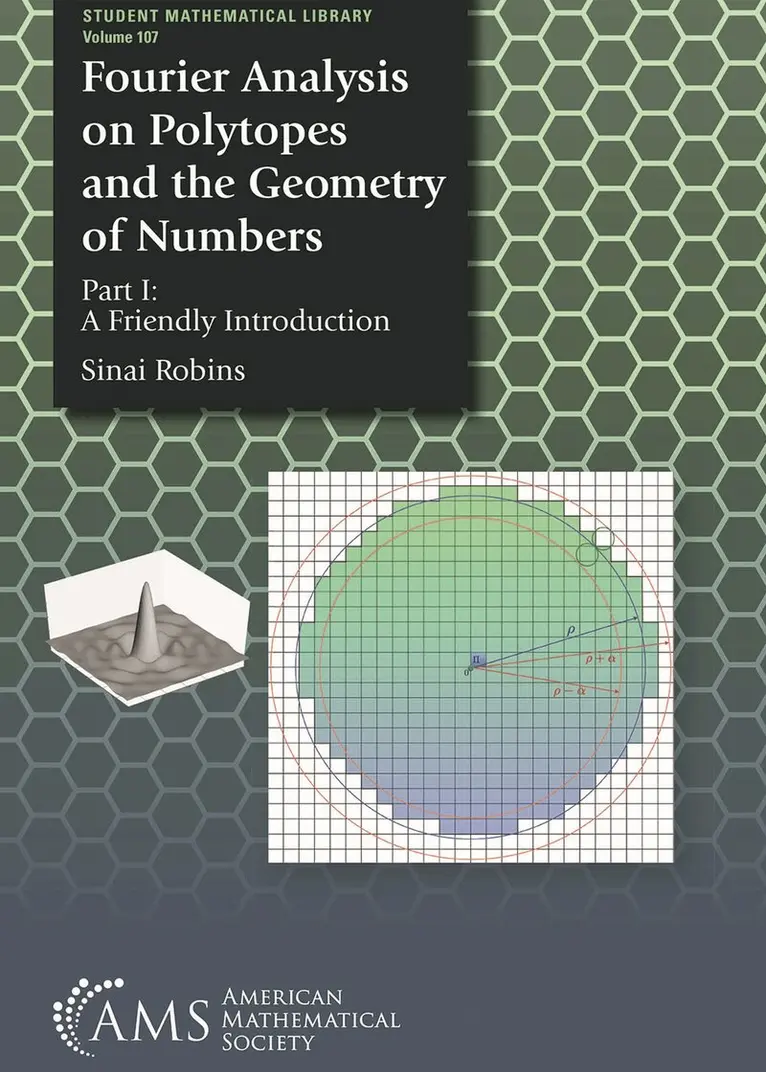
This book offers a gentle introduction to the geometry of numbers from a modern Fourier-analytic point of view. One of the main themes is the transfer of geometric knowledge of a polytope to analytic knowledge of its Fourier transform. The Fourier transform preserves all of the information of a polytope, and turns its geometry into analysis. The approach is unique, and streamlines this emerging field by presenting new simple proofs of some basic results of the field. In addition, each chapter is fitted with many exercises, some of which have solutions and hints in an appendix. Thus, an individual learner will have an easier time absorbing the material on their own, or as part of a class.Overall, this book provides an introduction appropriate for an advanced undergraduate, a beginning graduate student, or researcher interesting in exploring this important expanding field.
433 kr
Skickas inom 5-8 vardagar
This richly illustrated textbook explores the amazing interaction between combinatorics, geometry, number theory, and analysis which arises in the interplay between polyhedra and lattices. Highly accessible to advanced undergraduates, as well as beginning graduate students, this second edition is perfect for a capstone course, and adds two new chapters, many new exercises, and updated open problems. For scientists, this text can be utilized as a self-contained tooling device.The topics include a friendly invitation to Ehrhart’s theory of counting lattice points in polytopes, finite Fourier analysis, the Frobenius coin-exchange problem, Dedekind sums, solid angles, Euler–Maclaurin summation for polytopes, computational geometry, magic squares, zonotopes, and more.With more than 300 exercises and open research problems, the reader is an active participant, carried through diverse but tightly woven mathematical fields that are inspired by an innocently elementary question: What are the relationships between the continuous volume of a polytope and its discrete volume?Reviews of the first edition:“You owe it to yourself to pick up a copy of Computing the Continuous Discretely to read about a number of interesting problems in geometry, number theory, and combinatorics.”— MAA Reviews“The book is written as an accessible and engaging textbook, with many examples, historical notes, pithy quotes, commentary integrating the material, exercises, open problems and an extensive bibliography.”— Zentralblatt MATH“This beautiful book presents, at a level suitable for advanced undergraduates, a fairly complete introduction to the problem of counting lattice points inside a convex polyhedron.”— Mathematical Reviews“Many departments recognize the need for capstone courses in which graduating students can see the tools they have acquired come together in some satisfyingway. Beck and Robinshave written the perfect text for such a course.”— CHOICE
433 kr
Skickas inom 5-8 vardagar
This richly illustrated textbook explores the amazing interaction between combinatorics, geometry, number theory, and analysis which arises in the interplay between polyhedra and lattices. Highly accessible to advanced undergraduates, as well as beginning graduate students, this second edition is perfect for a capstone course, and adds two new chapters, many new exercises, and updated open problems. For scientists, this text can be utilized as a self-contained tooling device.The topics include a friendly invitation to Ehrhart’s theory of counting lattice points in polytopes, finite Fourier analysis, the Frobenius coin-exchange problem, Dedekind sums, solid angles, Euler–Maclaurin summation for polytopes, computational geometry, magic squares, zonotopes, and more.With more than 300 exercises and open research problems, the reader is an active participant, carried through diverse but tightly woven mathematical fields that are inspired by an innocently elementary question: What are the relationships between the continuous volume of a polytope and its discrete volume?Reviews of the first edition:“You owe it to yourself to pick up a copy of Computing the Continuous Discretely to read about a number of interesting problems in geometry, number theory, and combinatorics.”— MAA Reviews“The book is written as an accessible and engaging textbook, with many examples, historical notes, pithy quotes, commentary integrating the material, exercises, open problems and an extensive bibliography.”— Zentralblatt MATH“This beautiful book presents, at a level suitable for advanced undergraduates, a fairly complete introduction to the problem of counting lattice points inside a convex polyhedron.”— Mathematical Reviews“Many departments recognize the need for capstone courses in which graduating students can see the tools they have acquired come together in some satisfyingway. Beck and Robinshave written the perfect text for such a course.”— CHOICE
303 kr
Skickas inom 10-15 vardagar
Das Gebiet des „Zählens von Gitterpunkten in Polytopen", auch Ehrhart-Theorie genannt, bietet verschiedene Verbindungen zu elementarer endlicher Fourier-Analysis, Erzeugendenfunktionen, dem Münzenproblem von Frobenius, Raumwinkeln, magischen Quadraten, Dedekind-Summen, algorithmischer Geometrie und mehr. Die Autoren haben mit dem Buch einen roten Faden geknüpft, der diese Verbindungen aufzeigt und so die grundlegenden und dennoch tiefgehenden Ideen aus diskreter Geometrie, Kombinatorik und Zahlentheorie anschaulich verbindet. Mit 250 Aufgaben und offenen Problemen fühlt sich der Leser als aktiver Teilnehmer, und der einnehmende Stil der Autoren fördert solche Beteiligung. Die vielen fesselnden Bilder, die die Beweise und Beispiele begleiten, tragen zu dem einladenden Stil dieses einzigartigen Buches bei.