Stefani Hoffman - Böcker
Visar alla böcker från författaren Stefani Hoffman. Handla med fri frakt och snabb leverans.
5 produkter
5 produkter
441 kr
Skickas inom 7-10 vardagar
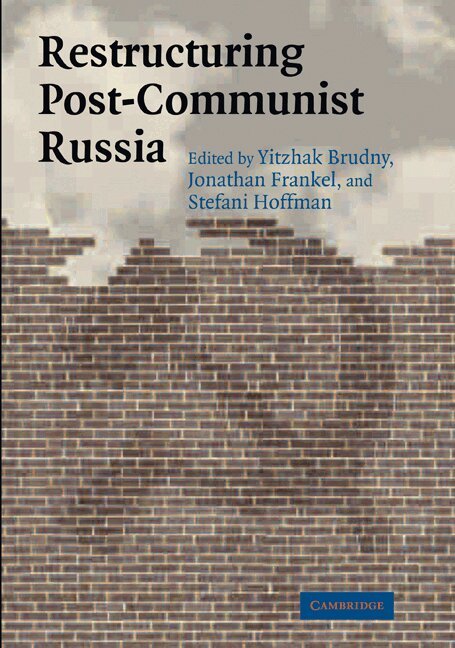
Since the fall of the Soviet Union in 1991, the question of 'whither Russia?' has been the source of ceaseless speculation both at home and abroad. In search of answers, twelve highly qualified scholars examine the complex interplay between continuity and change that has marked developments in Russia under the leadership first of Boris Yeltsin and now of Vladimir Putin. Analsying the recent past, they also peer into the country's future. In his introduction to the volume Peter Rutland asks whether we are witnessing the gradual entrenchment of parliamentary democracy, the slow return to autocracy or mere political stagnation. Restructuring Post-Communist Russia poses the fundamental questions while providing the information and analysis needed to give the (at least, preliminary) answers.
794 kr
Skickas inom 7-10 vardagar
Since the fall of the Soviet Union in 1991, the question of 'whither Russia?' has been the source of ceaseless speculation both at home and abroad. In search of answers, twelve highly qualified scholars examine the complex interplay between continuity and change that has marked developments in Russia under the leadership first of Boris Yeltsin and now of Vladimir Putin. Analsying the recent past, they also peer into the country's future. In his introduction to the volume Peter Rutland asks whether we are witnessing the gradual entrenchment of parliamentary democracy, the slow return to autocracy or mere political stagnation. Restructuring Post-Communist Russia poses the fundamental questions while providing the information and analysis needed to give the (at least, preliminary) answers.
813 kr
Skickas inom 10-15 vardagar
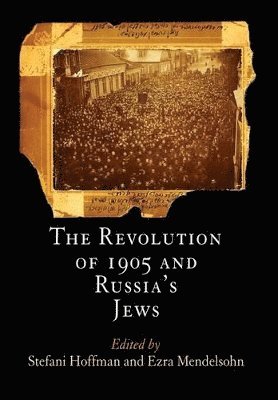
The 1905 Revolution in Russia ushered in an unprecedented (though brief) period of social and political freedom in the Russian Empire. This environment made possible the emergence of mass Jewish politics and the flourishing of a new, modern Jewish culture expressed in Yiddish, Hebrew, and Russian. Unfortunately, 1905 also unleashed popular anti-Semitism in the shape of pogroms on a scale previously unknown.Russian Jewry, by far the largest Jewish community in the world at that time, faced fateful decisions. Should the Jews strive to uphold Jewish national uniqueness either in the context of the Russian Empire or by emigrating to Palestine/the Land of Israel, or should they identify with and merge into the general revolutionary or liberal movements in their country of birth? What direction should Jewish culture and social organizations take within the context of democratization and modernization? In what language or languages should this culture be expressed? How should Jews abroad react to the revolutionary crisis and to the dilemmas of their coreligionists?The thought-provoking essays in this volume shed new light on these issues while placing them in the larger context of the historical, social, and cultural developments within the Russian Empire. The authors, representing various disciplines, emphasize both the highly varied Jewish responses to the great crisis and the degree to which these responses shared certain vital characteristics.
2 014 kr
Skickas inom 3-6 vardagar
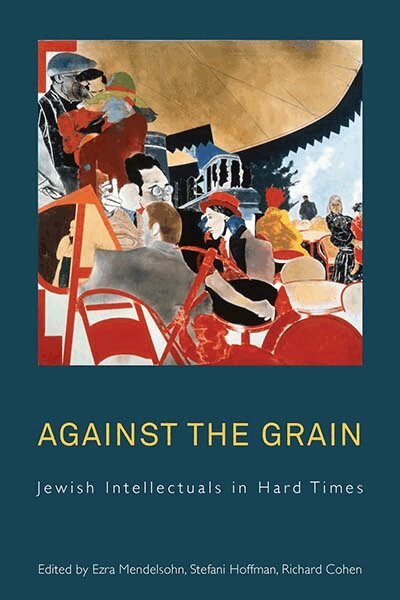
Highlighting the seminal role of German Jewish intellectuals and ideologues in forming and transforming the modern Jewish world, this volume analyzes the political roads taken by German Jewish thinkers; the impact of the Holocaust on the Central and East European Jewish intelligentsia; and the conundrum of modern Jewish identity. Several of German Jewry’s most outstanding figures such as Scholem, Strauss, and Kohn are discussed. Inspired by Steven E. Aschheim’s work, several contributors focus on the fraught relationship between German and East European Jews (the so-called Ostjuden) and between German Jews and their non-Jewish neighbors. More generally, this book examines how Central European Jewish thinkers reacted to the terrible crises of the twentieth century—to war, genocide, and the existential threat to the very existence of the Jewish people. It is essential reading for those interested in the triumphs and tragedies of modern European Jewry.
433 kr
Skickas inom 7-10 vardagar
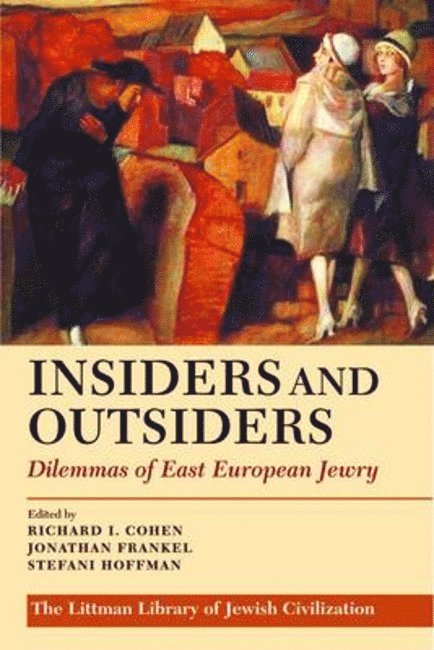
Insiders and Outsiders: Dilemmas of East European Jewry examines problems ofJewish cultural and political orientations, associations, andself-identification within a broad framework. The contributors approach thepredicament of east European Jews in various settings: some focus primarily onthe Jews' inner development and outlook, while others discuss how elements ofthe majority society viewed their presence. Scholars of history, art history,and literature display originality and insight in illuminating the nuances andintricacies of the Jewish ‘outsider’.Following an overview by the distinguished intellectual historianof German Jewry Steven Aschheim, who offers some comprehensive thoughts on theinsider/outsider dilemma in modern times and its relevance to eastern Europe,the discussion evolves around three major themes: the cultural conundrum; modesof acculturation, assimilation, and identity; and the minority’s inclusion inor exclusion from the political agendas of certain east European societies. Itconcludes with a focus on two remarkable cities―Czernowitz and Vilnius―wherethe Jewish minority has often been conceived as being no less ‘inside’ thanother groups.Contributors to the ‘cultural conundrum’ section deal with artistsand writers from Romania and Poland who have gained wide public and criticalattention over the years, including Reuven Rubin, Itzik Manger, Avot Yeshurun,and Mihail Sebastian. Other essays discuss the work of a group of writers fromPoland, including Henryk Grynberg, Wilhelm Dichter, Joanna Olczak-Ronikier,Krzysztof Teodor Toeplitz, and Michal Glowinski, who reflected intensively ontheir experiences as Jews in the Second World War and tried to integrate theseexperiences into their often fractured identities. The complex personalevolution of these figures shows the multi-layered influences on theircreativity and imagination, while underscoring the dilemmas they faced to findpoints of meeting between their Jewish background and their national identity.The section on modes of acculturation, assimilation, and identityoffers detailed analyses of the ways in which multi-ethnic and multi-nationalsituations demand that the ‘outsider’, consciously or unconsciously, developinner strategies to fashion a specific identity. Surveying such vibrant areasas Czechoslovakia and Poland between the two world wars and the city of Lwów inthe late nineteenth century, three essays present some of the choices Jews madein order to deal with the changing political and cultural context. Theirmeditations on belonging and not-belonging―onthe constitution of identity and its fluidity, and on the formation, breakdown,and reconfiguration of physical, mental, social, and geographicalborders―acquire a special relevance and urgency in these settings.How did Jews as ‘outsiders’ configure their political allegiance ineastern Europe? How prominent were they in the radical elements of thecommunist movement in Russia? What tactics did they employ to safeguard theirfuture in such societies and what means did they employ to galvanize the‘Jewish street’? These are some of the questions raised in the section onsociety and politics, which delves into such problematic terrain as ‘Jewishinformers’, the ‘non-Jewish Jew’, and ‘Jewish politics’.The concluding essays examine thetensions, paradoxes, and ironies of the phenomenon of the Jewish outsider inCzernowitz and Vilnius, two cities where, indeed, Jews were often construed tobe the true ‘insiders’.CONTRIBUTORS: Steven E. Aschheim, Karen Auerbach, RichardI. Cohen, Jonathan Frankel, Stefani Hoffman, Zvi Jagendorf, Hillel J. Kieval,Rachel Manekin, Amitai Mendelsohn, Joanna B. Michlic, Antony Polonsky, DavidRechter, Scott Ury, Leon Volovici, Ruth R. Wisse, Mordechai Zalkin