Stephan Dahlke - Böcker
Visar alla böcker från författaren Stephan Dahlke. Handla med fri frakt och snabb leverans.
4 produkter
4 produkter
Del 102 - Lecture Notes in Computational Science and Engineering
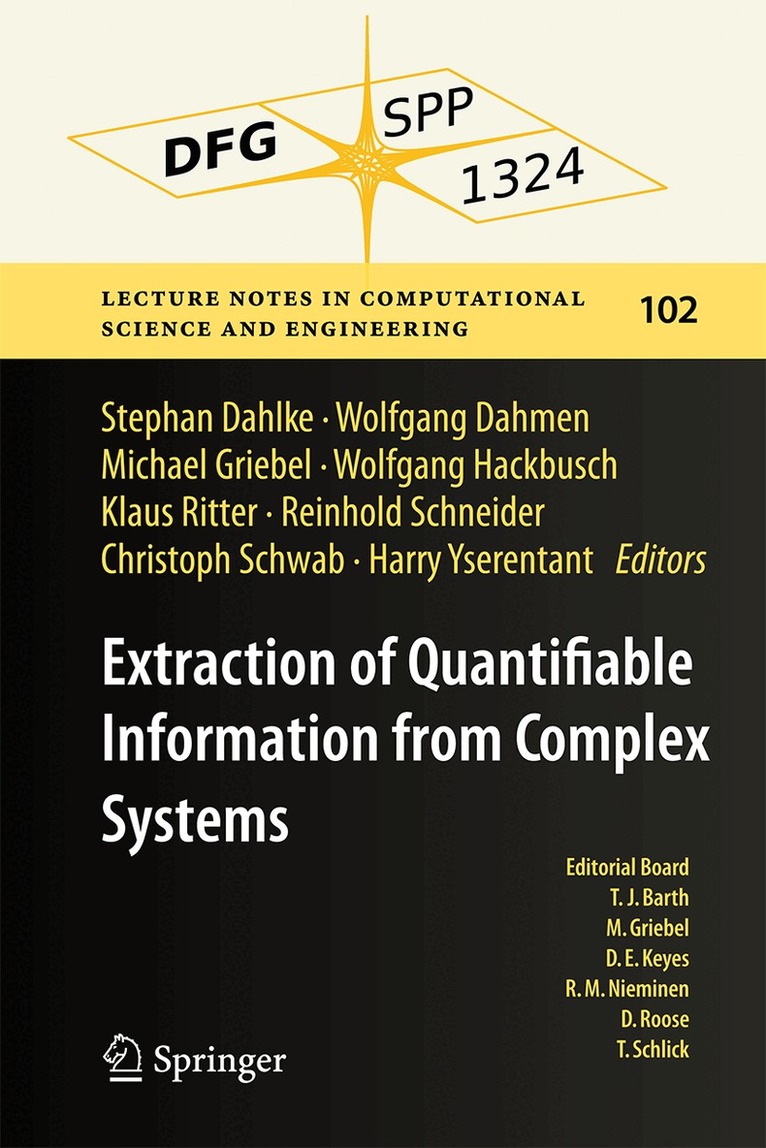
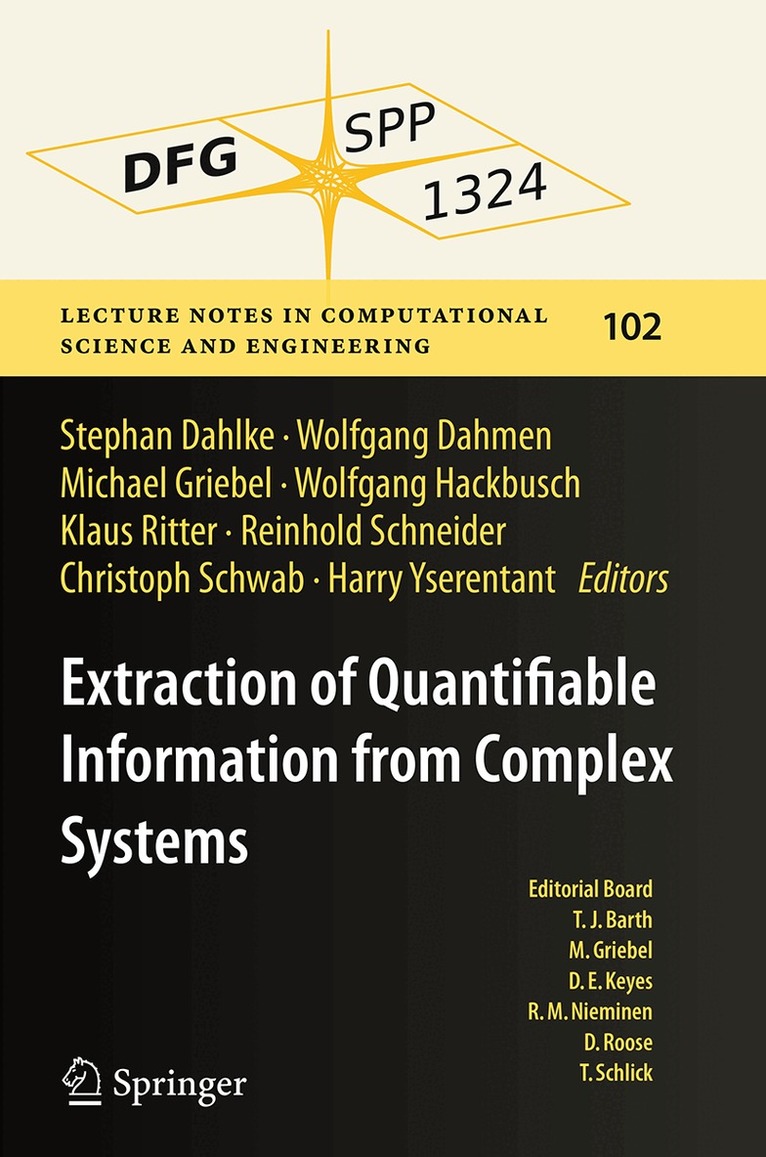
Extraction of Quantifiable Information from Complex Systems
Inbunden, Engelska, 2014
540 kr
Skickas inom 10-15 vardagar
In April 2007, the Deutsche Forschungsgemeinschaft (DFG) approved the Priority Program 1324 “Mathematical Methods for Extracting Quantifiable Information from Complex Systems.” This volume presents a comprehensive overview of the most important results obtained over the course of the program. Mathematical models of complex systems provide the foundation for further technological developments in science, engineering and computational finance. Motivated by the trend toward steadily increasing computer power, ever more realistic models have been developed in recent years. These models have also become increasingly complex, and their numerical treatment poses serious challenges. Recent developments in mathematics suggest that, in the long run, much more powerful numerical solution strategies could be derived if the interconnections between the different fields of research were systematically exploited at a conceptual level. Accordingly, a deeper understanding of the mathematical foundations as well as the development of new and efficient numerical algorithms were among the main goals of this Priority Program. The treatment of high-dimensional systems is clearly one of the most challenging tasks in applied mathematics today. Since the problem of high-dimensionality appears in many fields of application, the above-mentioned synergy and cross-fertilization effects were expected to make a great impact. To be truly successful, the following issues had to be kept in mind: theoretical research and practical applications had to be developed hand in hand; moreover, it has proven necessary to combine different fields of mathematics, such as numerical analysis and computational stochastics. To keep the whole program sufficiently focused, we concentrated on specific but related fields of application that share common characteristics and as such, they allowed us to use closely related approaches.
540 kr
Skickas inom 10-15 vardagar
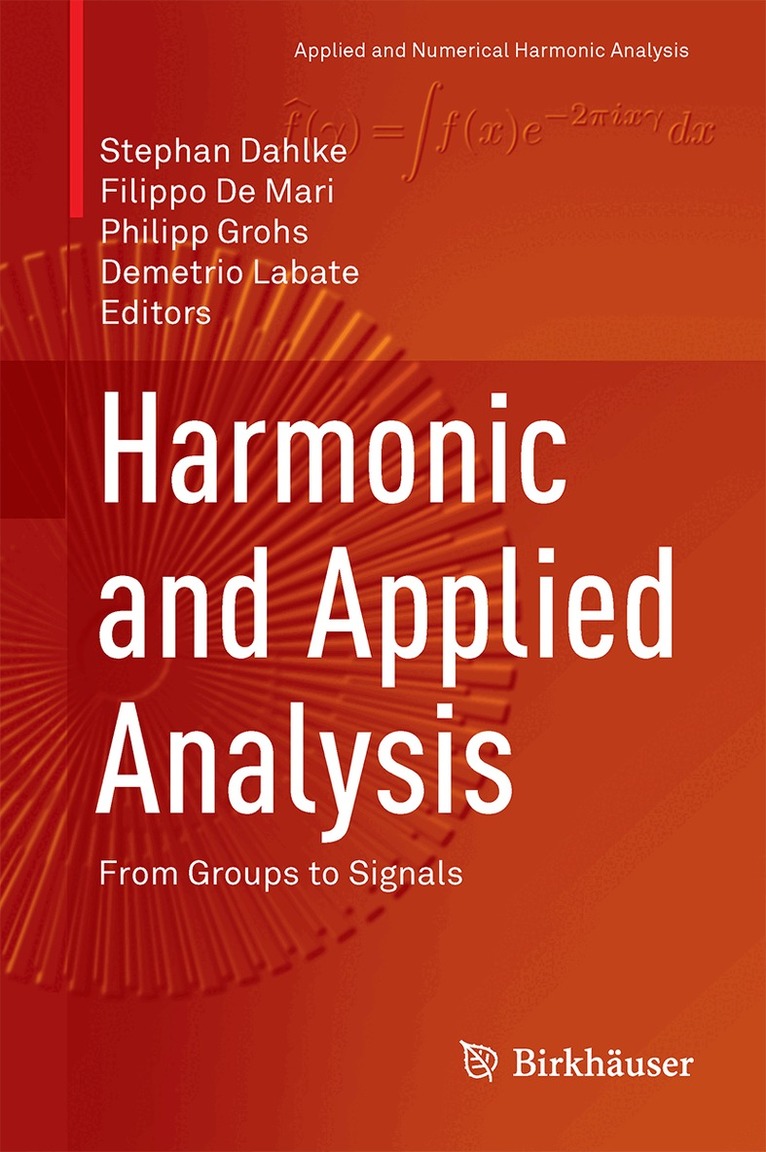
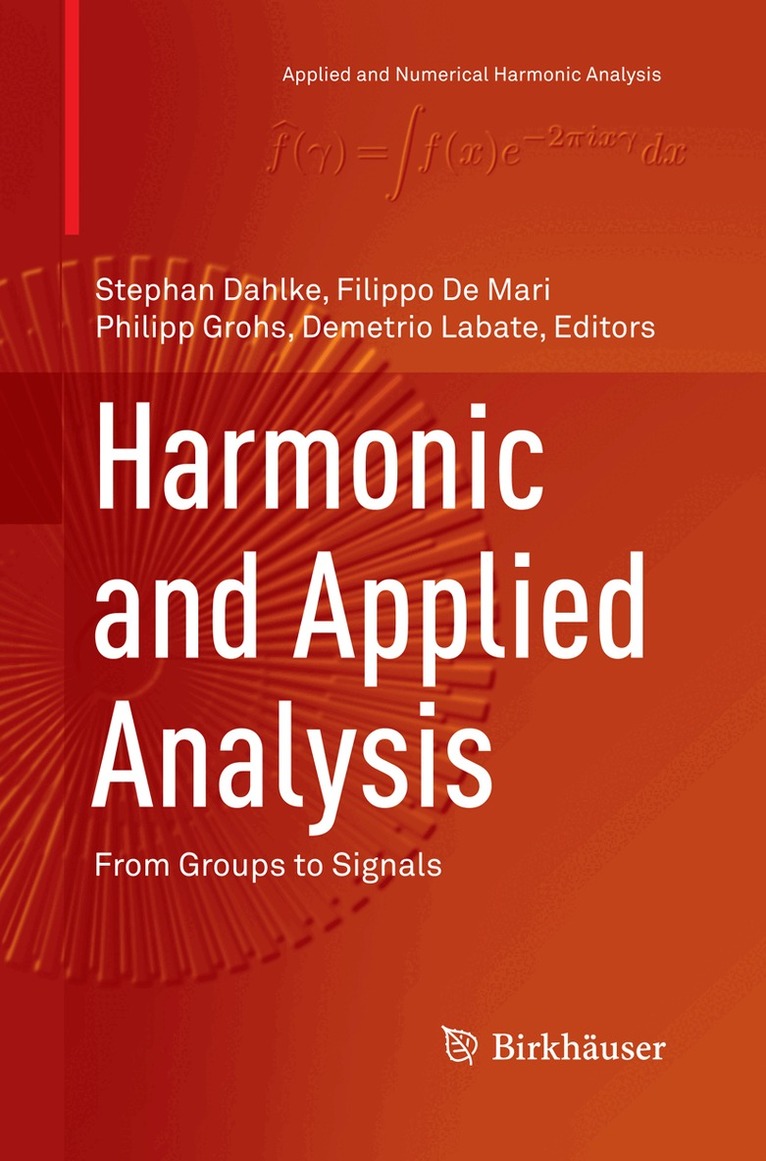
This contributed volume explores the connection between the theoretical aspects of harmonic analysis and the construction of advanced multiscale representations that have emerged in signal and image processing. It highlights some of the most promising mathematical developments in harmonic analysis in the last decade brought about by the interplay among different areas of abstract and applied mathematics. This intertwining of ideas is considered starting from the theory of unitary group representations and leading to the construction of very efficient schemes for the analysis of multidimensional data.After an introductory chapter surveying the scientific significance of classical and more advanced multiscale methods, chapters cover such topics asAn overview of Lie theory focused on common applications in signal analysis, including the wavelet representation of the affine group, the Schrödinger representation of the Heisenberg group, and the metaplectic representation of the symplectic groupAn introduction to coorbit theory and how it can be combined with the shearlet transform to establish shearlet coorbit spacesMicrolocal properties of the shearlet transform and its ability to provide a precise geometric characterization of edges and interface boundaries in images and other multidimensional dataMathematical techniques to construct optimal data representations for a number of signal types, with a focus on the optimal approximation of functions governed by anisotropic singularities.A unified notation is used across all of the chapters to ensure consistency of the mathematical material presented.Harmonic and Applied Analysis: From Groups to Signals is aimed at graduate students and researchers in the areas of harmonic analysis and applied mathematics, as well as at other applied scientists interested in representations of multidimensional data. It can also be used as a textbookfor graduate courses in applied harmonic analysis.
Del 102 - Lecture Notes in Computational Science and Engineering
Extraction of Quantifiable Information from Complex Systems
Häftad, Engelska, 2016
537 kr
Skickas inom 10-15 vardagar
In April 2007, the Deutsche Forschungsgemeinschaft (DFG) approved the Priority Program 1324 “Mathematical Methods for Extracting Quantifiable Information from Complex Systems.” This volume presents a comprehensive overview of the most important results obtained over the course of the program. Mathematical models of complex systems provide the foundation for further technological developments in science, engineering and computational finance. Motivated by the trend toward steadily increasing computer power, ever more realistic models have been developed in recent years. These models have also become increasingly complex, and their numerical treatment poses serious challenges. Recent developments in mathematics suggest that, in the long run, much more powerful numerical solution strategies could be derived if the interconnections between the different fields of research were systematically exploited at a conceptual level. Accordingly, a deeper understanding of the mathematical foundations as well as the development of new and efficient numerical algorithms were among the main goals of this Priority Program. The treatment of high-dimensional systems is clearly one of the most challenging tasks in applied mathematics today. Since the problem of high-dimensionality appears in many fields of application, the above-mentioned synergy and cross-fertilization effects were expected to make a great impact. To be truly successful, the following issues had to be kept in mind: theoretical research and practical applications had to be developed hand in hand; moreover, it has proven necessary to combine different fields of mathematics, such as numerical analysis and computational stochastics. To keep the whole program sufficiently focused, we concentrated on specific but related fields of application that share common characteristics and as such, they allowed us to use closely related approaches.
540 kr
Skickas inom 10-15 vardagar
This contributed volume explores the connection between the theoretical aspects of harmonic analysis and the construction of advanced multiscale representations that have emerged in signal and image processing. It highlights some of the most promising mathematical developments in harmonic analysis in the last decade brought about by the interplay among different areas of abstract and applied mathematics. This intertwining of ideas is considered starting from the theory of unitary group representations and leading to the construction of very efficient schemes for the analysis of multidimensional data.After an introductory chapter surveying the scientific significance of classical and more advanced multiscale methods, chapters cover such topics asAn overview of Lie theory focused on common applications in signal analysis, including the wavelet representation of the affine group, the Schrödinger representation of the Heisenberg group, and the metaplectic representation of the symplectic groupAn introduction to coorbit theory and how it can be combined with the shearlet transform to establish shearlet coorbit spacesMicrolocal properties of the shearlet transform and its ability to provide a precise geometric characterization of edges and interface boundaries in images and other multidimensional dataMathematical techniques to construct optimal data representations for a number of signal types, with a focus on the optimal approximation of functions governed by anisotropic singularities.A unified notation is used across all of the chapters to ensure consistency of the mathematical material presented.Harmonic and Applied Analysis: From Groups to Signals is aimed at graduate students and researchers in the areas of harmonic analysis and applied mathematics, as well as at other applied scientists interested in representations of multidimensional data. It can also be used as a textbookfor graduate courses in applied harmonic analysis.