Stephanie J. Rickard – författare
Visar alla böcker från författaren Stephanie J. Rickard. Handla med fri frakt och snabb leverans.
3 produkter
3 produkter
Inbunden, Engelska, 2018
1 330 kr
Skickas inom 7-10 vardagar
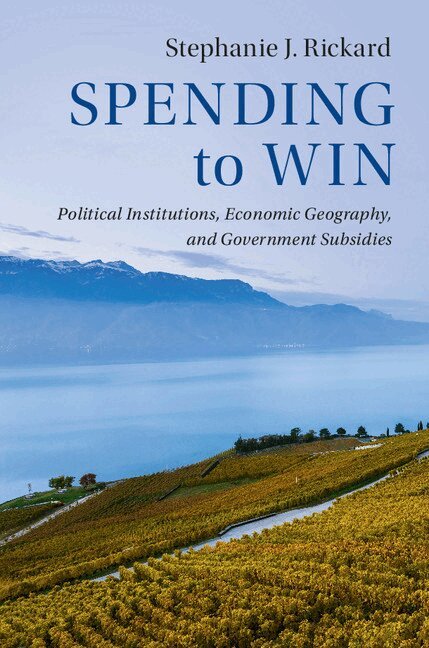
Governments in some democracies target economic policies, like industrial subsidies, to small groups at the expense of many. Why do some governments redistribute more narrowly than others? Their willingness to selectively target economic benefits, like subsidies to businesses, depends on the way politicians are elected and the geographic distribution of economic activities. Based on interviews with government ministers and bureaucrats, as well as parliamentary records, industry publications, local media coverage, and new quantitative data, Spending to Win: Political Institutions, Economic Geography, and Government Subsidies demonstrates that government policy-making can be explained by the combination of electoral institutions and economic geography. Specifically, it shows how institutions interact with economic geography to influence countries' economic policies and international economic relations. Identical institutions have wide-ranging effects depending on the context in which they operate. No single institution is a panacea for issues, such as income inequality, international economic conflict, or minority representation.
Häftad, Engelska, 2020
462 kr
Skickas inom 7-10 vardagar
Governments in some democracies target economic policies, like industrial subsidies, to small groups at the expense of many. Why do some governments redistribute more narrowly than others? Their willingness to selectively target economic benefits, like subsidies to businesses, depends on the way politicians are elected and the geographic distribution of economic activities. Based on interviews with government ministers and bureaucrats, as well as parliamentary records, industry publications, local media coverage, and new quantitative data, Spending to Win: Political Institutions, Economic Geography, and Government Subsidies demonstrates that government policy-making can be explained by the combination of electoral institutions and economic geography. Specifically, it shows how institutions interact with economic geography to influence countries' economic policies and international economic relations. Identical institutions have wide-ranging effects depending on the context in which they operate. No single institution is a panacea for issues, such as income inequality, international economic conflict, or minority representation.
842 kr
Skickas inom 5-8 vardagar
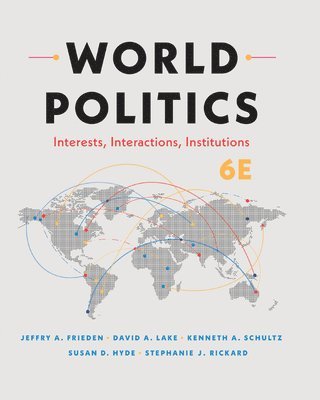
With its innovative 3Is framework based around interests, interactions, and institutions, the Sixth Edition of World Politics takes a contemporary approach to the international relations course, presenting students with puzzles about the world around them. Two new co-authors, Susan Hyde (University of California, Berkeley) and Stephanie Rickard (London School of Economics), bring fresh insights to the international political economy chapters, as well as to emerging topics of interest in the course, including human migration, human rights, and the environment. A new Norton Illumine Ebook provides an interactive environment for students to read, learn, and apply the 3Is framework to examples in the book and beyond.Highlights of the Sixth Edition’s new content:New co-authors Stephanie Rickard and Susan Hyde bring a next-generation approach to the 3I’s framework, offering fresh perspectives on international political economy and on emerging areas of scholarship, such as human rights, deglobalization, and the environment.Significant revisions to the following chapters: Ch. 7, now titled Cross-Border Flows of Goods and Services; Ch. 8, now titled Cross-Border Flows of Money and People; Ch. 11: International Law and Norms; Ch. 12: Human Rights; and Ch.13: The Global Environment.The authors explore contemporary themes in international relations across all chapters, including democratic backsliding, the rise of authoritarianism, and the spread of populism.New and revised “What Shaped Our World?” and “How Do We Know?” pedagogy provide windows into historical and contemporary events and data using the three I’s framework.A new Norton Illumine Ebook provides a robust interactive environment for students to read, learn, and apply the concepts of the course. End-of-section Check Your Understanding Questions confirm students’ understanding of key concepts and provide opportunities to apply the 3Is framework.