Stephen B. Howell – författare
Visar alla böcker från författaren Stephen B. Howell. Handla med fri frakt och snabb leverans.
6 produkter
6 produkter
3 266 kr
Skickas inom 10-15 vardagar
Taken together the data presented in this review, and work by many other investigators, support the notion that DNA excision repair is important in a tumor cell's resistance to platinum compounds. Inhibition of this repair system by combination chemotherapy with the excision repair inhibitors HU and Ara-C produces synergistic cell kills and increased levels and persistance of DNA interstrand crosslinks. The studies with cis-DDP and ~-DDP in combination with UV induced thymine dimers suggest that there may be competition for DNA repair enzymes between the dimer and the platinum lesion. Whether the competing lesion is an intrastrand crosslink, interstrand crosslink, or platinum monoadduct (or all of these lesions) cannot be determined. The similarity between an intrastrand crosslink and a cyclobutane dimer suggests that these lesions may compete for repair. However, the increased peak levels of interstrand crosslinks, and increased persistence of these lesions at later time points suggest that this lesion may also be a substrate for the repair system. These observations may be of clinical relevance. Recently Dr. Kathy Albain of our institution has completed a Phase III I study using a 12 hour pretreatment with HU and Ara-C in patients prior to their cis-DDP therapy. She observed a significant number of responders in this trial (54). She is currently completing a second Phase IIII study substituting IV HU for the oral formulation. We anticipate initiating other clinical trials based upon these observations.
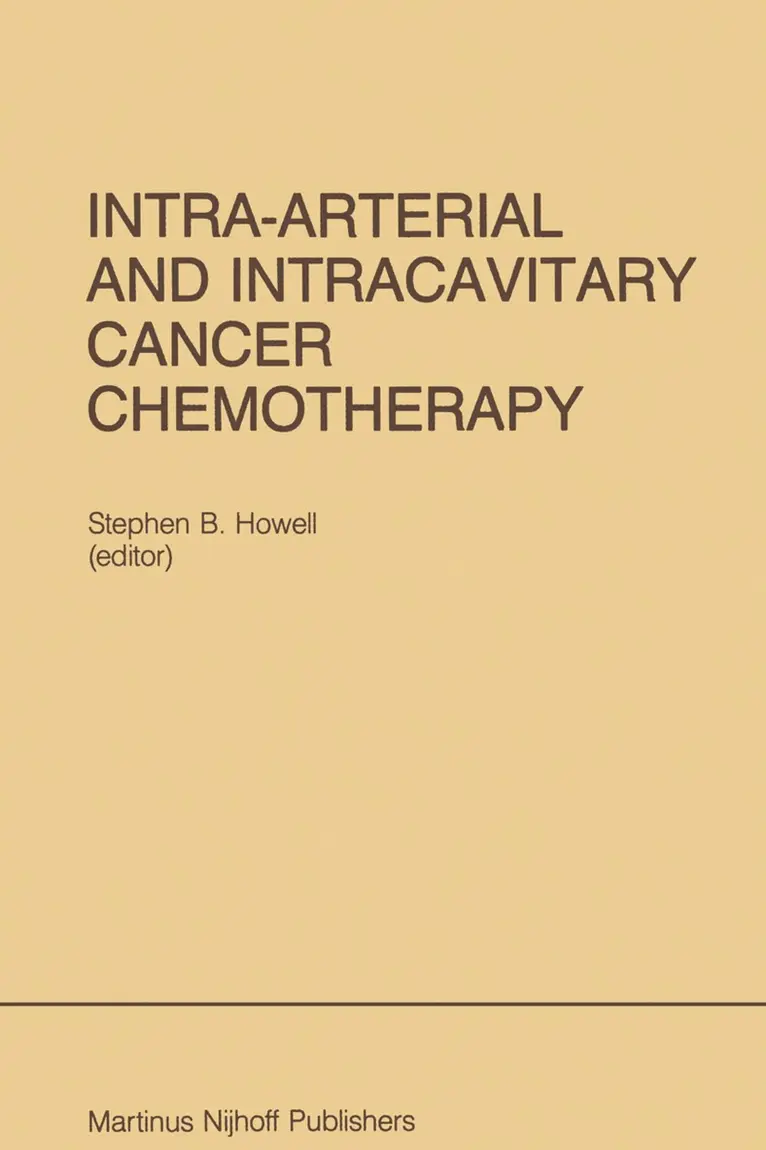
Intra-Arterial and Intracavitary Cancer Chemotherapy
Proceedings of the Conference on Intra-arterial and Intracavitary Chemotheraphy, San Diego, California, February 24–25, 1984
Inbunden, Engelska, 1984
1 094 kr
Skickas inom 10-15 vardagar
The use of intra-arterial therapy is not nearly as easy as the use of systemic intravenous therapy. The unique complications of intra-arterial therapy can be minimized by selecting the right drug delivery system and by judicious use of appropriate chemotherapeutic agents. Intra-arterial therapy should not be used by physicians who are unwilling to provide the commitment necessary. Experience and dedication are essential ingredients. Only careful clinical investigation can underwrite the future in this area. REFERENCES 1. Ensminger WD, Gyves JW: Regional cancer chemotherapy. Cancer Treat Rep (68):101-115, 1984. 2. Clouse ME, Ahmed R, Ryan RB, Oberfield RA, McCaffrey JA: Complications of long-term transbrachial hepatic arterial infusion chemotherapy. Am J Roentgenol (129):799-803, 1977. 3. Niederhuber JE, Ensminger WD, Gyves JW, Thrall J, Walker S, Cozzi E: Regional chemotherapy of colorectal cancer metastatic to the liver. Cancer (53):1336-1343, 1984. 4. Lokich J, Ensminger W: Ambulatory pump infusion devices for hepatic artery infusion. Sem Onc (10):183-190, 1983.
Intra-Arterial and Intracavitary Cancer Chemotherapy
Proceedings of the Conference on Intra-arterial and Intracavitary Chemotheraphy, San Diego, California, February 24–25, 1984
Häftad, Engelska, 2011
1 094 kr
Skickas inom 10-15 vardagar
The use of intra-arterial therapy is not nearly as easy as the use of systemic intravenous therapy. The unique complications of intra-arterial therapy can be minimized by selecting the right drug delivery system and by judicious use of appropriate chemotherapeutic agents. Intra-arterial therapy should not be used by physicians who are unwilling to provide the commitment necessary. Experience and dedication are essential ingredients. Only careful clinical investigation can underwrite the future in this area. REFERENCES 1. Ensminger WD, Gyves JW: Regional cancer chemotherapy. Cancer Treat Rep (68):101-115, 1984. 2. Clouse ME, Ahmed R, Ryan RB, Oberfield RA, McCaffrey JA: Complications of long-term transbrachial hepatic arterial infusion chemotherapy. Am J Roentgenol (129):799-803, 1977. 3. Niederhuber JE, Ensminger WD, Gyves JW, Thrall J, Walker S, Cozzi E: Regional chemotherapy of colorectal cancer metastatic to the liver. Cancer (53):1336-1343, 1984. 4. Lokich J, Ensminger W: Ambulatory pump infusion devices for hepatic artery infusion. Sem Onc (10):183-190, 1983.
3 266 kr
Skickas inom 10-15 vardagar
Taken together the data presented in this review, and work by many other investigators, support the notion that DNA excision repair is important in a tumor cell's resistance to platinum compounds.
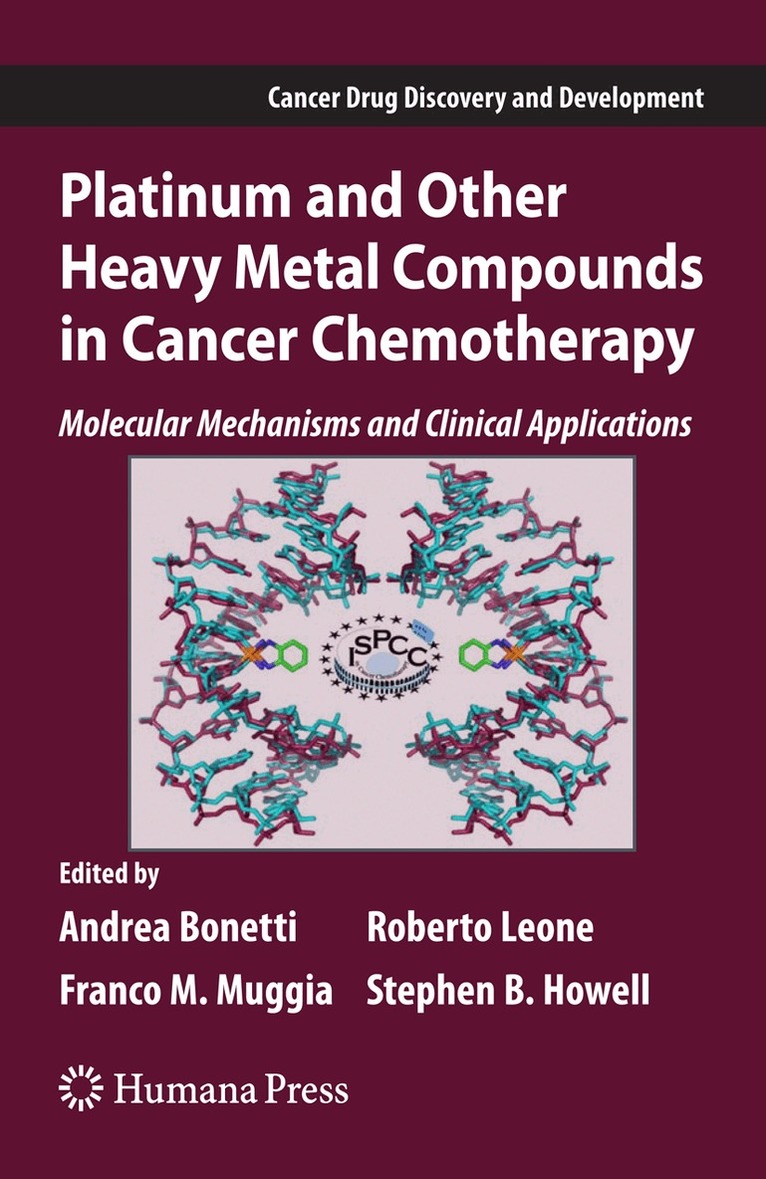
Platinum and Other Heavy Metal Compounds in Cancer Chemotherapy
Molecular Mechanisms and Clinical Applications
Häftad, Engelska, 2016
2 180 kr
Skickas inom 10-15 vardagar
Cisplatin, the first member of the family of platinum-containing chemotherapeutic agents, was discovered by Barnett Rosenberg in 1965 and approved by the FDA for marketing in 1978. After 30 years of use in the clinic, cisplatin remains a central element of many treatment regimens. Cisplatin is still an irreplaceable component of a regimen that produces high cure rates in even advanced nonseminomatous germ-cell cancers, and is widely used in the treatment of ovarian cancers and other gynecologic cancers, head and neck, and numerous other tumor types. The development of carboplatin has reduced some of the adverse events associated with cisplatin treatment, and the introduction of the DACH platinum compound oxaliplatin has broadened the spectrum of activity of the platinums to include gastro-intestinal cancers, especially colorectal cancer. The clinical importance of this family of drugs continues to drive investigation into how these drugs work and how to improve their efficacy and reduce their toxicity. The papers in this volume were presented in Verona, Italy, during the tenth International Symposium on Platinum Coordination Compounds in Cancer Chemotherapy. The symposium was jointly organized by the Department of Oncology of the Mater Salutis Hospital – Azienda Sanitaria Locale 21 of the Veneto Region – and by the Department of Medicine and Public Health, Section of Pharmacology, the University of Verona. They reflect the vitality of this field and the increasing use of new molecular and cell biologic, genetic, and biochemical tools to identify approaches to further improve their use.
Platinum and Other Heavy Metal Compounds in Cancer Chemotherapy
Molecular Mechanisms and Clinical Applications
Inbunden, Engelska, 2008
2 180 kr
Skickas inom 10-15 vardagar
Cisplatin, the first member of the family of platinum-containing chemotherapeutic agents, was discovered by Barnett Rosenberg in 1965 and approved by the FDA for marketing in 1978. After 30 years of use in the clinic, cisplatin remains a central element of many treatment regimens. Cisplatin is still an irreplaceable component of a regimen that produces high cure rates in even advanced nonseminomatous germ-cell cancers, and is widely used in the treatment of ovarian cancers and other gynecologic cancers, head and neck, and numerous other tumor types. The development of carboplatin has reduced some of the adverse events associated with cisplatin treatment, and the introduction of the DACH platinum compound oxaliplatin has broadened the spectrum of activity of the platinums to include gastro-intestinal cancers, especially colorectal cancer. The clinical importance of this family of drugs continues to drive investigation into how these drugs work and how to improve their efficacy and reduce their toxicity. The papers in this volume were presented in Verona, Italy, during the tenth International Symposium on Platinum Coordination Compounds in Cancer Chemotherapy. The symposium was jointly organized by the Department of Oncology of the Mater Salutis Hospital – Azienda Sanitaria Locale 21 of the Veneto Region – and by the Department of Medicine and Public Health, Section of Pharmacology, the University of Verona. They reflect the vitality of this field and the increasing use of new molecular and cell biologic, genetic, and biochemical tools to identify approaches to further improve their use.