Stephen D. King – författare
Visar alla böcker från författaren Stephen D. King. Handla med fri frakt och snabb leverans.
8 produkter
8 produkter
Häftad, Engelska, 2018
148 kr
Skickas inom 5-8 vardagar
A controversial look at the end of globalization and what it means for prosperity, peace, and the global economic orderGlobalization, long considered the best route to economic prosperity, is not inevitable. An approach built on the principles of free trade and, since the 1980s, open capital markets, is beginning to fracture. With disappointing growth rates across the Western world, nations are no longer willing to sacrifice national interests for global growth; nor are their leaders able—or willing—to sell the idea of pursuing a global agenda of prosperity to their citizens. Combining historical analysis with current affairs, economist Stephen D. King provides a provocative and engaging account of why globalization is being rejected, what a world ruled by rival states with conflicting aims might look like, and how the pursuit of nationalist agendas could result in a race to the bottom. King argues that a rejection of globalization and a return to “autarky” will risk economic and political conflict, and he uses lessons from history to gauge how best to avoid the worst possible outcomes.
Häftad, Engelska, 2018
203 kr
Skickas inom 5-8 vardagar
An eminent economist warns that Western nations’ economic expectations for the future are way out of sync with the realities of economic stagnation and stringent steps will be required to avoid massive political and economic upheaval. “It is alarmingly difficult to disagree with Stephen King. All one can say, perhaps, is that one of the great errors of human nature—strongly displayed before the credit crunch—is the belief that a prevailing trend will continue indefinitely. The crunch is surely a reminder that what goes up must come down.”—Charles Moore, Daily Telegraph “[King] is dabbling in the financial equivalent of the horror genre. Perhaps even scarier, his is the stuff of nonfiction.”—Michael J. Casey, Wall Street Journal
Häftad, Engelska, 2024
125 kr
Skickas inom 5-8 vardagar
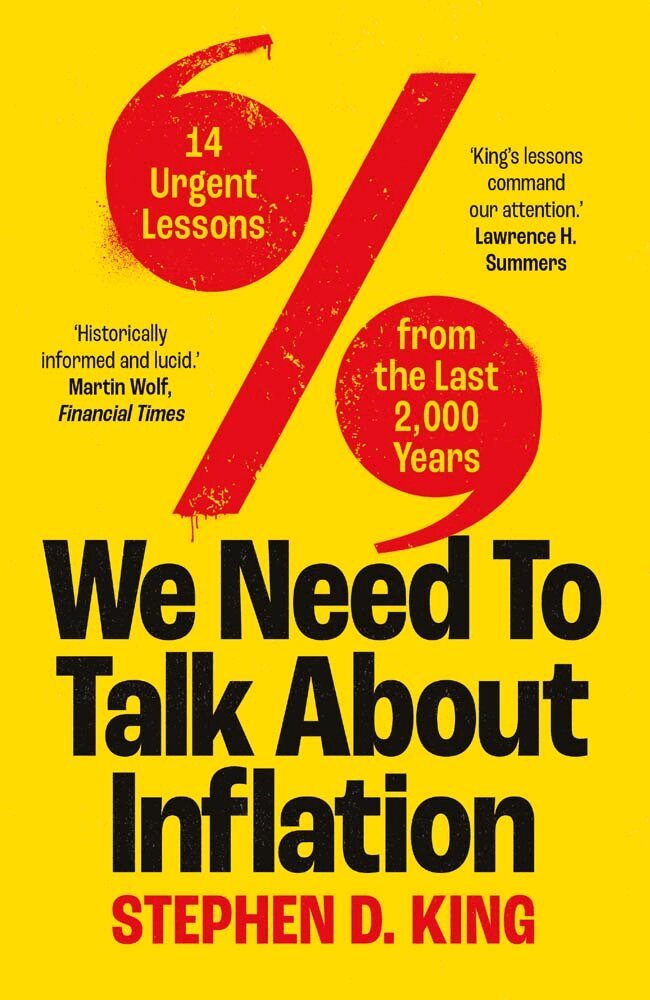
A FINANCIAL TIMES “BOOK TO READ IN 2023”“Everything you wanted to know about inflation but were afraid to ask.”—Mervyn King“King’s lessons command our attention.”—Lawrence H. Summers“Maybe you don’t think inflation is back for good. That is your right. But you’d be advised to read this book first.”—Stephanie FlandersFrom investors and monetary authorities to governments and policy makers, almost everyone had assumed inflation was dead and buried. But now people the world over are confronting a poisonous new economic reality and, with it, the prospect of vast and increasing wealth inequality.How have we arrived in this situation? And what, if anything, can we do about it?Celebrated economist Stephen D. King—one of the few to warn ahead of time about the latest inflationary upheaval—identifies key lessons from the history of inflation that policy makers chose not to heed. From ancient Rome through the American Civil War and up to the asset bubbles of today, inflation stems from policy error, sovereign greed, and a collective loss of faith in currencies.We Need to Talk About Inflation cuts through centuries of bad judgment and misunderstanding, offering a means to intervene now—so we can begin to tackle the political and social upheaval unleashed by inflation.
Inbunden, Engelska, 2027
293 kr
Kommande
Why the consequences of a prolonged period of weaker economic growth will be more profound than anyone dares to predictIn the heady progress of the post-war era, our lifestyles changed, our political systems adapted, and rapid economic growth became the model of every developed economy. But this prevailing consensus is falling apart around us. Growth is now, at best, no more than anaemic. Policymakers dream about an AI revolution and tweak their fiscal rules to accommodate a newly-austere economic reality but, all the while, government debt soars, financial markets become increasingly jittery, and voters lose trust in their politicians.Celebrated economist Stephen D. King asks how our politics will adapt to such persistently low growth. While leaders make fiscal promises based on a future that is unlikely to materialise, nationalism thrives, battlelines are drawn between perceived winners and losers, and the rules-based international order crumbles. The absence of growth triggers invidious political wrangling over tax, welfare, defence and infrastructure, intensifies competition for resources, and leads to social instability.King shows how our new world is governed by them-and-us divisions over limited economic spoils. This is the political economy of plunder.
E-bok
PDF, Engelska, 20064 572 kr
Läs direkt efter köp
The emphasis now placed on the concept of sediment cells as boundaries for coastal defence groups, and the development of SMPs, should help CPAs realise the importance of natural processes at the coast when designing defence and protection schemes. However, this will only be the case where defence groups exist, and where CPAs take up the challenge of developing SMPs. Coastal landscapes have been produced by the natural forces of wind, waves and tides, and many are nationally or internationally important for their habitats and natural features. Past practices at the coast, such as the construction of harbours, jetties and traditional defence systems may have contributed to the deterioration of the coast. English Nature (1992) have argued that if practices and methods of coastal defence are allowed to continue, then coastlines would be faced with worsening consequences, including: The loss of mudflats and the birds which live on them Damage to geological Sites of Special Scientific Interest (SSSIs) and scenic heritage by erosion, due to the stabilisation of the coast elsewhere Cutting of sediment supplies to beaches resulting in the loss of coastal wildlife Cessation through isolation from coastal processes, of the natural operation of spits, with serious deterioration of rare plants, animals and geomorphological and scenic qualities (English Nature, 1992) A number of designations, provided by national and international legislation do exist to aid conservation.
Del 4 - Coastal Systems and Continental Margins
Coastal and Marine Geo-Information Systems
Applying the Technology to the Environment
Inbunden, Engelska, 2003
3 797 kr
Skickas inom 10-15 vardagar
The emphasis now placed on the concept of sediment cells as boundaries for coastal defence groups, and the development of SMPs, should help CPAs realise the importance of natural processes at the coast when designing defence and protection schemes. However, this will only be the case where defence groups exist, and where CPAs take up the challenge of developing SMPs. Coastal landscapes have been produced by the natural forces of wind, waves and tides, and many are nationally or internationally important for their habitats and natural features. Past practices at the coast, such as the construction of harbours, jetties and traditional defence systems may have contributed to the deterioration of the coast. English Nature (1992) have argued that if practices and methods of coastal defence are allowed to continue, then coastlines would be faced with worsening consequences, including: The loss of mudflats and the birds which live on them Damage to geological Sites of Special Scientific Interest (SSSIs) and scenic heritage by erosion, due to the stabilisation of the coast elsewhere Cutting of sediment supplies to beaches resulting in the loss of coastal wildlife Cessation through isolation from coastal processes, of the natural operation of spits, with serious deterioration of rare plants, animals and geomorphological and scenic qualities (English Nature, 1992) A number of designations, provided by national and international legislation do exist to aid conservation.
Häftad, Engelska, 2025
162 kr
Skickas inom 5-8 vardagar
Del 4 - Coastal Systems and Continental Margins
Coastal and Marine Geo-Information Systems
Applying the Technology to the Environment
Häftad, Engelska, 2010
3 797 kr
Skickas inom 10-15 vardagar
The emphasis now placed on the concept of sediment cells as boundaries for coastal defence groups, and the development of SMPs, should help CPAs realise the importance of natural processes at the coast when designing defence and protection schemes. However, this will only be the case where defence groups exist, and where CPAs take up the challenge of developing SMPs. Coastal landscapes have been produced by the natural forces of wind, waves and tides, and many are nationally or internationally important for their habitats and natural features. Past practices at the coast, such as the construction of harbours, jetties and traditional defence systems may have contributed to the deterioration of the coast. English Nature (1992) have argued that if practices and methods of coastal defence are allowed to continue, then coastlines would be faced with worsening consequences, including: The loss of mudflats and the birds which live on them Damage to geological Sites of Special Scientific Interest (SSSIs) and scenic heritage by erosion, due to the stabilisation of the coast elsewhere Cutting of sediment supplies to beaches resulting in the loss of coastal wildlife Cessation through isolation from coastal processes, of the natural operation of spits, with serious deterioration of rare plants, animals and geomorphological and scenic qualities (English Nature, 1992) A number of designations, provided by national and international legislation do exist to aid conservation.