Stephen Wheeler – författare
2 389 kr
Skickas inom 10-15 vardagar
1 240 kr
446 kr
Skickas inom 5-8 vardagar
326 kr
Skickas inom 5-8 vardagar
398 kr
Skickas inom 5-8 vardagar
416 kr
Skickas inom 5-8 vardagar
284 kr
Skickas inom 5-8 vardagar
299 kr
Skickas inom 5-8 vardagar
398 kr
Skickas inom 5-8 vardagar
270 kr
Skickas inom 5-8 vardagar
902 kr
Skickas inom 10-15 vardagar
2 244 kr
Skickas inom 10-15 vardagar
1 006 kr
Läs direkt efter köp
How can humanity sustain itself and thrive on a small planet? This challenge grows ever more urgent as the climate crisis deepens and as right-wing populism and high levels of inequality prevent action.
Planning for Sustainability presents a wide-ranging, intellectually well-grounded, and accessible introduction to the concept of sustainability planning. The text explores topics such as how more livable cities and towns might be created, how greenhouse gas emissions might be curtailed, how social inequities might be reduced, how local ecosystems can be restored, and how more sustainable forms of economic development can be brought about.
More than simply a third edition, this book has been extensively rewritten to provide a timely rethinking of the nature of sustainability planning, issues central to it, and scales of application. There is a new focus on system change in order for other forms of progress to come about. This edition also includes expanded material on climate action, housing, social equity, capitalism, democracy, the Sustainable Development Goals, and the developing world.
This book considers in turn each scale of planning—international, national, regional, municipal, neighborhood, and site and building—and illustrates how sustainability action at different scales interrelates. This comprehensive volume lays out a hopeful and constructive view of the future in a time of growing challenge. It will be essential reading for students of urban planning, urban development, and similar fields and practitioners.
1 006 kr
Läs direkt efter köp
How can humanity sustain itself and thrive on a small planet? This challenge grows ever more urgent as the climate crisis deepens and as right-wing populism and high levels of inequality prevent action.
Planning for Sustainability presents a wide-ranging, intellectually well-grounded, and accessible introduction to the concept of sustainability planning. The text explores topics such as how more livable cities and towns might be created, how greenhouse gas emissions might be curtailed, how social inequities might be reduced, how local ecosystems can be restored, and how more sustainable forms of economic development can be brought about.
More than simply a third edition, this book has been extensively rewritten to provide a timely rethinking of the nature of sustainability planning, issues central to it, and scales of application. There is a new focus on system change in order for other forms of progress to come about. This edition also includes expanded material on climate action, housing, social equity, capitalism, democracy, the Sustainable Development Goals, and the developing world.
This book considers in turn each scale of planning—international, national, regional, municipal, neighborhood, and site and building—and illustrates how sustainability action at different scales interrelates. This comprehensive volume lays out a hopeful and constructive view of the future in a time of growing challenge. It will be essential reading for students of urban planning, urban development, and similar fields and practitioners.
1 440 kr
Läs direkt efter köp
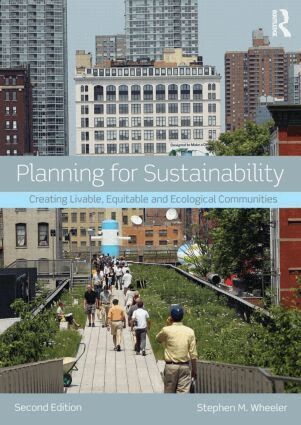
How can human communities sustain a long-term existence on a small planet? This challenge grows ever more urgent as the threat of global warming increases.
Planning for Sustainability presents a wide-ranging, intellectually well-grounded and accessible introduction to the concept of planning for more sustainable and livable communities. The text explores topics such as how more compact and walkable cities and towns might be created, how local ecosystems can be restored, how social inequalities might be reduced, how greenhouse gas emissions might be lowered, and how more sustainable forms of economic development can be brought about.
The second edition has been extensively revised and updated throughout, including an improved structure with chapters now organized under three sections: the nature of sustainable planning, issues central to sustainable planning, and scales of sustainable planning. New material includes greater discussion of climate change, urban food systems, the relationships between public health and the urban environment, and international development.
Building on past schools of planning theory, Planning for Sustainability lays out a sustainability planning framework that pays special attention to the rapidly evolving institutions and power structures of a globalizing world. By considering in turn each scale of planning—international, national, regional, municipal, neighborhood, and site and building—the book illustrates how sustainability initiatives at different levels can interrelate. Only by weaving together planning initiatives and institutions at different scales, and by integrating efforts across disciplines, can we move towards long-term human and ecological well-being.
1 428 kr
Läs direkt efter köp
How can human communities sustain a long-term existence on a small planet? This challenge grows ever more urgent as the threat of global warming increases.
Planning for Sustainability presents a wide-ranging, intellectually well-grounded and accessible introduction to the concept of planning for more sustainable and livable communities. The text explores topics such as how more compact and walkable cities and towns might be created, how local ecosystems can be restored, how social inequalities might be reduced, how greenhouse gas emissions might be lowered, and how more sustainable forms of economic development can be brought about.
The second edition has been extensively revised and updated throughout, including an improved structure with chapters now organized under three sections: the nature of sustainable planning, issues central to sustainable planning, and scales of sustainable planning. New material includes greater discussion of climate change, urban food systems, the relationships between public health and the urban environment, and international development.
Building on past schools of planning theory, Planning for Sustainability lays out a sustainability planning framework that pays special attention to the rapidly evolving institutions and power structures of a globalizing world. By considering in turn each scale of planning—international, national, regional, municipal, neighborhood, and site and building—the book illustrates how sustainability initiatives at different levels can interrelate. Only by weaving together planning initiatives and institutions at different scales, and by integrating efforts across disciplines, can we move towards long-term human and ecological well-being.
309 kr
Skickas inom 5-8 vardagar
254 kr
Skickas inom 3-6 vardagar
555 kr
Skickas inom 3-6 vardagar
462 kr
Skickas inom 5-8 vardagar
454 kr
Skickas inom 5-8 vardagar
2 586 kr
Skickas inom 5-8 vardagar
462 kr
Skickas inom 5-8 vardagar
468 kr
Skickas inom 5-8 vardagar