Susan M.P. McKenna-Lawlor - Böcker
Visar alla böcker från författaren Susan M.P. McKenna-Lawlor. Handla med fri frakt och snabb leverans.
4 produkter
4 produkter
2 432 kr
Skickas inom 10-15 vardagar
Empirical research often lacks theory. This book progressively works out a method of constructing models which can bridge the gap between empirical and theoretical research in the social sciences. This might improve the explanatory power of models. The issue is quite novel, and it benefited from a thorough examination of statistical and mathematical models, conceptual models, diagrams and maps, machines, computer simulations, and artificial neural networks. These modelling practices have been approached through different disciplines. The proposed method is partly inspired by reverse engineering. The standard covering law approach is abandoned, and classical induction restored to its rightful place. It helps to solve several difficulties which impact upon the social sciences today, for example how to extend an explanatory model to new phenomena, how to establish laws, and how to guide the choice of a conceptual structure. The book can be used for advanced courses in research methods in the social sciences and in philosophy of science.
1 062 kr
Skickas inom 10-15 vardagar
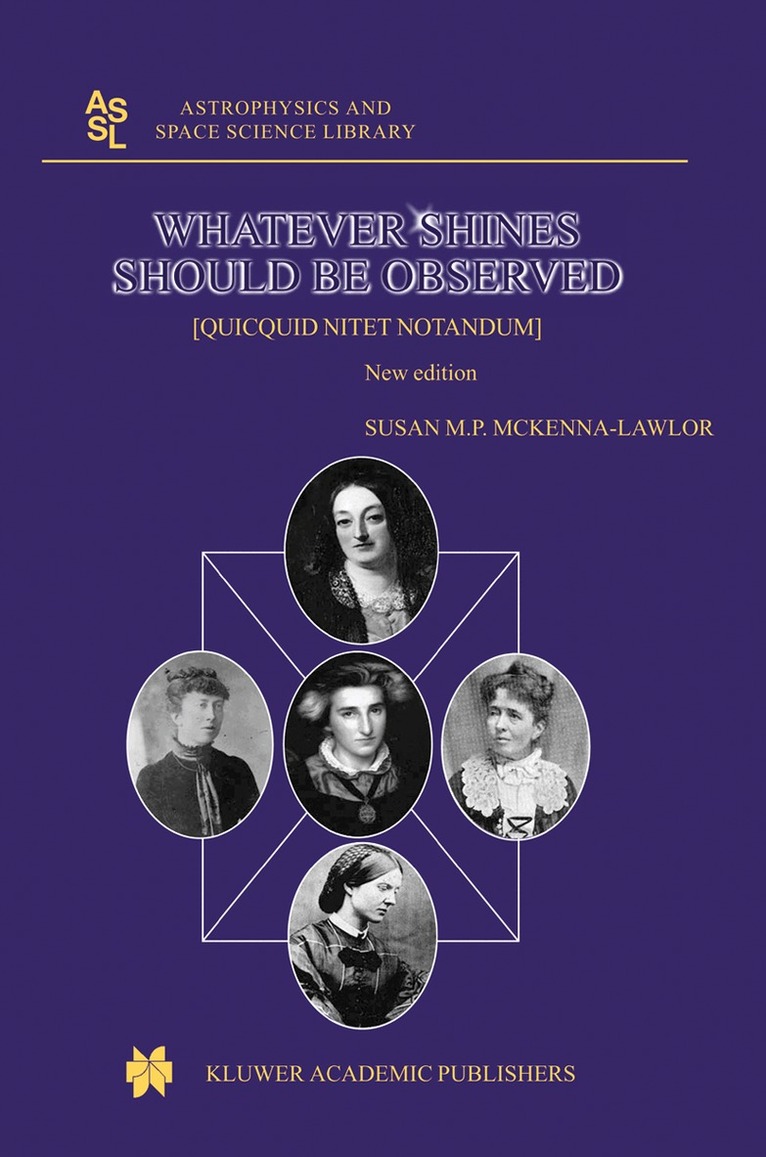
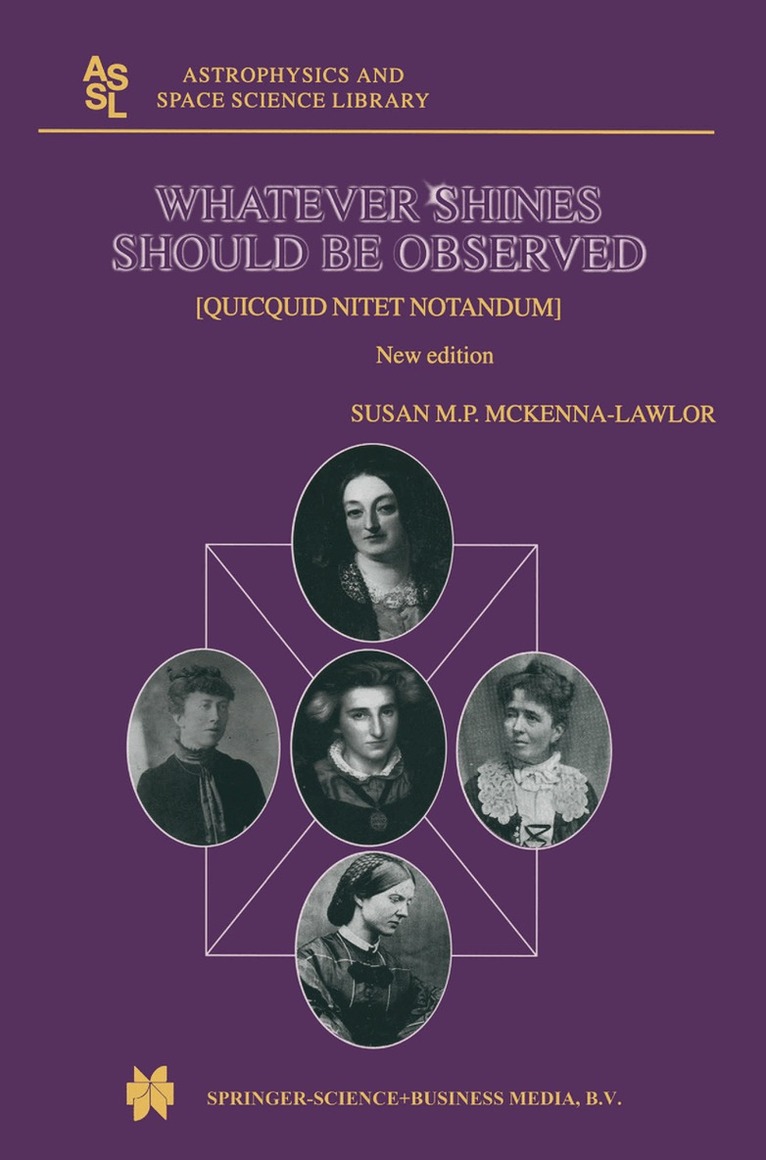
This text looks to the 19th century to celebrate the achievements of five distinguished women, four of whom were born in Ireland while the fifth married into an Irish family, who made pioneering contributions to photography, microscopy, astronomy and astrophysics. The women featured came from either aristocratic or professional families. Thus, at first sight, they had many material advantages among their peers. In the ranks of the aristocracy there was often a great passion for learning, and the mansions in which these families lived contained libraries, technical equipment (microscopes and telescopes) and collections from the world of nature. More modest professional households of the time were rich in books, while activities such as observing the stars, collecting plants etc. typically formed an integral part of the children's education. To balance this it was the prevailing philosophy that boys could learn, in addition to basic subjects, mathematics, mechanics, physics, chemistry and classical languages, while girls were channelled into "polite" subjects like music and needlework.This arrangement allowed boys to progress to University should they so wish, where a range of interesting career choices (including science and engineering) was open to them. Girls, on the other hand, usually received their education at home, often under the tutelage of a governess who would not herself had had any serious contact with scientific or technical subjects. In particular, progress to University was not during most of the 19th century an option for women, and access to scientific libraries and institutions was also prohibited. Although those women with aristocratic and professional backgrounds were in a materially privileged position and had an opportunity to "see" through the activities of their male friends and relatives how professional scientific life was lived, to progress from their places in society to the professions required very special determination. Firstly, they had to individually acquire scientific and technical knowledge, as well as necessary laboratory methodology, without the advantage of formal training.Then, it was necessary to carve out a niche in a particular field, despite the special difficulties attending the publication of scientific books or articles by a woman. There was no easy road to science, or even any well worn track. To achieve recognition was a pioneering activity without discernible ground rules. With the hindsight of history, we recognise that the heroic efforts which the women featured in this volume made to overcome the social constraints that held them back from learning about, and participating in, scientific and technical subjects, had a consequence on a much broader canvas. In addition to what they each achieved professionally they contributed within society to a gradual erosion of those barriers raised against the participation of women in academic life, thereby assisting in allowing University places and professional opportunities to gradually become generally available.
2 427 kr
Skickas inom 10-15 vardagar
Essential Spaceflight Dynamics and Magnetospherics describes, in the first instance, some of the key aspects of celestial mechanics and spaceflight dynamics. It begins with classical two and three body problems illustrative of the aesthetic aspects of applying analytical methods of investigation to celestial mechanics. Then, osculating orbital elements are introduced as well as analysis techniques sufficient to evaluate the influence of various disturbing forces on spacecraft. Next a theory of manoeuvres is outlined and the methodology of making interplanetary trajectory corrections. Ideas involving various approaches to orbital element determinations using measured data are also considered. The forces applied to a spacecraft can result in the development of torques that influence attitude motion and the effects of the most important of these are described in terms of equilibrium positions, periodic motions, steady-state and transient motions. Also considered is the problem of attitude control of a spacecraft using active and/or passive methods of orientation and stabilization. In addition, a more advanced treatment of the development of attitude control systems is provided.
Del 292 - Astrophysics and Space Science Library
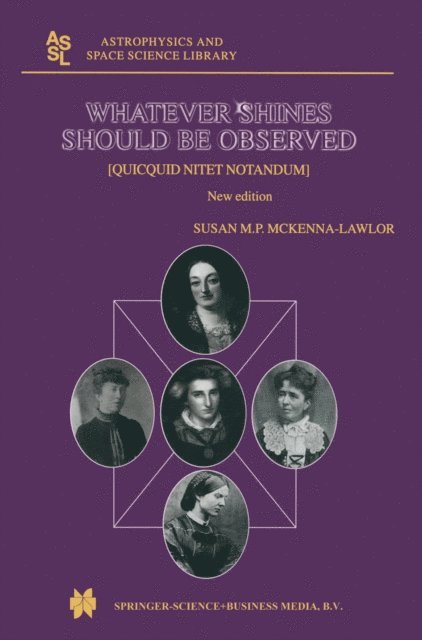
Whatever Shines Should be Observed
[quicquid nitet notandum]
Häftad, Engelska, 2010
1 091 kr
Skickas inom 10-15 vardagar
It is good to mark the new Millennium by looking back as well as forward. Whatever Shines Should Be Observed looks to the nineteenth century to celebrate the achievements of five distinguished women, four of whom were born in Ireland while the fifth married into an Irish family, who made pioneering contributions to photography, microscopy, astronomy and astrophysics. The women featured came from either aristocratic or professional families. Thus, at first sight, they had many material advantages among their peers. In the ranks of the aristocracy there was often a great passion for learning, and the mansions in which these families lived contained libraries, technical equipment (microscopes and telescopes) and collections from the world of nature. More modest professional households of the time were rich in books, while activities such as observing the stars, collecting plants etc. typically formed an integral part of the children's education.To balance this it was the prevailing philosophy that boys could learn, in addition to basic subjects, mathematics, mechanics, physics, chemistry and classical languages, while girls were channelled into 'polite' subjects like music and needlework. This arrangement allowed boys to progress to University should they so wish, where a range of interesting career choices (including science and engineering) was open to them. Girls, on the other hand, usually received their education at home, often under the tutelage of a governess who would not herself had had any serious contact with scientific or technical subjects. In particular, progress to University was not during most of the nineteenth century an option for women, and access to scientific libraries and institutions was also prohibited. Although those women with aristocratic and professional backgrounds were in a materially privileged position and had an opportunity to 'see' through the activities of their male friends and relatives how professional scientific life was lived, to progress from their places in society to the professions required very special determination.Firstly, they had to individually acquire scientific and technical knowledge, as well as necessary laboratory methodology, without the advantage of formal training. Then, it was necessary to carve out a niche in a particular field, despite the special difficulties attending the publication of scientific books or articles by a woman. There was no easy road to science, or even any well worn track. To achieve recognition was a pioneering activity without discernible ground rules. With the hindsight of history, we recognise that the heroic efforts which the women featured in this volume made to overcome the social constraints that held them back from learning about, and participating in, scientific and technical subjects, had a consequence on a much broader canvas. In addition to what they each achieved professionally they contributed within society to a gradual erosion of those barriers raised against the participation of women in academic life, thereby assisting in allowing University places and professional opportunities to gradually become generally available.It is a privilege to salute and thank the wonderful women of the nineteenth century herein described for what they have contributed to the women of today. William Herschel's famous motto quicquid nitet notandum (whatever shines should be observed) applies in a particular way to the luminous quality of their individual lives, and those of us who presently observe their shining, as well as those who now wait in the wings of the coming centuries to emerge upon the scene, can each see a little further by their light.