Thomas G. Kurtz – författare
Visar alla böcker från författaren Thomas G. Kurtz. Handla med fri frakt och snabb leverans.
8 produkter
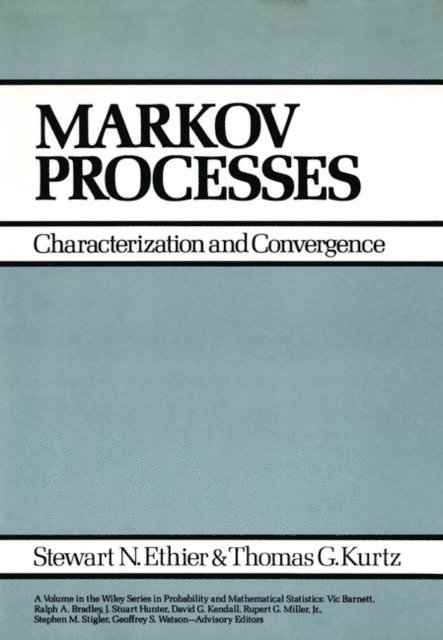
Markov Processes
Characterization and Convergence
Av Thomas G. Kurtz, Stewart N. Ethier
E-bok, 2009
1906 kr
Lägg i varukorg
The Wiley-Interscience Paperback Series consists of selected books that have been made more accessible to consumers in an effort to increase global appeal and general circulation. With these new unabridged softcover volumes, Wiley hopes to extend the lives of these works by making them available to …
Markov Processes
Characterization and Convergence
Av Stewart N. Ethier, Thomas G. Kurtz
Häftad, 2005
1644 kr
Lägg i varukorg
The Wiley-Interscience Paperback Series consists of selected books that have been made more accessible to consumers in an effort to increase global appeal and general circulation. With these new unabridged softcover volumes, Wiley hopes to extend the lives of these works by making them available to …
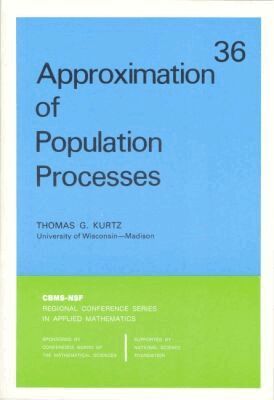
Approximation of Population Processes
Häftad, 1987
678 kr
Lägg i varukorg
Population processes are stochastic models for systems involving a number of similar particles. Examples include models for chemical reactions and for epidemics. The model may involve a finite number of attributes, or even a continuum.This monograph considers approximations that are possible when …
Large Deviations for Stochastic Processes
Häftad, 2006
1688 kr
Lägg i varukorg
The book is devoted to the results on large deviations for a class of stochastic processes. Following an introduction and overview, the material is presented in three parts. Part 1 gives necessary and sufficient conditions for exponential tightness that are analogous to conditions for tightness in …
Stochastic Analysis of Biochemical Systems
Av David F. Anderson, Thomas G. Kurtz
Häftad, 2015
441 kr
Lägg i varukorg
This book focuses on counting processes and continuous-time Markov chains motivated by examples and applications drawn from chemical networks in systems biology. The book should serve well as a supplement for courses in probability and stochastic processes. While the material is presented in a …
Stochastic Analysis of Biochemical Systems
Av Thomas G. Kurtz, David F. Anderson
E-bok, 2015
587 kr
Lägg i varukorg
This book focuses on counting processes and continuous-time Markov chains motivated by examples and applications drawn from chemical networks in systems biology. The book should serve well as a supplement for courses in probability and stochastic processes. While the material is presented in a …
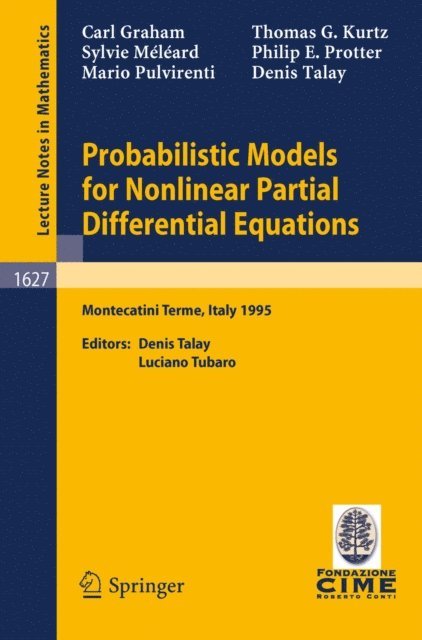
Probabilistic Models for Nonlinear Partial Differential Equations
Lectures given at the 1st Session of the Centro Internazionale Matematico Estivo (C.I.M.E.) held in Montecatini Terme, Italy, May 22-30, 1995
Av Carl Graham, Thomas G. Kurtz m. fl.
Häftad, 1996
550 kr
Lägg i varukorg
The lecture courses of the CIME Summer School on Probabilistic Models for Nonlinear PDE's and their Numerical Applications (April 1995) had a three-fold emphasis: first, on the weak convergence of stochastic integrals; second, on the probabilistic interpretation and the particle approximation of …
Probabilistic Models for Nonlinear Partial Differential Equations
Lectures given at the 1st Session of the Centro Internazionale Matematico Estivo (C.I.M.E.) held in Montecatini Terme, Italy, May 22-30, 1995
Av Denis Talay, Mario Pulvirenti m. fl.
E-bok, 2006
734 kr
Lägg i varukorg
The lecture courses of the CIME Summer School on Probabilistic Models for Nonlinear PDE''s and their Numerical Applications (April 1995) had a three-fold emphasis: first, on the weak convergence of stochastic integrals; second, on the probabilistic interpretation and the particle approximation of …